This time without potatoes but with more words.
My other, main, reason for being a medievalist is marginalia: that is, in illuminated manuscripts and in a world around them that’s a medieval manuscript writ large, a world of multi-media multi-dimensional storytelling that extends to associate all things (and beings) marginal and marginalised.
This world is still very much around you in Belgium, where I grew up; your whole environment is Medieval … and older and deeper, and Surrealist and bande dessinée … and you’re never too sure where one ends and the next begins, their borders blur. Where you are is layered, sometimes it’s been concreted over, it makes you stumble over broken pavement, there’s glimmers of other otherworlds haunting the gaps. In addition, you see more when you’re a child, and yet more because you’re short-sighted; already used to being in two worlds at once because you see something else just beyond the frame of your glasses, removing your glasses and looking closely lets you access a third world.
Seeing this way is a curse, the life sentence of high myopia; and a blessing, the lucky conjunction of the ideal elements at the perfect stage of early development. It didn’t stop there; it continued in training for appreciating where I was then, for later work in close reading and medieval literary studies and multilingualism, and for being in other places. Seeing them as layered worlds; always looking outside the frame, around the corner, into the crack in the surface; seeking the margins.

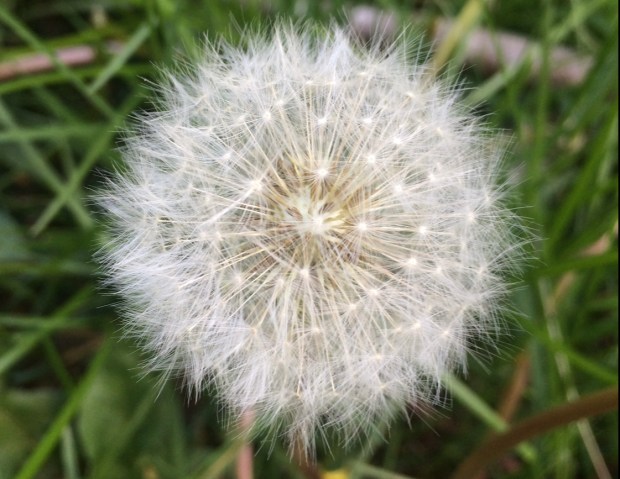
Description
Be warned: pre-modern conditioning is a way of life and it’s for life. It’s serious, tough, slow, hard, dirty work; requires dedication and discipline; and is only for the doomed and disabled, for the super-powered select elect, the very special.
Sorry, just kidding. The pre-modern condition can be taught and learned. It’s for anyone anywhere. It’s free and fun. It’s fast: no, seriously, it doesn’t need several years’ devoted doctoral work. It is dangerous and it does require daily practice, though.
The first step in your pre-modern conditioning journey, and your obligatory regular daily exercise in applied medievalism, is to be curious. Sounds simple? It should be easy but it might be the most difficult thing that you’ve done in a long time, since you were a very small child, depending on how much your education and training have made you uncurious and how much unlearning you’ll have to do. Being curious might mean relearning curiosity, rediscovering whimsy, regaining delight, and reconnecting with your sense of wonder; a sense like the five (or six) (or seven) others, in common to all humans and many other sentient creatures.
This first step probably looks something like opening your eyes, opening a third eye, opening your mind, listening, focus, unfocus, mindfulness, mind-wandering, etc.
Why would you want to do this? What will you gain? What’s the potential return on your investment? What are the learning objectives and outcomes? How will you benefit?
Well, if you’d asked me during 2020-21’s COVID-19 lockdowns and the lethal heat-dome here in BC, I’d have recommended any reading, any looking outside the terrified doomed self, as therapeutic light relief in heavy times of climate crisis and global catastrophe. If you’d asked me twenty years ago, I’d have answered: this weird contemplative thing — seeing differently, reading between the lines, creative reading — it complements constructive reconstructive research-reading and analytical synthetic critical-reading, and these three things come together in a whole larger complete thing, reading, which is a useful transferrable skill. Ten years ago, I’d have said: this thing has instrinsic value. It is worth knowing in its own right, it is an end in and of itself. The same answer to any questions about learning anything. The same answer that university faculty in the arts and sciences have been giving, over the last century, when asked what the point is of a university undergraduate education (in these faculties, that is, the literate intelligent humanities and allied sapience). And, back to the original question of why you, specifically individually you, would or should do this: it makes you a better human being.
Now in 2026 and GenAI times, I would remove the vague moralising and add urgency: it’s a matter of survival. This might be the most vital thing that you do right now to be human at all, and to stay human, to cognise and meta-cognise, to feel intelligent and alive, to feel, and to be.
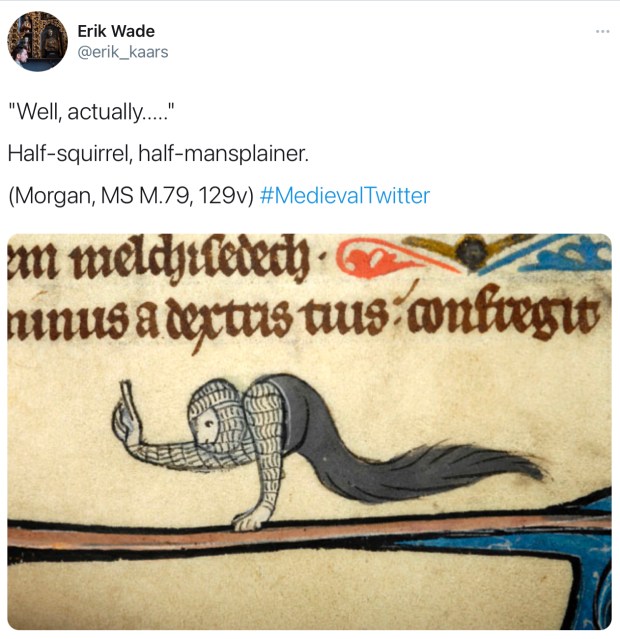
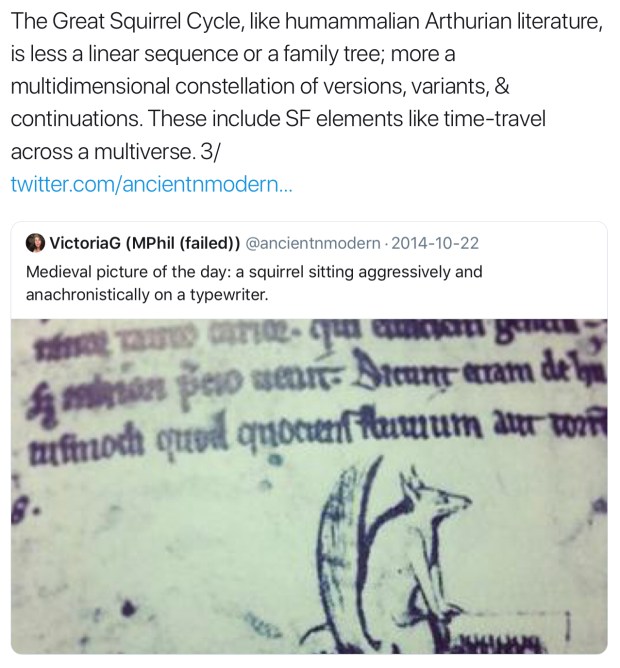
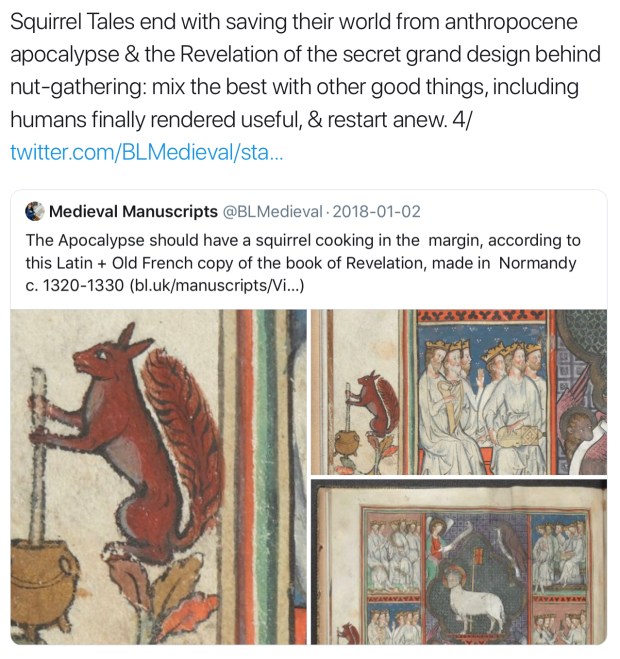
Here’s a sample practice transcription exercise:
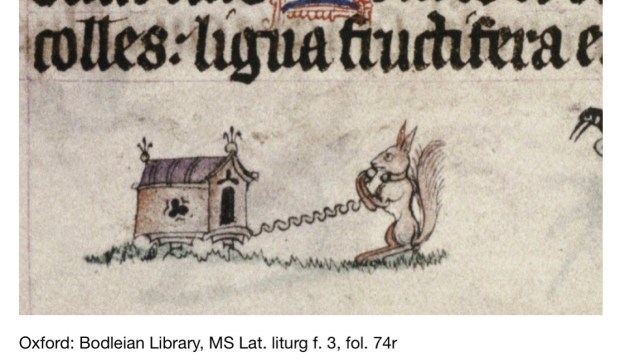
Look! A squirrel!
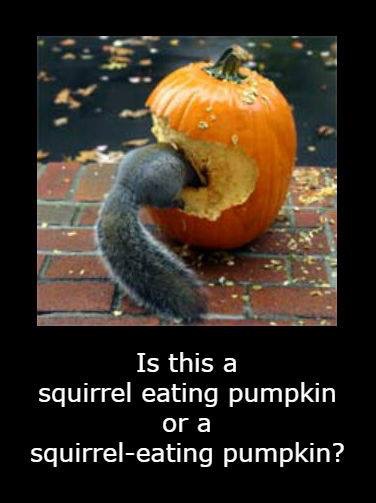
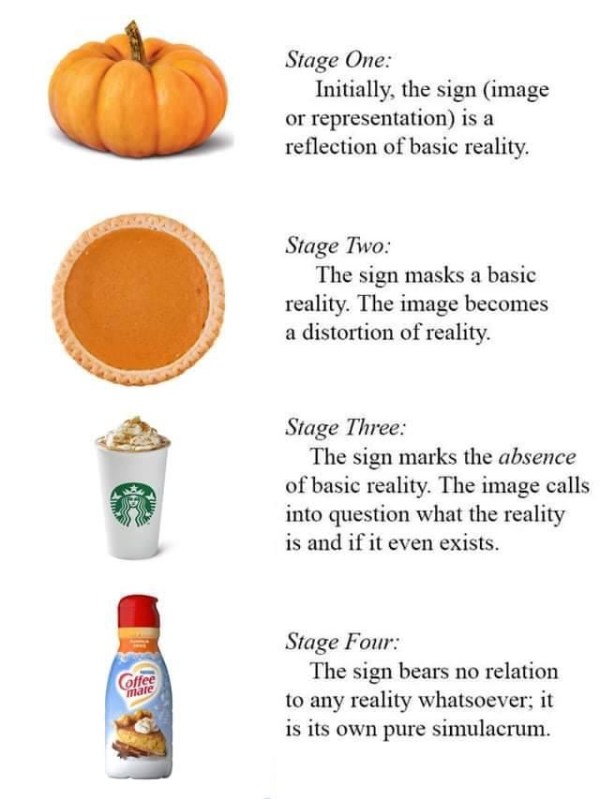
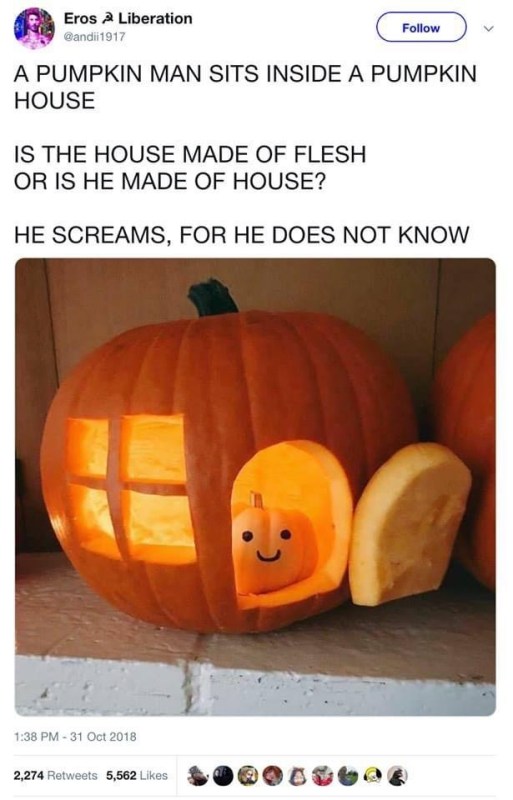
Prescription
Here’s an example of how this different kind of seeing — in local terms here at UBC, a “way of knowing” — translates to looking at medieval manuscripts, to close reading in slow motion while keeping an eye on what’s happening in those marginal areas near the edges and out of the corner of your eye.
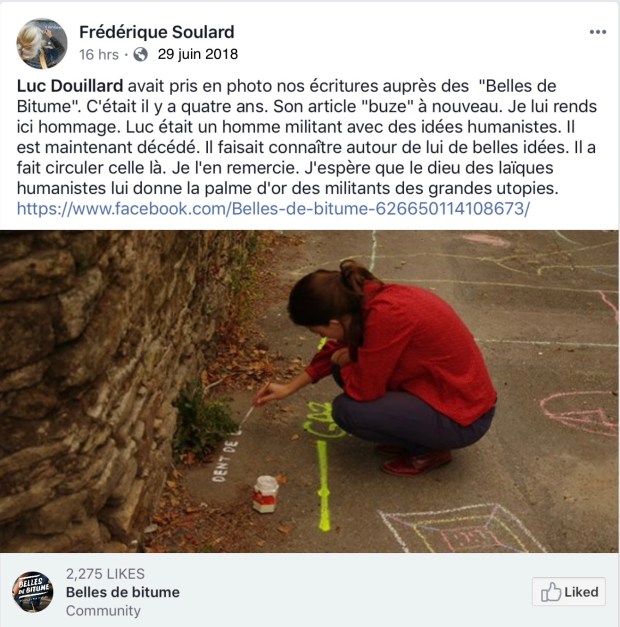
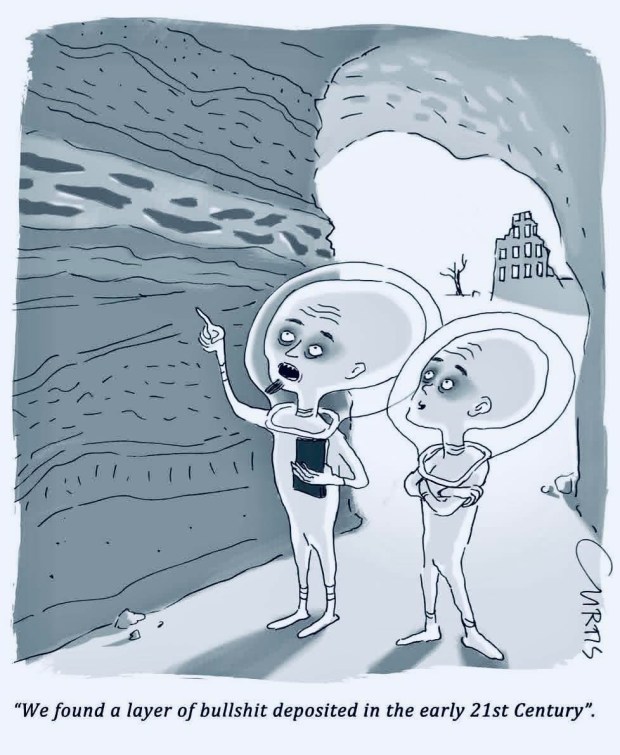
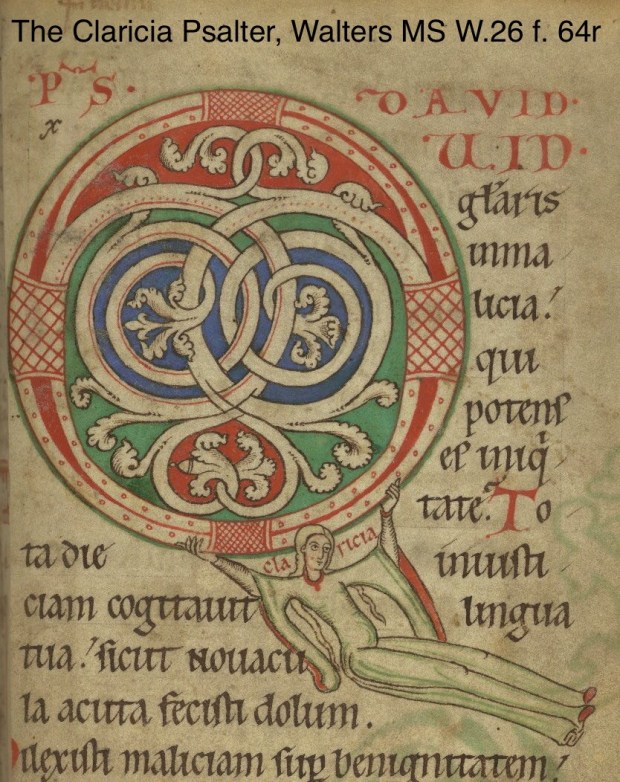
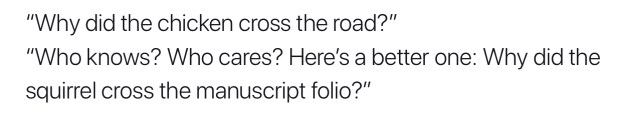
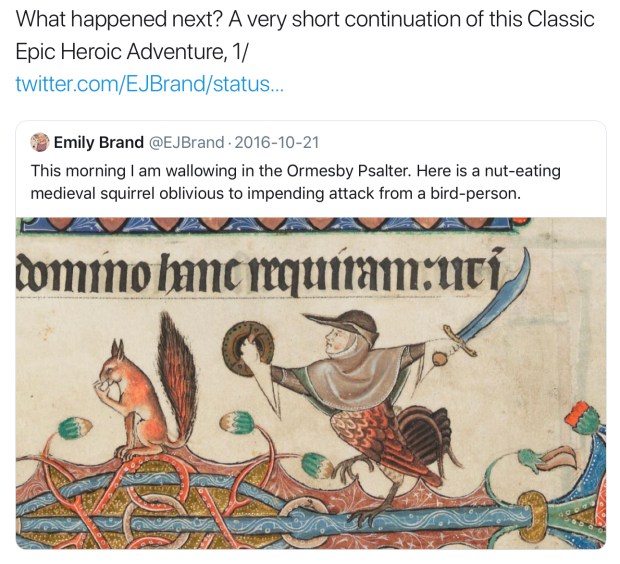
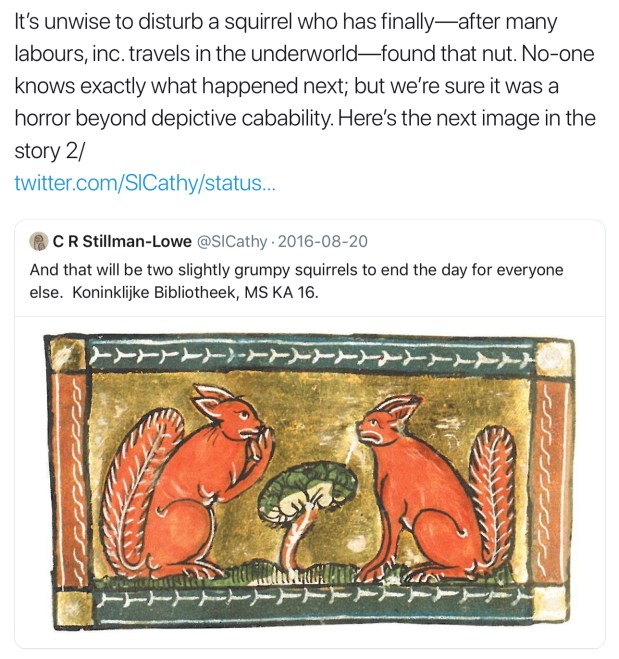
I’ve taken the liberty of selecting four unrelated pages from different manuscripts; each can be read independently, like a page in a comic (the two media and their reading are structurally related), or you can read them as a sequential narrative. Selection, collection, rearrangement, copying (and more or less creative theft), collage, continuation, variation, structuring by adding storytelling, remixing, making a set of items into a coherent whole book: welcome to the joys of pre-modern textuality.
Your next exercise after this one will be to go forth, play with online manuscripts, and create your own four-step gag.
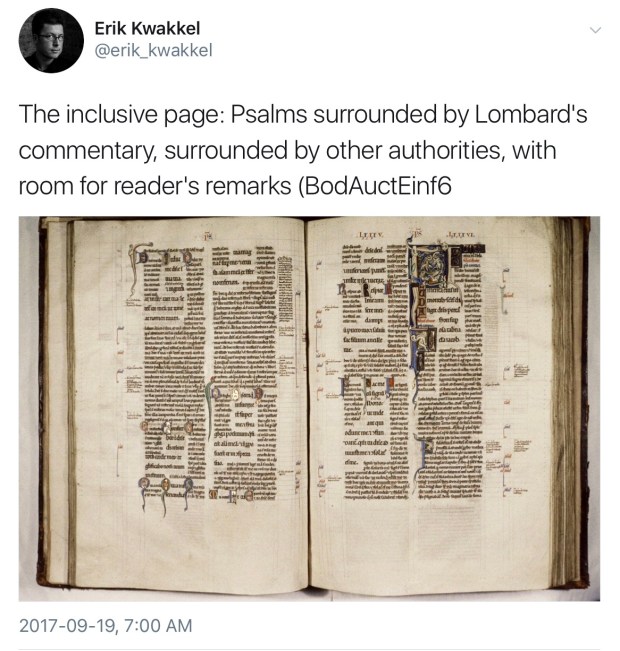
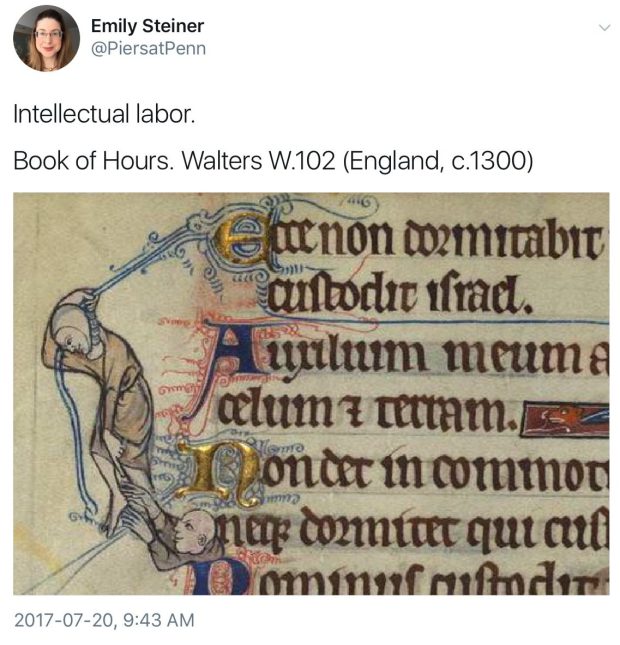
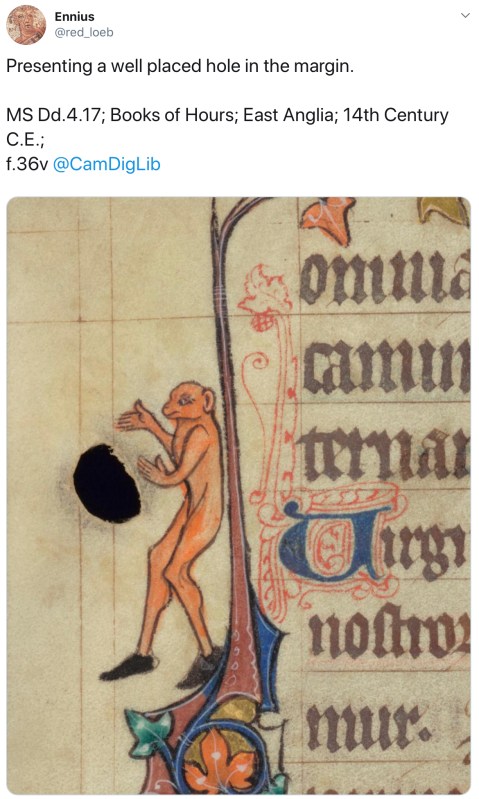
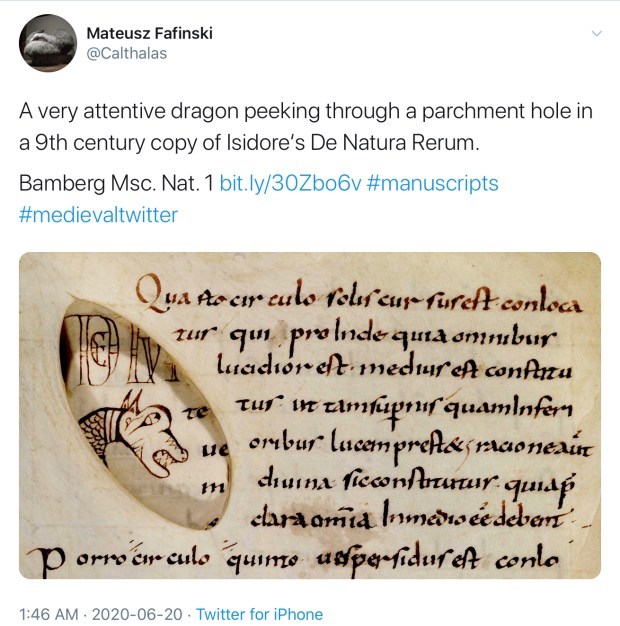
A next-next exercise after that: commentary! It, too, is a pre-modern joy; that is, joyful in itself and characteristic of pre-modern Afro-Eurasian manuscripts. The four excerpts above offer a quick impressionistic snapshot of manuscript diversity: their places of origin up to a thousand kilometres apart, their times of making up to five centuries distant from each other. They are cultural kin, too. All four works are in Latin, the most usual language for western Afro-Eurasian writing communicating ideas; move another few thousand kilometres and your communicatively-unifying languages will be Coptic, Ge’ez, Nubian, Arabic, Persian, Chinese, Pali, Manchu, etc. All four are layered works, made by more than one person, and multimedia. They include commentary, other voices (or at least facial expressions), and space for more.
Comments themselves are wide-ranging in kind: highlighting and underlining (sometimes just a dot) to draw attention to a specific word, flourishes, doodling decoration, a word, a footnote or sidenote, a stanza or paragraph, a continuation, a whole additional other text (that might later be perceived as a distinct work in its own right), and of course images. You will find incursions and echoes from other cultures and their ways of knowing, older peoples and beings, local Indigeneity, ghosts.
Of the four texts here that centre their commentaries, all have authoritative status: three are sacred and the last is an ancient work of natural philosophy. Text is central, the subject of its book, and the object of commentary, but never objectifed as comments are in conversational association, working together — even if in disagreement — to question, discuss, debate, find meaning(s), and understand. Sometimes texts are left open.
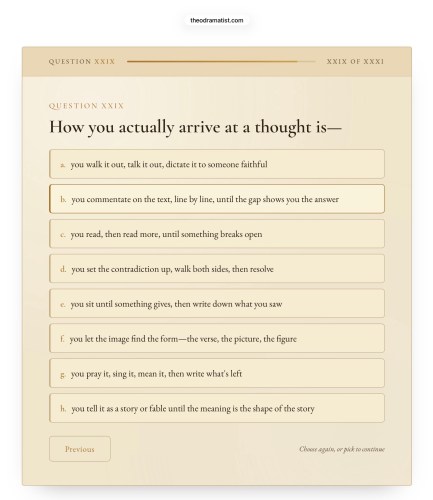
Pre-modern reading is active and lively, open to interpretation, and includes you in its invitation to all readers to join a community of sense-making across time and space, open-ended, unending.
The pre-modern condition can have a sense of equity, diversity, inclusion, decolonization, and Indigenization. Not necessarily; not always; not always obviously; but it’s always worth seeking, just in case, to honour those who have wandered and wondered before you in a work.
The pre-modern condition is unsettled and unsettling.
Compare a 2026 copy of the Psalms as authorised by your religious authority of choice, or the most up-to-date scholarly edition of Lucretius. The contrast in textual approach may be surprising until your pre-modern conditioning helps you to accept a different way of seeing the world. A text is not fixed and static, it’s more than words in black and white, and even the most dogmatic can have multiple senses and mixed messages. Dogma does tend to go hand in hand with didacticism, as ever, but that can be the teaching and learning of this different kind of reading, not passive but active and interactive.
Pre-modern open books are alive, spead life, bring people to life. So much has been lost with modern printed unopen books, but fortunately so many manuscripts are freely accessible openly online. Start with four-step gags, move on to memes, you’re now in the world of commentary.
Meanwhile, we can also still continue to look outside books and to the larger book around us that is the world that we inhabit, in the daily practice of “Look! A squirrel!” exercises.
Postscript
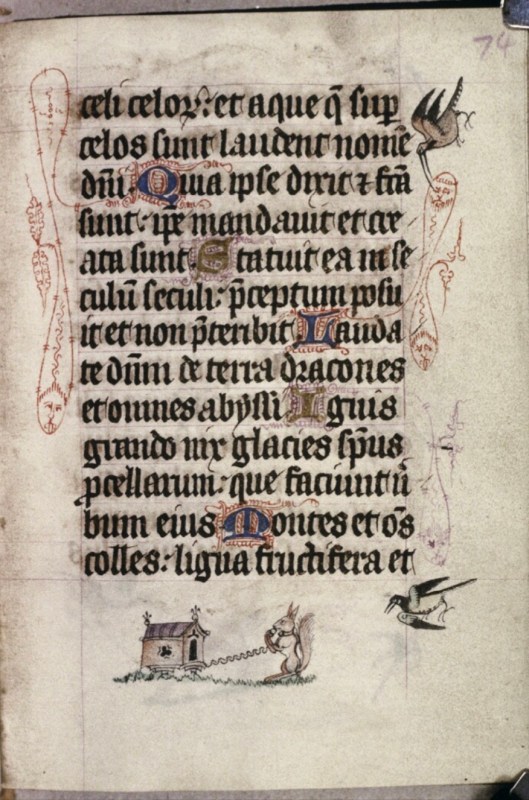
Oxford, Bodleian Library MS. Lat. liturg. f.3, fol. 74v:
the bigger picture.
Let’s return to where we started, the detail from a page in a 14th-century Book of Hours; Flemish, made in the country where I grew up.
Rereading that “look! a squirrel!” image as a detail that’s part of its whole page brings together text, image, design, decoration, and communication from the margins and beyond; an adventure in trying to find meaning and understanding in an alien world. That’s quite the pompous sentence. A grand broad outline, a grandiose existential metaphor, it might also apply in material practice to the specifics of this particular pre-modern book.
So: let’s add some context. Imagine being a 14-year-old Anne of Bohemia travelling across a plague-ravaged continent and a stormy sea, to an arranged marriage with someone you’ve never met, in a country where you’ve never been, whose language you don’t speak. That’s not too taxing, this sort of thing still happens to children in our world and times. Now imagine — maybe still on your grim way, maybe arrived but not yet fully processed and with the weight of an impending ceremony, the threat of strangers’ social expectations, and unknown horrors still ahead of you — imagine being gifted this book whose contents are familiar (devotional, the reassuring background routine of everyday life), written in a language that you know. Imagine the comfort and joy.
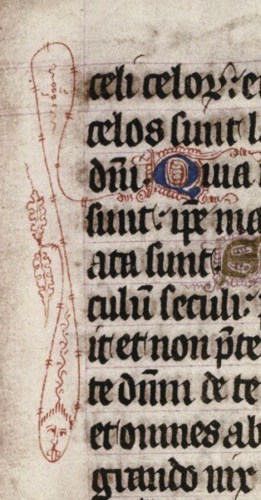
I know, I have no evidence for Anne’s interactions with this book, don’t spoil it. We have to imagine; there are limits to our possible understanding of others’ reading, personal life, the interior lives of the dead. Codicology, material history, and reading reception can take you a long way but only so far. Imagination can help, and can help us. The squirrel’s visual wit and whimsy brings us together, you and I and our Anne-the-fellow-reader.
Contemporary cultural connotations add to our compassion: a leashed pet trying to stay true to itself and wild and wily, chained to a cramped claustrophobic chapel/palace (/reliquary/mise en abyme book), contemplating her fate, distracted from it for a fleeting moment by a tasty treat, with no escape from the chains of constant connection to online social networks and from control by kyriarchy. It’s a wry image and a dark humour, but then again that’s always been the most sustaining kind.
This is why humans read. Why we read about other humans reading. Why we wonder. Why we question.
Here’s a question for you: Why’s that magpie there?
Is it included, tolerated, or excluded? Is it a separate compositional layer from the text, its rubricated initials, their extension into flourishes, theirs in turn into ghostly figures, and the bas-de-page scene with our squirrel? A later addition, adding commentary and continuation? Or an integral part of one whole multi-media work?
What’s the magpie about to do? Taking advantage of our squirrel’s moment of worldly nut-nibbling distraction, about to peck her on the bum? Why: to interrupt the stillness, a moment of forbidden liberatory personal pleasure, and poke her back into performative action? To admonish and train her, this wild creature that’s still not yet fully tamed and forgets that it doesn’t have agency and that it’s ignoring its duties to its audience? To direct her attention upwards to the text and what it offers, not just obedience but resource for resistance and hope for salvation?
Is the magpie working with the text and the other elements above the squirrel? Or is it a contrary agent or an independent actor? Beak open, addressing the squirrel or the other elements? Attacking the text, or at least its protective intermediaries and guardians? Directing those outside the text to read it attentively, think about it and maybe question its superficial message and motives; or the opposite, to stop a squirrel from staying with it and thinking about it overlong, risking over-reading? To move her towards it or away from it, and if so, where?
Visual mixed messages make us stop and look again. And again. And in other directions, you investigate other senses, following the guidance of visual cues while resisting them as they might be redirecting you away from protected and prohibited knowledge, and you look around for other lines (and curves) of enquiry that are outside the straight line and simple binary of “this way/that way.” Pre-modern-conditioned reading is unsettling and queer.
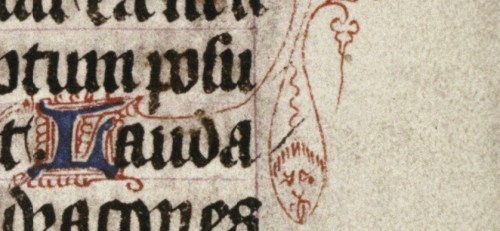
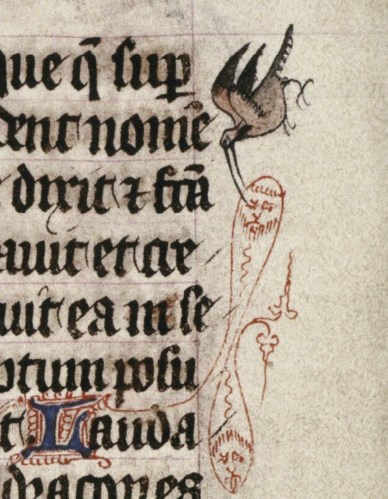
“Praise?”
“LOL nope”
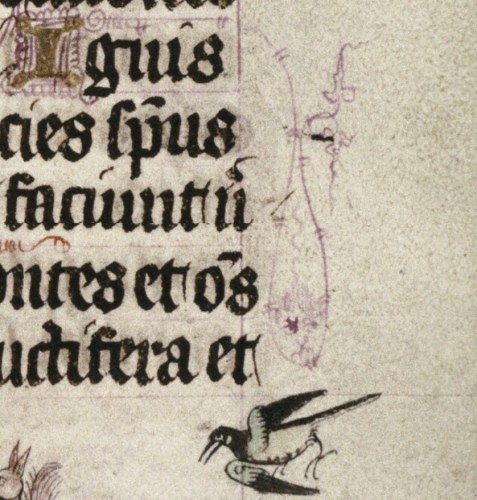
“SQUIRREL!!”
…
If you read the page like a comic, top left to bottom right then circling, all the visual elements and attention-drawing movement in the bas-de-page teachable-moment-scene redirect us to focus on its central text, Psalms 148: 4-9.
The page’s emphasis is on its last words, ligna fructifera et, hovering ominously just above the squirrel and out of her sight. That final et entices you to turn the page and read on, while the position of the squirrel and magpie push you to stay or to move in the opposite direction; backwards, to the left, somewhere else. Is our squirrel momentarily distracted (coincidentally, by the fruit of a tree), innocently unaware of her prescribed duty and raison d’être (despite the acorn, for fattening pigs and for fecundity; in spite of the text’s flourishing extensions into oak-leaves), frozen in thought, or deliberately turned away to avoid the looming reminders to be a figurative fruitful tree? Dark comedy; the historical Anne will die, childless, of plague in 1394.
Remember, back to the original question, what we’re trying to make sense of here is a magpie and they’ve always been cheeky. Thieving, too; attracted by sustenance like anyone else, and to superficial bling like a prized pet’s shiny bejewelled collar. We might be over-thinking: glossing over simple mischief and selfish greed; selectively ascribing higher human marginalist motivations of protection and care for others, solidarity and mutual aid and social justice; forgetting the bigger humanimal picture in our anthropomorphosing reading. Maybe the magpie is warning us readers about hubris, and its motley-clad jest is serious teasing, punching up. Or out, sideways, and pecking inwards.
Are we being led astray, is the whole page a double bluff to distract us from the theft of a precious treasure that might be about to happen? Thinking smaller: is it a warning to a bride-to-be about smart stylish-looking silver-tongued prospective lovers? (If you like this thought, you’ll love the medieval French and Occitan fabliaux and courtly romance that were also popular reading in the 14th century.) Thinking bigger: is this page’s whole story an allegory? Its exegetical layers would of course include moral lesssons about behaving appropriately in character and attaining the wisdom and humility of accepting one’s nature and those of others in your shared ecosystem; highlighting the ecological tone of Psalm 148’s praise of and by all creation. Charity starts at home, starting small and local and low is a first step (just like our “Look! A squirrel!” practice exercise), on the lifelong path of reading (a.k.a. life) that hopes to move virtuously towards higher understanding, love, and grace. Learning along the way, and remembering and treasuring every lesson, each one a wonder no matter how superficially small.
For the pre-modern condition, it’s no trivialisation if a nut is just a nut while a squirrel squirrels and a magpie is being a magpie.
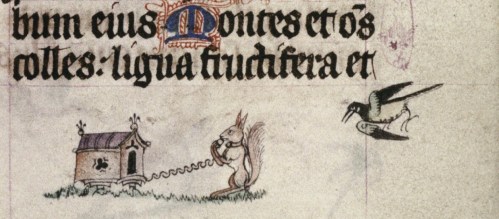
What’s the magpie about to say to the squirrel?
Is it an intermediary, transmitting messages from the other layers, perhaps translating, perhaps interpreting? Will it offer an alternate reading and subversive other senses? (It is, after all, a magpie.) Remember, we’re in the pre-meta-modern days before land-line devices became cordless, before today’s wireless communications flying invisible magic through the ether. Remember, while any text (or, legible thing) at least carries the potential for speculative fiction, pre-modern ones do so more overtly and comfortably, starting with multi-sensory layers and invitation to interpretation, an implied expectation of your interactivity in sense-making. Is that just a 14th-century acorn, is it a nut for all seasons, or is it more? A time-travelling interdimensional prophetic magpie warns, “Get off that phone!”
What’s it doing anyway, flying surreptitiously around — through, over? — the text and into the margin? Where did it come from? Outside, inside, under, somewhere beyond margins and outside the page? And look again: there are two of them; or is it the same magpie twice? Blink and you’ll see a third, squint and there’s a fourth just out of the corner of your eye. Symbolically black and white and ambiguous, capable of learning and intellection and intelligent speech, potential and process in motion, a moment of its multi-dimensional live action represented on a two-dimensional surface. For me, that magpie is creative reading between the lines. For you? What else do you see?
Image credit and full catalogue record: https://medieval.bodleian.ox.ac.uk/catalog/manuscript_6539
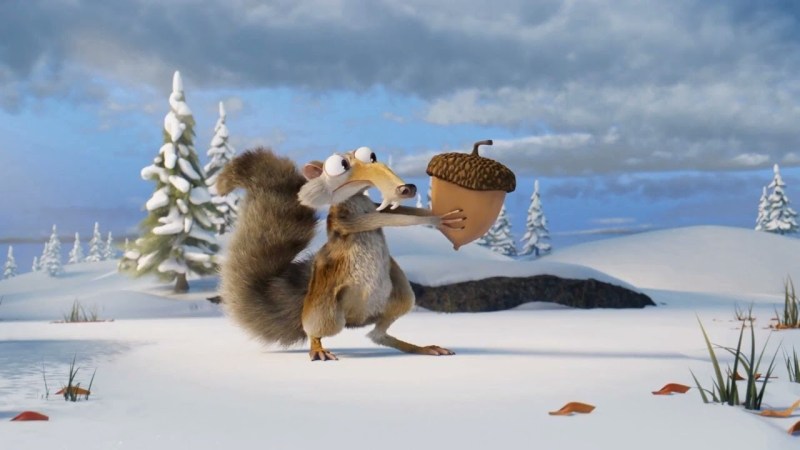
accidentally for the briefest of moments on their interdimensional way between adventures in other worlds?
Image credit: https://www.youtube.com/watch?v=Uuua5lVrdP0

