
Back in February, I completed an institutional survey about GenAI. The only thing that’s changed in my thinking since then and that I should add to it, is that it’s important to distinguish between artificial intelligences:
- YES to artificial intelligence in general and to distributive AI.
- But: as specialist tools for advanced work on large data sets, beyond what is possible with a database, as a stage in the history of research computing. Given the tools’ expense, their use should be restricted to large projects at a national and international level in the public interest and for the advancement of knowledge.
- I am in favour of what some might call gatekeeping, by experts, acknowledging and respecting expertise, especially in a time of anti-expertise “everyone has an equal right to their opinion” anti-science anti-intellectualism. This proposed selective careful use should be ethical, knowledgeable, responsible, accountable; and public in a broad sense, governmentally-funded but also with other institutions and organisations that have a sense of shared public good and longer-term sustainability, and are not for private commercial profit.
- A parallel: the Large Hadron Collider at CERN and the Worldwide LHC Computing Grid, now into the fourth decade of collaboration by over 100 countries and over 10,000 scientists.
- Examples: across the sciences, maths, computing, engineering, and medicine; and the AI for Social Good movement.
- YES Limited chatbots, built on a small set of data, with restrictions on functionality, for a specific purpose.
- A first example: a certain local parcel-delivery company whose chatbot is better, faster, and more human than its previous use of human employees, especially on the telephone when they eventually answered and performed their limited looping scripts, who were an unmitigated disaster and probably contributed to the increased blood-pressure, fragilised mental health, and reduced life expectancy of the general population. Never have I felt such existential despair and such optimism about a future without humans at the same time.
- A second example: virtual intelligence, especially immersive virtual spaces for collaboration, simulations, and role-playing interactions for training; I’m a fan of Second Life and its educational use twenty years ago, and of course The Uncensored Library in Minecraft.
- A third: chatbots built and housed in a closed system, for language-learning practice, especially (if well done) for pronunciation; with ever-increasing class sizes and a continuing need for individual one-on-one practice, this is a compromise to paying extra for tutoring, or cloning instructors (or reducing class sizes and teaching loads, treating learning seriously, and funding teaching properly).
- Generative AI otherwise, for all and any personal use free for all, in a right-libertarian egocentric ecocidal free market, which for me is a big nope: Claude, ChatGPT, Copilot, Gemini, etc. The personal becomes private when corporations commodify information and deprive users of what used to be open knowledge and a public utility. Bear in mind that I am old enough to remember the internet before what Cory Doctorow calls its enshittification.
- Agentic AI, a massive shuddering screaming nope for me. This is not a new loathing, though the fear and mortal dread of impending apocalypse are unwelcome fresh enhancements. Bear in mind that I have been reading science fiction for nearly half a century and that I am old enough to remember Mr Clippy.
21 February 2026, UBC survey of AI use by faculty, circulated via Canvas

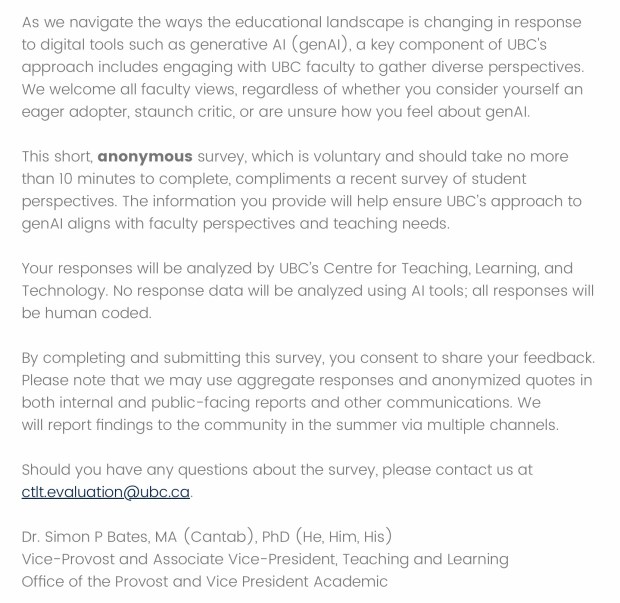
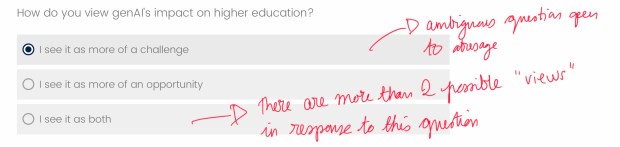
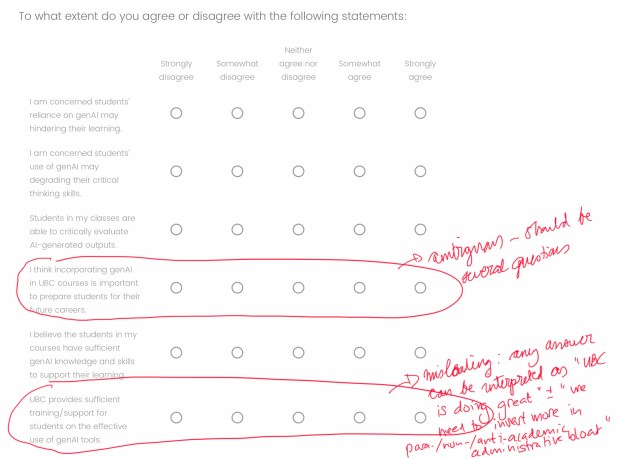
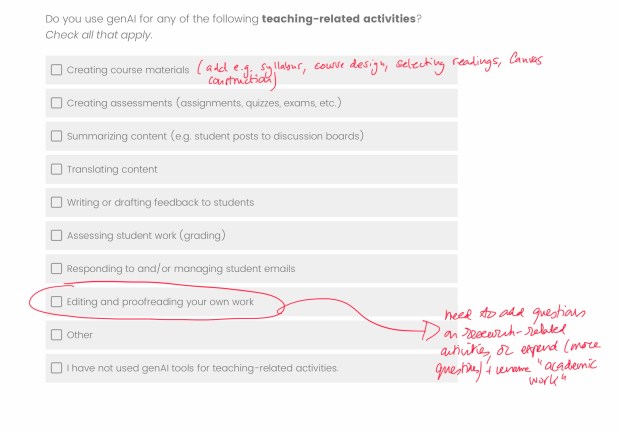
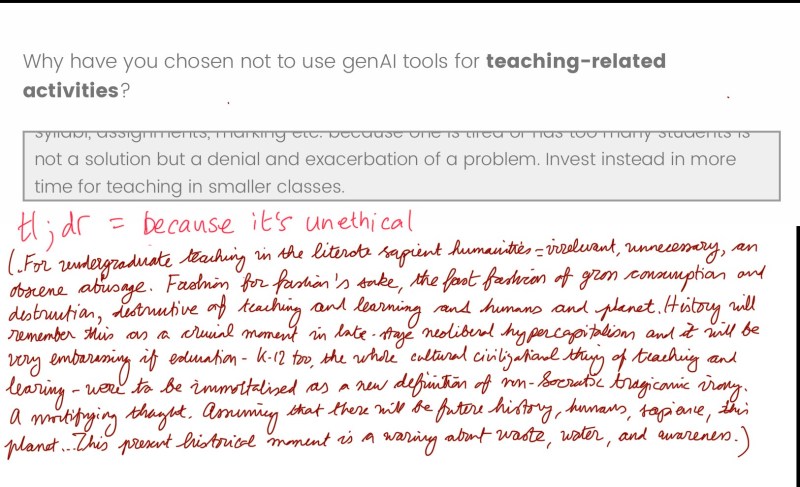
Unethical:
(1) environment:
energy and water use for data centres;
(2) human:
collegial solidarity with fellow academics, writers, thinkers, and artists whose work has been stolen for LLM training;
(3) pedagogical and cognitive:
I want to model good high-quality expert thinking, reading, and writing for students in the literate thinking humanities, and good practices in life/work balance — so I do not use genAI tools for short-cuts that are only useful, and superficially so at that, because of faculty overwork: assistance (machine or otherwise) with correspondence, advising, syllabi, assignments, marking etc. because one is tired or has too many students is not a solution but a denial and exacerbation of a problem. Invest instead in more time for teaching in smaller classes.
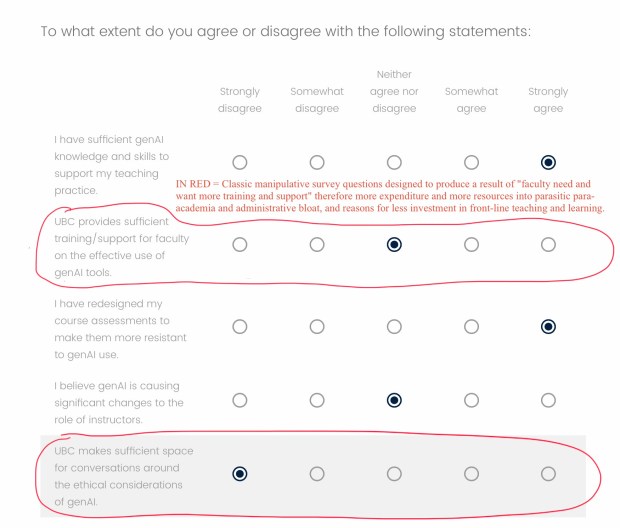

Stop it.
(1) Make the default in all situations and systems that genAI is turned off and for a consenting choice to opt-in, not default imposed and laboriously opt-out (as with Copilot forced on us in all MS systems and to be turned off manually, and worse still having to be turned off again multiple times).
(2) Distinguish clearly between different kinds of genAI use, like for other tools, and stop the fallacious PR based in a false binary — one is either for it or against it — with subsequent pressure and bullying, when in reality the use of genAI is more complex, contextual, and conditional. Like other tools, it can be valuable for people with disabilities, and appropriate for specific research. But that doesn’t mean either that it should be for everyone (or expected of everyone, or imposed) or for no-one (and prohibited to all). For an analogy: the same is true of students recording classes (that is, just recording for their own use, to support their learning, and not as a substitute for attentive attendance and not for dissemination). This kind of thought is just about at the undergraduate logic 101 level; it is a sign of the times that it needs to be spelled out.
(3) Stop investing time and resources in yet more training. We don’t need more training, and especially not from people who are not colleagues or peers, from para-academic people whose work and experience is irrelevant, and from salespeople. Stop taking good faculty colleagues away from front-line academic work, into bureaucratised committees. Teaching and research are under-funded. Teaching conditions are ever worsening. Teaching conditions are students’ learning conditions. And the most important thing that students need to learn at a university is how to think, and read and write and learn and question — these activities are a virtuous circle — intelligently, critically, creatively, humanly.
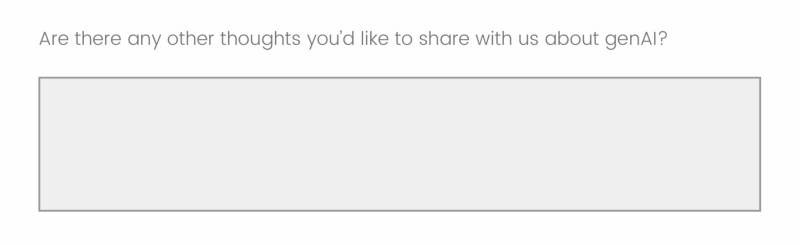
We’re in a time of human, national, international, and planetary crisis; and some of your faculty are here because teaching others — and living a life of learning and helping others to live a life of learning, another virtuous circle — is one of the most important things that a human being can do. Always has been, hopefully always will be, urgently now. This survey, and UBC Central’s institutional pushing of genAI, is socio-culturally, politically, and systemically unethical (this would be 4 in my list from earlier). Stop being distracted, and distracting other people, from what is vital and essential.
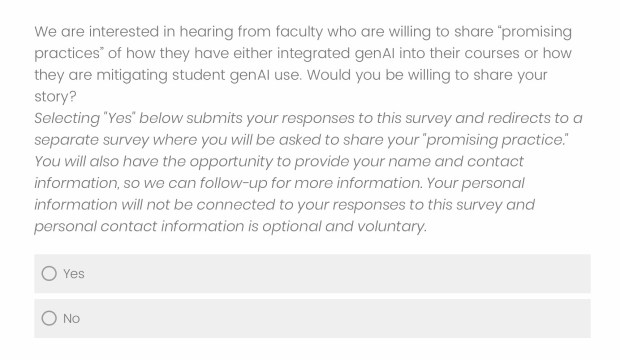
I replied “yes,” paused to stretch and have a glass of water, and wrote this next section in a separate note. I didn’t submit it in my survey response.
Nicely worded, classic — the kind of thing that we did in survey design as undergraduates in the 1990s.
Note that this survey is part of a large TLEF (Teaching and Learning Enhancement Fund) project, and that TLEFs, as well as CTLT (Centre for Teaching, Learning and Technology) itself, draw resources — human and financial and material — away from actual teaching: class sizes, faculty workload, and quality deep broad advanced learning.
Material resources: administrative (whether you “perceive” this more generously as para-academic, or less so as non- or actively anti-) offices occupy space in a building that also houses an arts and humanities library, albeit not as extreme a disproportion of space as that occupied by administrative offices — especially, and symbolically significantly, financial — in the large main arts and humanities library. Most books are not on open shelf but in storage. It is impossible to do proper research browsing well-filled open stacks. “Use” has been reduced to a single easily-quantified metric, and the wrong one, borrowing, I can only guess based on a simplistic ignorant perception of what research is.
This is the opposite of every top quality research library in the world, who focus sensibly on footfall (it’s just as easy to measure) and who have most books available only for reference, in-library short-term (ex. 2-day) reserve, and short-term (ex. 1 week) loan. With the idea that you work *in* the library, that it is a space for intensive work, bodily, with books and in their company; designed and intended as a bookish environment for intellectual activity. That is: the most basic experiential learning in the (literate, cognisant) humanities; in a university whose definining quintessential characteristic is working with ideas, as a place of learning.
As a medievalist, I have a more open non-modern perception of “book” and “bookish” that includes other materials and media; similarly, “reading” is bigger than the (post-medieval, neoliberal) simple passive idea of the thing, just words, just done once and in a straight line from start to end, and insofar as it’s not passive it’s for extractive or destructive purposes.
Back to the survey …

This won’t be a brief overview, because genAI use at an undergraduate level in the literate humanities is a complicated matter. It would be an error to over-simplify, and absurd in a university.
Here are two examples from a beginners’ language class. In this course, the default position on genAI is: students can do whatever they wish for practice and other reinforcement learning outside class — that, like actually doing the practice work, is their responsibility — and anyway I can’t control it, in practical terms. I provide guidance on how to learn outside class, in its many different ways, based on my own teaching (and learning) experience and on my knowledge of the longer history of language-learning. I encourage students to play with different kinds of learning that are new to them; yes, that would include genAI; but always, to think about learning. What is important here: learning.
Example 1: students have 15-minute quick check-in quizzes every two weeks. I adapted this assignment to be strongly anti-genAI and pro-human-I. Closed book, phones away, on paper … but in groups and with the opportunity to exchange and collaborate with other groups, to swap answers and explanations, and turn what could have been a summative exercise into a formative interactivity. Students have reported that they like being able to talk with other students and they feel good after the quiz. I started doing this to alleviate anxiety, to support student mental health (stress, performance, isolation, depression) and to encourage the development of support, collegiality, solidarity, and mutual aid which are coincidental useful so-called “soft” (a.k.a. quintessentially human) skills.
Example 2: a longer piece of writing, for which students can use any materials and tools that they wish — I define materials and tools as anything that is outside of their own minds — on condition that they write an explanatory paragraph. I’ve done versions of this, for selective assignments, for advanced students too and in literature / culture courses. Here’s an example of wording in English, highlighting that this exercise is also developping critical and collegial “advanced human intelligence” skills:
This activity was designed so that it can be completed using just:
– your textbook,
– the websites listed above in French,
– and online dictionaries for looking up unfamiliar vocabulary ([Canvas] modules > resources)
But also! You may use whatever you wish for this activity; mindful, when deciding, that its purpose isn’t just producing an answer faster but helping your learning along the way. If you used any other materials and tools, please state which ones you used, how, and why. Some guiding questions to think about:
– Explain your choice
– What did you do with this tool? How did you use it?
– How did it help your learning? What did you learn from using it? If you used it before for a different assignment (or course, or kind of learning), did you use it differently this time? Would you use it again? Would you use it the same way again? Can you imagine future other ways of using it in French or other language course-work?
– Would you recommend it to other students in the class?
Merci d’avance / thank you in anticipation for sharing (and for teaching us all) 🙂
26 February 2026: updated course policy on GenAI use
Here’s how I updated policy in a course that I was teaching at the time, after I was fed my materials were put into ChatGPT and so I changed the syllabus but also wrote an explanatory document for students, with links for further reading.
Sure, faculty can make changes to a syllabus mid-course (within reason, duly communicated, subject to university syllabus policy, etc.) but this should be done in conversation and for consensus-building and collaboration. It should be done with explanation and reasoning, not in an authority’s arbitrary governance by fiat and dictat. That would be grossly inappropriate. My job is teaching undergraduates. We are in a university, whose purpose is teaching and learning, and knowledge-seeking and -keeping and -making, in a utopian community of fellow seekers. That (re)search is a quest, and questing is about questioning. So it’s essential to talk about this with students as fellow intelligent humans; to ask questions yourself and of yourself; to expect students to ask “why?”; to expect follow-up questions and further questing for sources, resources, research, and supplementary reading.
Suggested related reading:
- On seeking and being a seeker (August 2025)