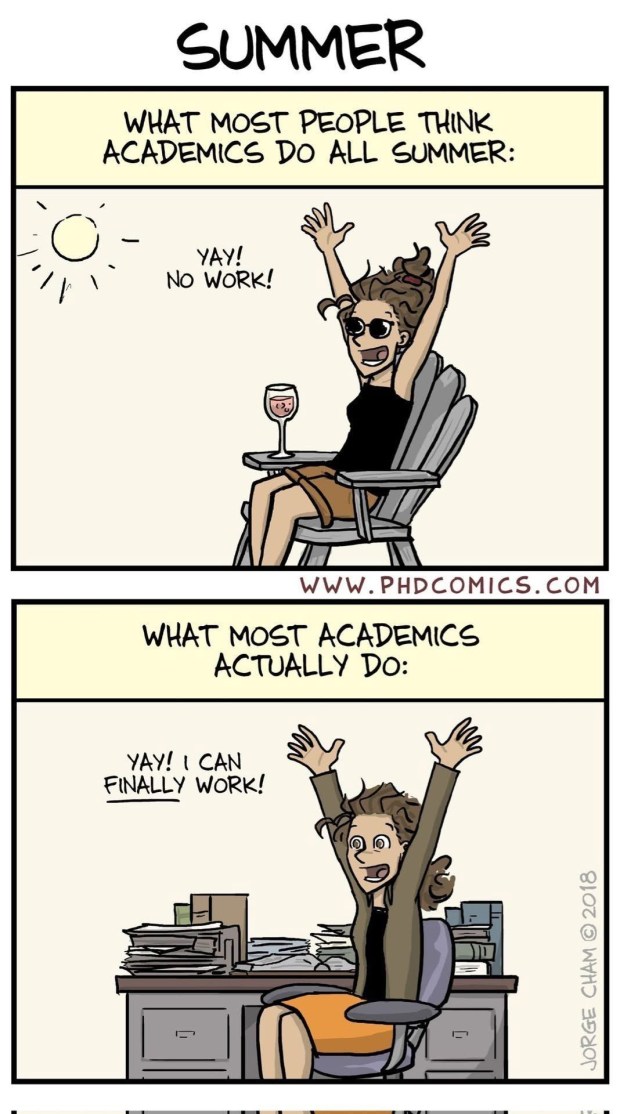
The summer thus far:
May
Summer course coordination
The continuation of March-April work, slightly redesigned and prepared summer term 1 FREN 101; syllabus, schedule, and the major assignments that are in common for all sections of the course. Assignments needed more work, as one section was in person and one was online, and the online course was used as the base form for both; done with the help of my colleague SA. Although I’m formally back to co-ordinating the multiple-section beginners’ French courses (FREN 101 and 102) only as of 1st July, before then I’ve been covering for the previous coordinator who is on leave. (No big secrets or grand revelations, this is all formal too.)
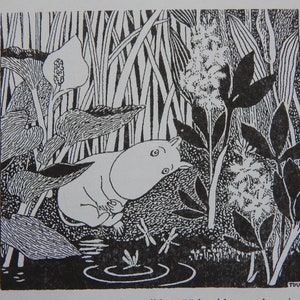
Under the slope, a little to the right of Moominpappa’s hammock, was a large pond of clear, brown water. The Mymble’s daughter always insisted that it had no bottom in the middle. Perhaps she was right. Around the edges broad and shining leaves grew for dragonflies and skimming beetles to rest on, and below the surface spidery creatures used to row wrigglingly along, trying to look important. Further down the pond-frog’s eyes glinted like gold, and sometimes you could catch a quick glimpse of her mysterious relatives that lived deep down in the mud.
Moomintroll was lying in his customary place (or one of his places) curled up on the green-and-yellow moss with his tail carefully tucked in under him.
He looked gravely and contentedly down into the water while he listened to the rustle of wings and the drowsy buzz of bees around him.
(Thomas Warburton trans. 1955, Puffin ed. 1971 p. 13-14.)
Course coordination for next year (September 2026)
Early stages of course (re)design work for next year, for FREN 101 & 102: reading. Its methodology could be described as collection and compilation, dissection and deconstruction, construction through comparitivism and criticism, research and analysis. I reread last year’s version of the courses (syllabus, schedule, assignments, objectives, materials) alongside: previous versions, the different materials that we will be working with next year (mostly reading an earlier edition of the printed textbook), other materials that had been contenders for next year, feedback from students and colleagues, and CEFR guidelines and other external information. Superficially, this looked like what proper academic work is supposed to look like, lots of books and papers spread over a desk with occasional overflow to armchair and floor, objects in constant motion.
Visibly heavy work, tangibly complex, fast-moving, reading was accompanied and followed by what might seem comparatively light and slow: thinking. The two early stages intersect, as some thinking is in writing, on motile notes. Seeming, a matter of perception, sort of light and sort of heavy; the thinking stage of work is vital; but outside its most obvious necessary territory, philosophy, it is all too often ignored and indeed invisibilised … precisely because it’s invisible. Thinking-work doesn’t count: it is not counted and discounted as it’s uncountable and unaccountable, in turn as it’s not accounted for at every step and move in accountable annotation because it is in the nature of thought that it is at once transparent and opaque. It’s unquantifiable, resistant to a hegemonic paradigm’s metrics and prescribed parameters derived from project management and social (pseudo-)sciences, and therefore removed from the equation, erased as an irrelevance and its existence denied.
Thought is unthinkable. Those areas that are outside the (literate and cognising) humanities and sciences tend to substitute authorised authoritative best practices for thought: fallacious appeals to authority and to popularity. Unfortunately, as fallacies are part of thinking and reasoning and argumentation, and as we’re dealing with anti-thinking and unthought, we might be in an impasse. That is, the impersonal “we” that is a university as an centralised whole, an institutional system, institutionalised systematization, local hegemony. The way out of that impasse is to remember that this isn’t a “we” matter but an “I” one and I work in poetry and poetics and reading, in the cognisant critical creative philology that complements philosophy. Besides, there are other kinds of “we” in a university, starting with its foundational essential defining one: fortuitous kithy family of choice, intellectual kinship, the personal “we” of anarchist collegial consensual community. I often forget, and fortunately colleagues remind me, that solidarity and mutual aid aren’t just theoretical and ideological, they’re practical and humanly experiential too and this “I” is not alone (thanks to AS, AV, BOA, EG, IDB, IA, JBM, KJ, MJK, NaN, NiN, SA, SM, SS, …).
Like any proper intellectual work, these design-and-shaping roots (and their systemically-desirable eradication) are a background process, fundamental and underground, sprouting and spinning threads that will form networks connecting and weaving and making a whole, a crafting stage that is at once planned and unplanned, and must be respected so that it (or, a human mind) can do its weird unpredictable untraceable thing in its own way. Sure, you the thinker will have an approximate shape in mind, delimited visually as a thing with beginning and end and sides (a.k.a. limits, boundaries between thing/not-thing); but like any organic object it can have a permeable membrane, a surface microbiome, protuberances and excrescences and gaps that grow and shrink and extend and connect to other things; it can be dynamic and change; it can respond to other things in its environment; and it can comprise other entities and be itself an ecosystem rather than a single organism. It’s the same kind of mental work that I do when reading, doing a reading, doing reading: see for example the pre-modern condition (1) and the pre-modern condition (2).
This summer is the first time that I’ve thought of course design as another way in which I’ve put my earlier specialist doctoral training into applied practice. It’s the first time that I’ve had the time and mental space and working conditions for decent cognising and meta-cognising. The last time I redesigned these courses completely, back in 2012, was with little time for thought and much over-stretched overwork (also doing placement, advising, and too many different courses all at once) and stress. 2018 was in better conditions (thanks new headship) but a partial redesign, working with/under another colleague who redesigned our whole French language sequence, selected new materials and aligned with the CEFR (thanks to SP, much missed), so my work was more that of local translation and adaptation. 2021 was a fast urgent change of materials; pro: collegial consensus; con: panic.
This time, I’ve had the luxury of time and thought, redesign conversations with colleagues having started around September/October last year. The selection of new course materials was by a community, collegially, organised by colleagues further up in the hierarchy (thanks to IDB and JCB) and with marking rubrics and scores; metrics and project management people will be satisfied. Its main work was reading and thinking and, in meetings, argumentation as the expression of further thinking. As the choice of materials was made at the end of April, I was able to start work contacting publishers and university bookstore at the start of May, to be ready for students getting materials in September. Four months seems like a long time and we’re half-way through now and I’m on schedule.
Thought might be transcendentally fluid and sublimely fluffy, but yes I do also have a schedule because otherwise … well, you can imagine …

Other
Recovery from my first workplace injury (25 April) in 30 years. Tips available on request about how to navigate the paperwork on this, as you’ll deal with at least three distinct systems, each with their respective language(s) and organisation. One of these, WorkSafeBC, is excellent: thank you for being clear and helpful.
The usual annual restorative collapsicle.
Other reading, for example about GenAI.
Oh, and not to forget, there was that Canvas incident in early May which resulted in some unscheduled extra work.

June
Completed by or around the solstice.
Summer course coordination
Mostly creating assignments. The design of a different kind of final exam and its full description and rubric; working with SA, started in March; the rubric includes earlier layers from related assigments, credit to SM and CL. I’ll post about this assignment innovation separately later.
Summer FREN 102 design and planning. No coordination here, as it’s just the one section and the one person, myself, though she is notoriously uncoordinated and can be difficult to coordinate (as witnessed by every school PE teacher ever — where sportsball stuff was all that was expected and measured — and UBC Kinesiology people who survived my comically epic failure to hoola-hoop). I’m actually ahead of schedule as I finished the syllabus and schedule and Canvas site a week ago, published it earlier today, and am meeting with our TA later today. I’ll have all the session slides and assignments ready next week, ideally as much as possible by the end of tomorrow.

Course coordination for next year (September 2026)
The next stage of course preparation work for FREN 101 & 102 for next year: the practical stuff, putting together the new course materials (not just my decision, we’d consulted and conferred and consented on them at the end of April), my design work from May, and a schedule / calendar for the term. A provisional version, based on the previous edition; and the materials have reshaped the course’s major assignments. It’s another part of that invisible / non-existent thinking-work, as contrasted with project management: rather than deciding that you now have a plan, and you fit everything into it; instead, that plan is loose and part of a rhizomal network of thoughts-in-progress, and all things are adaptable and can respond to one another and to other new input, right up until the end.
There is, of course, an end and has to be: a full syllabus + schedule, ready for everyone teaching and learning and the start of term. The other “end” is a structural one, the cardinal points that anchor a course’s narrative arc: its start, and expected prerequisites (for beginners, that’s easy: nothing, but also being an intelligent adult who’s curious and who knows other things about the world); its end, a final exam and the expected prior knowledge of the next course. “Ends” will translate, in the language of course design, into “objectives.” That’s for later, in the last stages of syllabus creation.
Other
More rest.
Reading.
Enjoying being mostly recovered from that injury. You can blame me for an #innovation that happened two months after the fateful accident and ruined a historic masterpiece of Brutalism (not a euphemism). You can praise UBC Facilities who did the actual practical work of painting, thank you for helping fragile brutalisable humans of the future as we co-create a respectful working environment of equity, diversity, and inclusion:
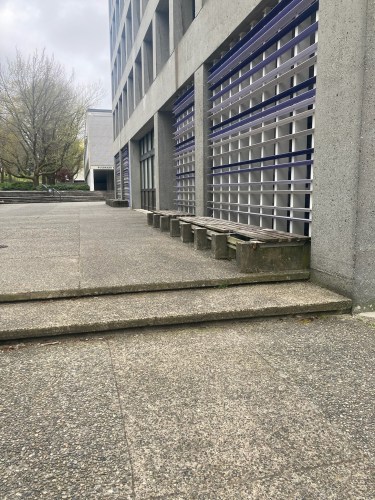
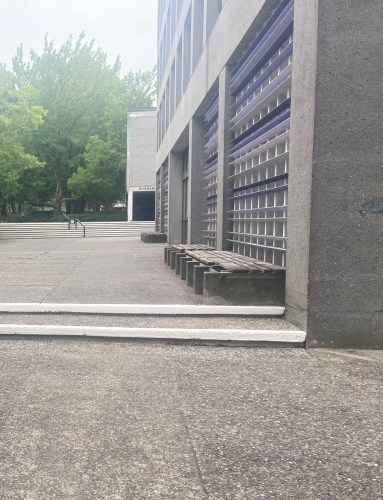
(You may name the steps after me in a century, unless of course I’m still alive or have done something more spectacular by then.) #TheWhiteStripes
July
Work this week and next:
Based on the freshly published new edition of our new materials, redoing the schedule / calendar:
- week by week and day by day:
- what students should prepare before class
- what we’ll do in class
- what students should practice after class
- = counts for participation (which will include individual self-evaluation at the end of term)
- over the term:
- major assignments in common for all sections of the course
Work in mid-July:
Preparation and training materials for colleagues who will be teaching in September. Practical set-up of materials, working with the publishers; #mindfulness #wellbeing “be kind to yourself” is all very nice, but that’s a “with” that’s overly-generous to me as the physically hardest of the work itself — the hands-on manual labour that expends time and energy, that exercises wear and tear on human hands and uses up whole bodies — is by the publishers. For which and to whom I am grateful.
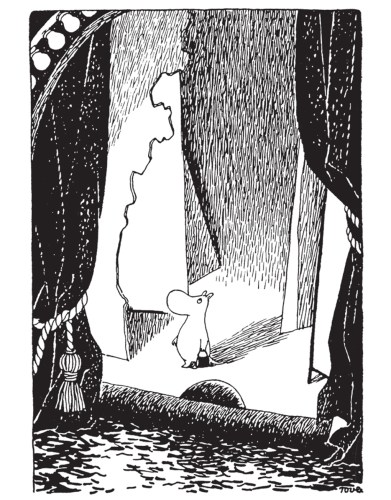
[…] behind them lurked an expanse of darkness, silence and dust […], the ceiling was the strangest of all. It was lost in mysterious, moving and fluttering shadows, while something large and vague kept slowly rocking to and fro […]
‘There’s a lot of things one can’t understand,’ Moominmamma said to herself. ‘But why should everything be exactly as one is used to having it?’
(Warburton trans. 1955, Puffin ed. 1971 p. 38)
Work on summer teaching this month:
Hopefully and with a bit of luck, I’ll have all the slides and assignments ready by the end of next week, otherwise I usually work on them in 2-week blocks in advance. If hope is realised, then my July and August work is “just” teaching and marking, 3 days/week Tuesday-Thursday with Monday and Friday for course coordination for September.
Meanwhile, some last-minute tasks remain before next week:
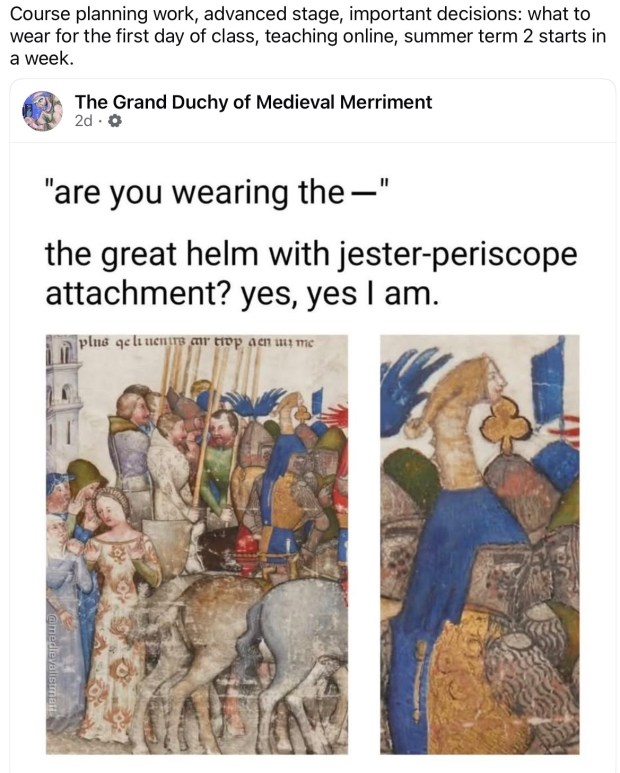
In the interests of efficient service and slick entertainment, your court jester will be working with a TA, who will also be online in virtual person. 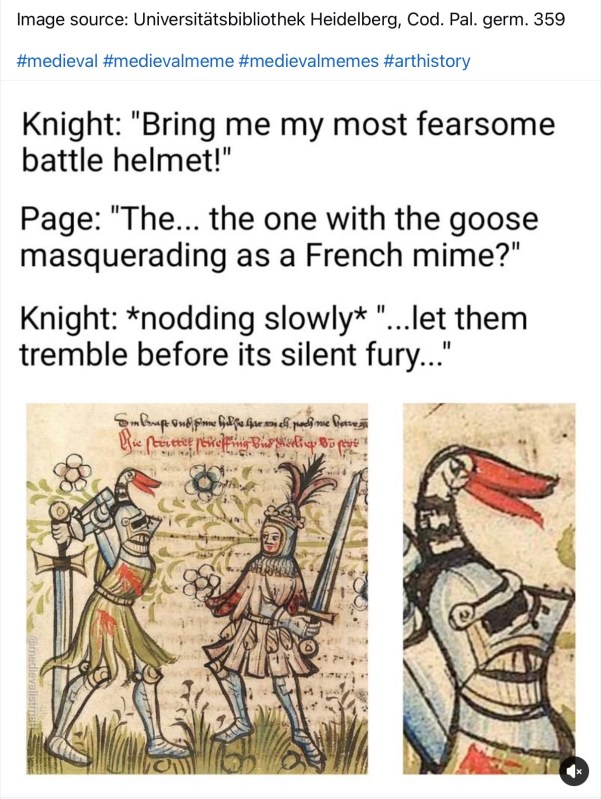
Online as in material person, and especially in a French class: if in doubt, mime. 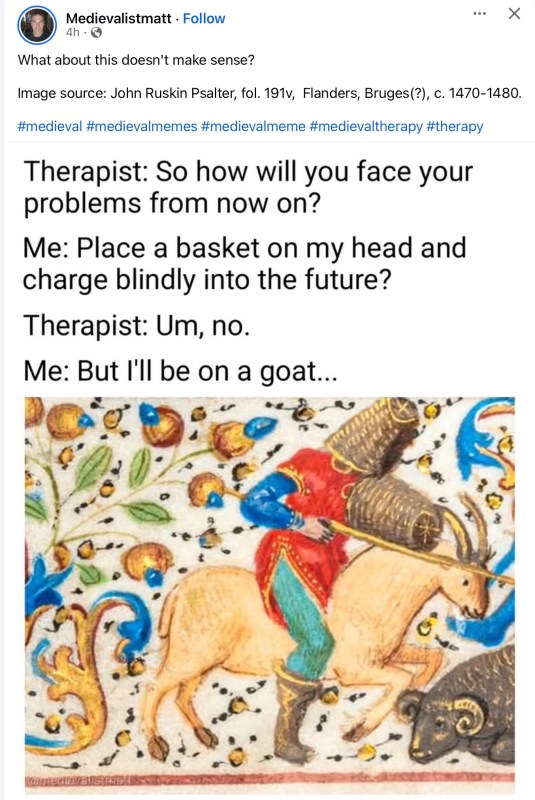
Online teaching pro tip: bad hair day? stress zit? zoom filters to the rescue! 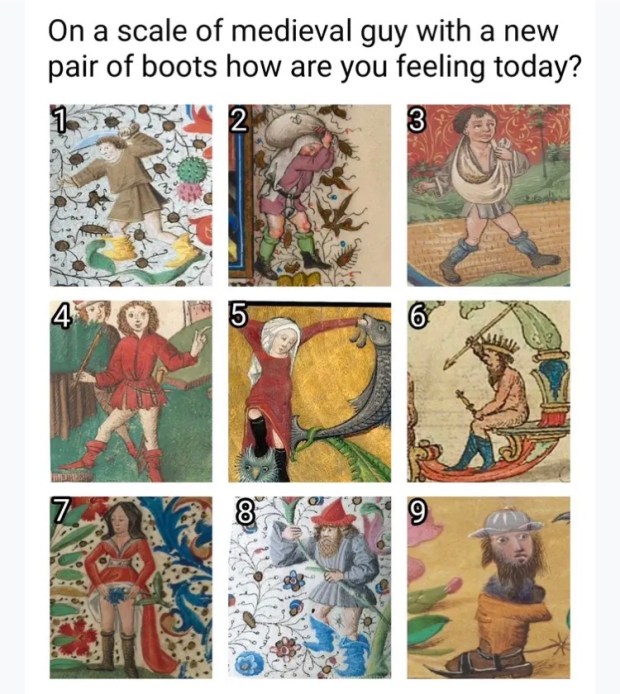
In space, no-one can hear you scream; in virtual space, no-one can see everything that you’re wearing. Pro / con depending on your shoes. Big pro, online no-one can smell your feet and, no matter the size of class, you don’t have to scream or shout or speak above a conversational tone.

