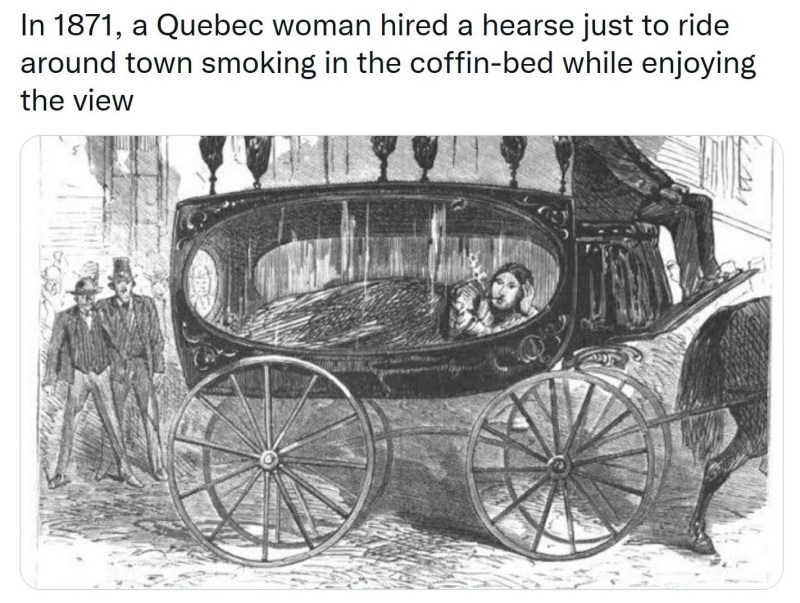
(Image: The Emperor’s New Clothes)
Here at UBC, there is an official institutional Learning Management System. There’s no obligation to use it, but there seems to have been a cultural convention to do so, at least in a minimal way for minimal purposes, as a conventionally-agreed common organisational space for teaching stuff used by faculty and students around what is a very large university, with its various courses, programs, departments, faculties, etc.
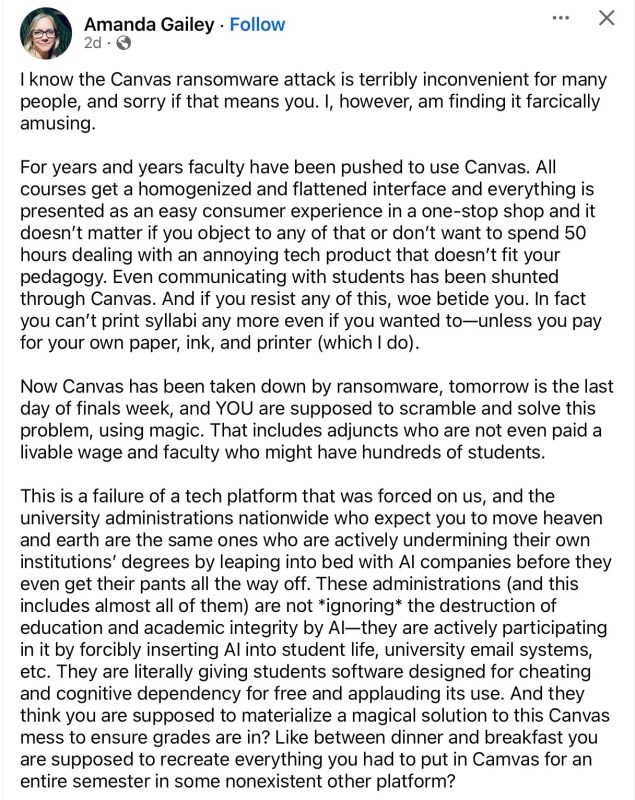
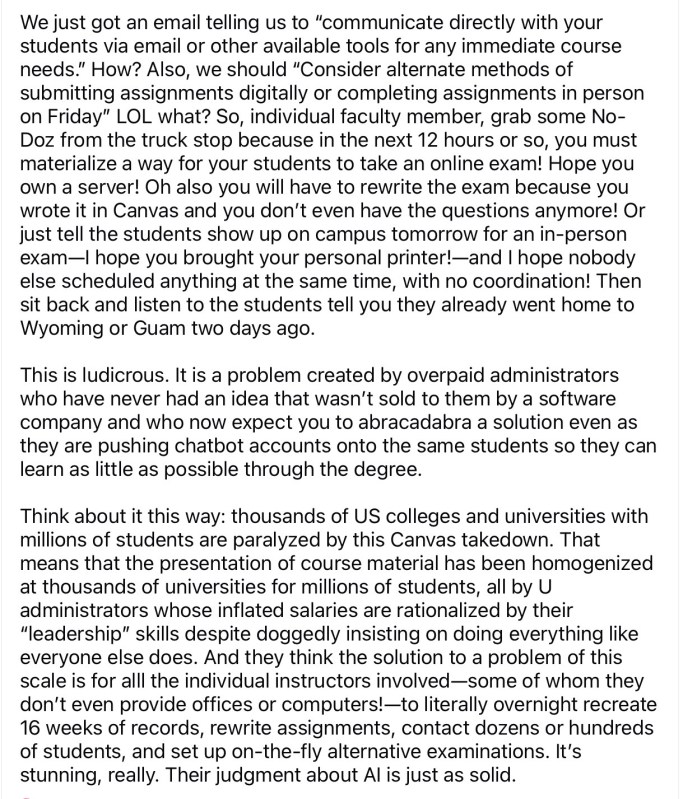
Our current LMS, Canvas, recently suffered a (worldwide) ransomware attack (The May 2026 Security Incident) and is unavailable at the time of writing. (Updates follow at the end of this post.)
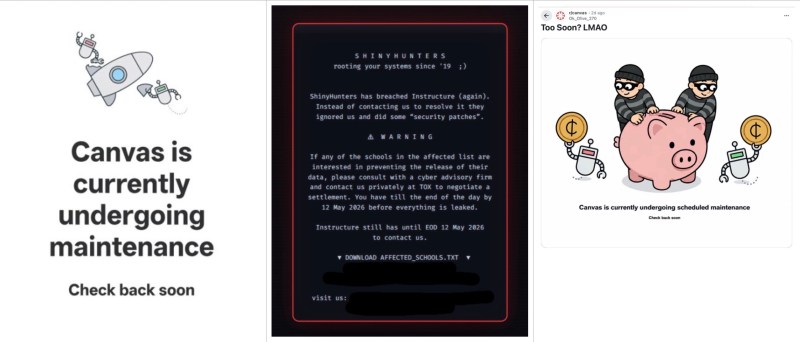
The Incident has affected many people, as this system is used by many universities as well as schools, other institutions and organisations, and companies and corporate training. Lots of people are understandably humanly stressed; like any attack on a larger inhuman abstraction, it has collateral damage that is human. Those people include children and students, with risks to personal information that could be sensitive. Those people also include faculty, other teachers, and IT support staff: already overworked and underpaid, these are the real live humans who are the most immediately and directly affected right now. They are doing extra work without paid overtime, potentially for an unknown length of time.
Our new term starts on Monday. I’m lucky, in that I don’t have to spend this weekend working on what-would-have-been-Canvas. I’m coordinating a course that starts next week but not teaching it. The rest of the post collects comments on the situation via discussions with colleagues elsewhere online. It’s timely: returning to the blog in order to celebrate WordPress.

Collègamix here at UBC or at other universities affected by The Big Canvas Thing: here is one current work-around, sharing in case it’s adaptable to your course/situation.
- Remember, there is no need for Canvas. It’s just a tool. Humans and our hominid kin have successfully transmitted knowledge for somewhere around about half a billion years, more or less depending on where you draw the line on delimiting humanity. With tools or without.
- Remember, “Instructure” is a learning management system company. The name is a nice pun in its own way, but the thing itself is nothing without instruction, and that in turn is nothing without instructors. The decades of PseudoEduNewSpeakCorporatese reducing these two to “content” and its “delivery” … is just hypercapitalist BS to distract focus to customer and product, and to dehumanise and diminish you and what you do; all the while persuading you to aspire to do management as that (unlike what you do do) is actual worthwhile valuable work, and similarly to aspire to be a manager (unlike being a worker, and being a person who works and who also does other things in what and how they define as their meaningful life).
- Remember: related to and connecting together the previous two points, you are an experienced expert amazing awesome specialist super-powered teacher whose brilliant human fabulousness outshines and indeed transcends any EdTech and its EducationProfessionals™️ In the words of a colleague at a previous university, you “could teach in a bin.”
- Practicalities: you need a comfortable space suitable for teaching and learning. That could be a classroom, or Zoom, or one of the other institutional online spaces (the horrid Teams for example), outside, on the beach, or take to the hills …
- Practicalities: materials. (If your materials are open source and online and so on, well done you, skip this step.) With the course that I’m coordinating, we always provide students with what they need for the start of term anyway, because they might be moving around classes, place in a different level of language class, etc.; in a shared folder. Anywhere with a shareable link will do the job (again, being institutionally compliant, the horrid OneDrive for example). Plus the syllabus of course. If this Canvas Issue goes on for longer: then we’ll all work with institutional IT for alternatives and solutions, which might include going lo-tech. If in doubt: add more medieval memes (and digitised manuscripts).
- Practicalities: a course with multiple sections? You’ll also need a shared folder for your instructional team.
- Logistics: for communications with the class, you’ll be using the horrid WorkDay and the old-fashioned technology of saying it in class. If a student missed something? Talk to a class colleague.
- Logistics: for submitting work, the horrid OneDrive or a password-protected site built on something like WordPress (UBC Blogs for example).
- Logistics: for grades, an old-fashioned spreadsheet. Students want to see their grades? You can share selections as needed, and they can maintain their own too. We’ve done this before.
- “Don’t Panic.” For more information, reread … Scarfolk and The Hitchhiker’s Guide to the Galaxy. Part of me would like The Canvas Issue to continue so as to (re)build collegiality, class consciousness, and learning-centred learning.
(Note that none of the above is new or original. See also: the full long history of teaching; not just the last century’s neocolonial version as authoritatively written by American w**te men, stamping their glorious names all over things like “inventing” common knowledge, resource-extracting from what’s otherwise dismissed as “folk wisdom,” and appropriating the bleeding obvious (ex. Bloom). I’ve done variations of the above for 20 years when previous Canvas issues happened, with predecessor LMSes, and when the LMS was so shite that I just used an alternative anyway as it was faster and easier to set up, and more stable … and for some courses — those that I was teaching solo rather than coordinating a team — I then just stayed with it.)
This is a moment for faculty to think seriously about LMSes and what they use them for and why. (Not just Canvas.) From what I’m reading in techy discussions online, this moment might be for another few days but it might be for longer, and with a longer time for “restoring vendor trust.”
For example, I guesstimate that 30-70% of my Canvas use and work is: compliance-culture; accountancy posturing as accountability; risk management, insurance, and self-defence in the name of transparency; science-envy metrics; and learning objectives and outcomes and rubrics which take up an absurd amount of time and energy to compromise, within conscience, between quantifiable artifices culturally imposed by certain social (pseudo)sciences and qualitative expert judgement. In rethinking these courses for the summer and next year, a lot of my design work of the last couple of months had already been to prune the courses drastically: starting with eradicating Canvas preparation, participation, and practice tasks around every class session (even if my previous practice has been to make these flexible, by unit/chapter). No more low-stakes complete/not ungraded little fussy things. Removing anything that looks, up close, like it might be busywork or makework, be that for students “studying” on Canvas or for people like me “doing teaching and related work” there. No more facilitation, micro-managing; instead, radically restoring student responsibility. Returning a tool to its primary essential quintessential purpose: a thing that makes work easier and faster, a place to centralise stuff, course by course, so that I don’t drown in email.
I’d been increasingly angry with Canvas anyway, and upset with myself, for thinking that I was using it for teaching differently and better and helping students to learn better; when all the extra things that I had done on Canvas were distractions from actually teaching, and falling into acting managerially myself. I wasn’t using a tool, I was being used by it, and it was turning me managerial. And Canvas has been exhausting me.
It’s curious that this realisation came about at a time when I’m moving back to what might look like a more managerial kind of work; having had a rest-break from course coordination after doing it for a decade. In another fortuitous coincidence, earlier this week in my annual end-of-year review with my department head, I said that one of my aims for this coming year is to spend less time doing (small fussy) Canvas stuff, so as to have more time for office hours and generally to have more energy and thought and care for what I think of as actually teaching, interactively with other people. To read work with students for feedback (which takes about the same time as doing audio feedback via Canvas Speedgrader, but we can also drink tea and eat chocolate).
In extractive capitalist terms that’s good too: efficiency and productivity to maximise profit for the growth of shareholder and stakeholder returns on their investment; using, spending, expending, saving, and exhausting resources; the conservation of energy; but as a long-term investment, sustainable and therefore responsible and ethical.
Some things can’t be changed: class sizes and student numbers in a large public university won’t ever be the same as a small liberal arts college; but it would be pleasant if I could offer more time for the 20-30% of students who care about learning. If I’m underestimating and that’s more like 70-80%, all the better. That’s an anti-LMS and we’re into unofficial underground optional voluntary discussion sessions, and proper Campbellian anarchist seeker pedagogy.
I’m only coordinating FREN 101 [beginners’ French language I] this term, not teaching it so I can’t and shouldn’t say too much on behalf of colleagues. Most of the course can be taught and learned without Canvas; this was partly by design, done between two months ago and last Tuesday (just before The Incident). Simplifying, returning to necessary essentials. There is 15% of the final grade that’s for coursework through the term, up to each instructor what and how, which might or might not be on Canvas.
I’m teaching 102 [beginners’ French language II], online, in July-August and there’s nothing that I’m planning to do that I can’t do using UBC Blogs as the central base. Communications too, plus w***day and human speech.
Nothing: That is: nothing that’s actually immediately directly teaching and learning. I’ve yet to find any extras on Canvas that aren’t administration, management, and policing; especially the micro-management, patronising, and supervisory vigilant controlling features that are designed for American (K-12) schools or corporate training.
And then there’s fluff and frills, the bells and whistles; which might seem cool and they might tempt you to find a way to use them, because they’re there so you reckon that’s for a good reason and they must have a purpose, be that because of some pedagogical fashion (which might in regressive turn have been SoTL-ed from a LMS) or because they make sense for a different area of knowledge or audience. A lot of them also turn out to be just more management and surveillance.
Like any other LMS, Canvas might seem, superficially, more convenient and easier to set up than WordPress – but that’s often because a user has conveniently forgotten about when they first learned to use it, or moved from another LMS, that whole learning process and the new language and structure of a platform. (“Conveniently” sounds meaner than I mean; it’s a natural human forgetting, the more so if the memory was traumatic.)
I feel for people who are teaching next week; I have the luxury and liberty of being able to turn this moment to stripping a course down and rebuilding it, as a thing in itself; an exercise in the applied practice of knowledge-centred learning, divorced from Canvas or any other external structure and platform.
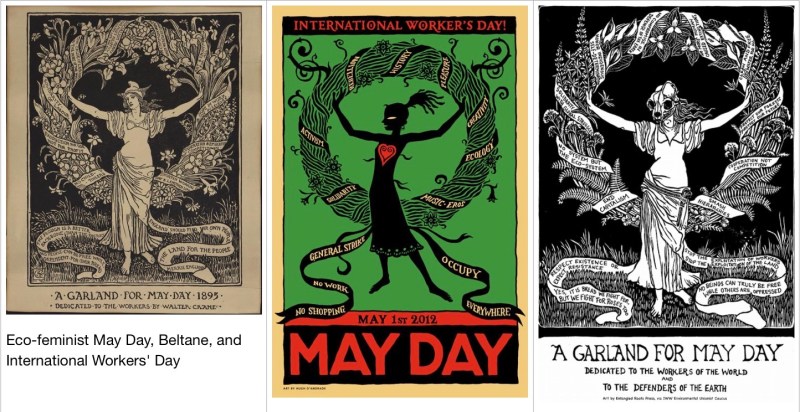
P.S. Happy May Day!
Updates, 2026-05-12 and -14
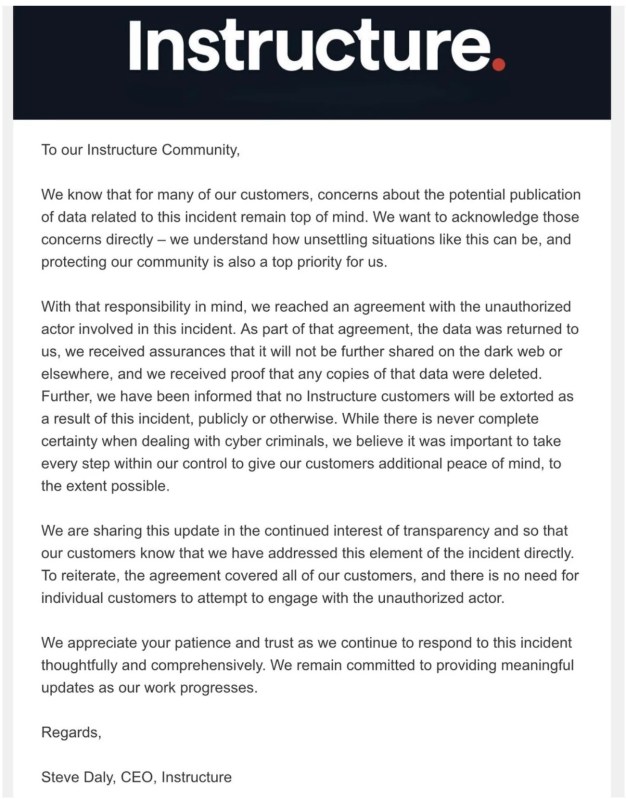
See also:
- https://www.reddit.com/r/canvas/comments/1taj9mk/instructure_just_confirmed_they_paid_the_ransom/
- https://stateofsurveillance.org/news/instructure-paid-ransom-shinyhunters-canvas-settlement-shred-logs-275-million-2026/ with further sources and reading
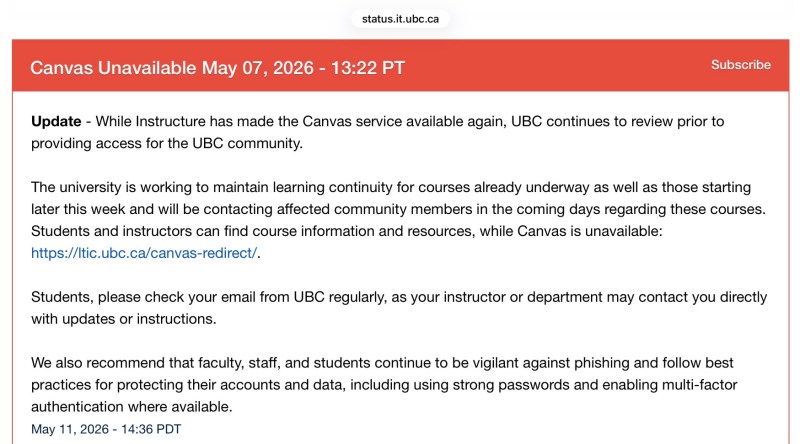
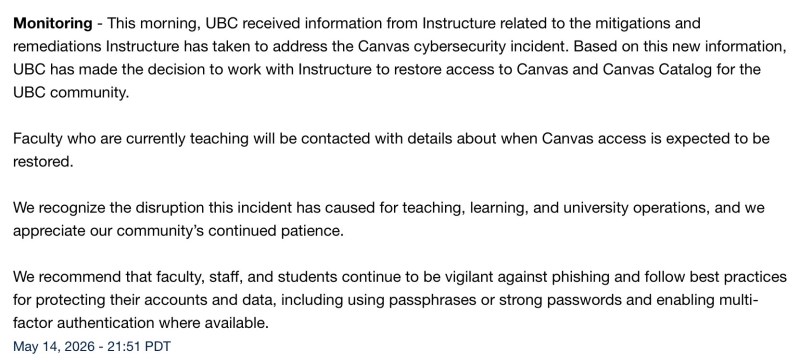
Meanwhile here at UBC, our colleagues in IT are being wise and wary: