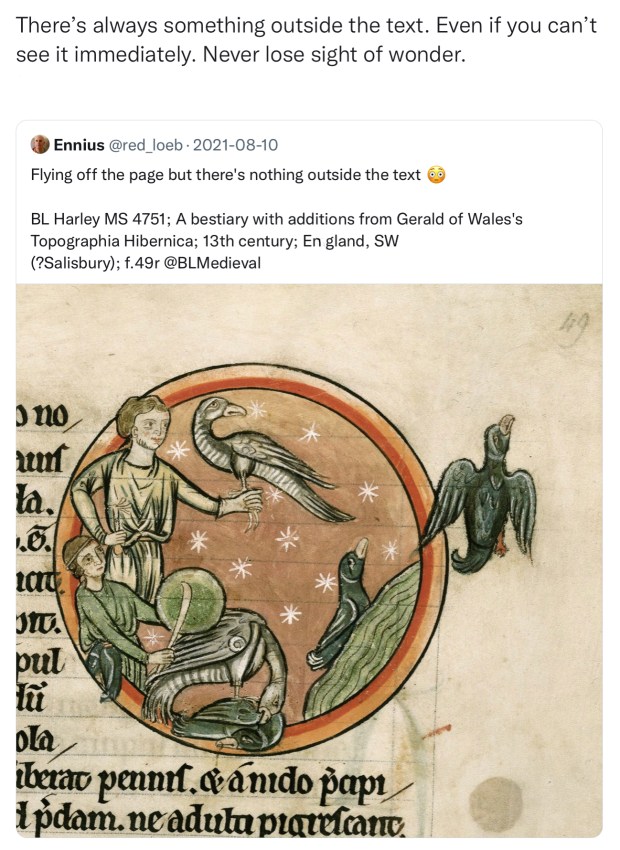
Summer teaching is over. Exams marked, final grades submitted, a last parting message (au revoir rather than adieu) posted on Canvas yesterday morning, Canvas dashboard edited to remove the courses that just ended and move in the new ones, institutional email folders archived. I don’t feel a need to think about next term yet: my courses are multiple-section ones designed and coordinated by other colleagues, and it’s testament to my trust in them that I feel comfortable and relaxed. That’s a rare thing at this time of year. So, at last, I’m catching up with writing.
The first planned writing yesterday is DONE! New UBC Blogs archive sites for courses designed between 2021 and now, which are housed on UBC’s learning management system (LMS), Canvas, and to which access is restricted to students who are registered in these courses. The most recent one, 2024’s MDVL 301/RMST 321 features scaffolded project design and an innovative final anti-exam (not new, been doing this since 2009), and (new for 2024-25) my most detailed marking rubrics ever.
RMST 201:
Introduction to Literatures and Cultures of the Romance World I: Medieval to Early Modern
(September-December 2021)
MDVL 301 / RMST 321 (cross-listed):
European Literature from the 5th to the 14th Century /
French Literature from the Middle Ages to the Revolution:
“A World of Marvels”
(January-April 2025)
The next stages: on both course sites, copying over all weekly readings and class notes and maybe some light breadcrumbing; on the 2021 one, also copying over assignment pages.
Autumn 2021’s RMST 201 was a weird course, and weirder to design. I had intended to write about it that year, but was overwhelmed and exhausted. That space of four years was the perfect distance for rereading my old notes, though, so the timing is actually perfect. I first wrote about the designing process on that UBC Blogs course site, but this blog is probably a better place for it.
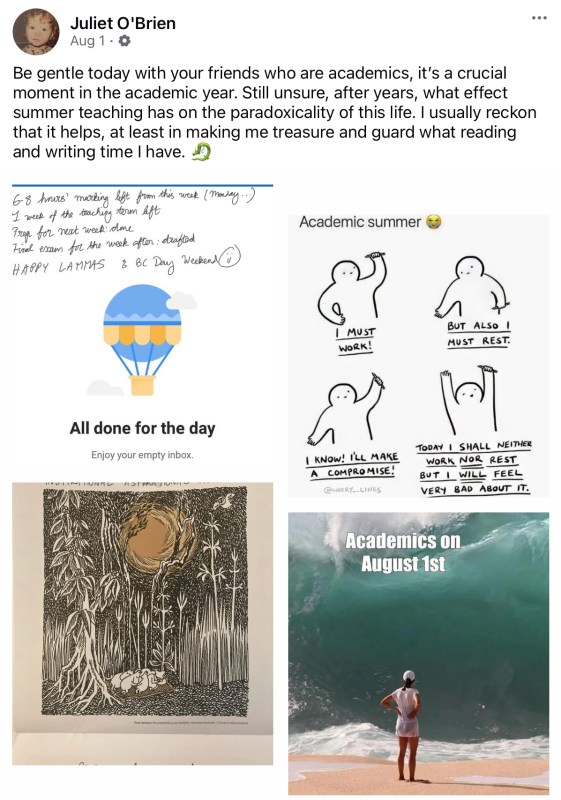
GHOSTS OF FUTURE ANTERIOR PERFECT COURSES: OUT-TAKES from earlier stages in course design
2021-03 note
Topics:
- variation on THE LIBERAL ARTS: cultures of learning, inc universities and students; geometry and geography
- variation on ANIMAL READING: all online, bestiaries + Marie de France + Montaigne
- BEING HUMAN frame: from Pyrenees cave-art cradle of Romania and humanity to colonialism
- variation on MARVELS inc what it means to be in a world, maps, landscape painting
- and THE FANTASTIC
- variation on CRITICISM
- APOCALYPSE NOW and the opposite of courtly / high culture
[This note was just after a meeting about the course, where my first approach was to tweak something that I’d taught before—the nearest that I would ever come to repeating a course—plus two other ideas that seemed fitting for pandemic times, because I knew that the term would be tough: uncertainty at that time whether we would still be online or in person; plus teaching five days a week, which is unusual for continuing faculty in our university.]
2021-04 note
loci
Occitania
Granada?
Sicily
Anglo-Normania
organisation: geographical, spiralling outwards from Pyrennees, modules by place, each seen from a marginal or outsider point of view
NO: structure the course AS a romance.
Courtly outer frame
In the middle: “Silence”
SUBTITLE: “ROMANCE ROMANCE ROMANCE”
2021-05 note
possible title: “ANIMAL, VEGETABLE, MINERAL, POETIC: MAKING / THE STUFF OF / THE ROMANCE WORLD”
module 1: environment
maps, landscapes, flora and fauna, sounds and smells, caves, refuges, between seas, sea in middle of lands, mountains, green pilgrimage …
Giotto frescos, 3D visual storytelling (4D and more with live performance, plus infinite variation of improvisation and versions, and retellings through time)
FIRST READING: cave of forgotten dreams, https://www.rai.it/dl/RaiTV/programmi/media/ContentItem-ab15a0df-a6a9-4a28-b3a0-dc53f7e116cc-cinema.html
module 2: word-art and songs and books
monasteries, abbeys, romanesque
stained glass windows
READING: POETRY MODULE
module 3: short narrative (fable, fabliau)
gothic, cathedrals, cities, fairs, carnaval, plague
module 4: READING A ROMANCE
module 5: less wordy arts
ritual words (loop back to module 1), plays, performance, other popular entertainment, puppets and giants (Belgium), carnivals, Spain, Cantigas, Rabelais
module 6: other wor(l)ds on the margins (geographical, multilinguistic)
Marie de France, Christine de Pizan, someone visionary, Bosch, SF
module 7: the end of the world
Montaigne
2021-06 note
[in conversation with a friend online]
So – thinking about this (vaguely, back of my mind) in slow stage planning the frame and narrative arc of a course, which like previous incarnations I’m starting with Pyrenees-area cave art, “middle earth” heart of the Mediterranean …
That is: centre of that old world not just the Pyrenees but also the Massif Central, thinking also about havens and homes and movement and migrancy, mapping Ice Age refuges as islands, in a landscape drawn and contoured by water and flow as much as by land and road and manmade borders.
And thinking about borders, margins, marginality. Though that last line of thought might not make it into the course necessarily, at least not beyond an intro of examining the official course title and description: “Romance Studies 201 – Introduction to Literatures and Cultures of the Romance World I: Medieval to Early Modern. An introduction to the main themes that shaped the Romance World as its different national identities emerged in the Mediterranean sphere.”
Because whatever else this course ends up being—and I’ll be working on it over the next couple of months, tomorrow being last day of leave—it will not be on anything “national” in any of the nation/nationalism senses that students might expect (or that certain colleagues might presuppose). Starting with ancient cave art gives us both a “nacion/pays” in the appropriate geographical location, and art-forms that are a shared “place of origin” that speaks across space and time and starts a common bond for the socio-political “nation” that is a class of individuals from many nation-states (and maybe none) around the world, a world of ancient refuges and their artwork.
(Alas, the whole course won’t be on early art, or multimedia innovation, but that’s the start of the outer frame.)
I still vividly remember the excitement when humans met the Chauvet caves again for the first time in centuries, and the bonus excitement when the book came out, was bookselling at the time (mid-90s).
2021-07 note
place / displace
start with place and ideas of what place is
- place, displacement, identity
- environment
- Pyrennees, Ice Age havens
- Mediterranean
- rivers, coasts, deltas, borderlands
- wilderness and wildness
- weeds and wildflowers, and poetry and a poetics of place
- winds
- maps, names, language, and a grammar of place
- mapping the world: big books
- “animal reading” variation, reading and writing the world
- le berceau d’une Europe sans frontières
- borders, borderlands, borderlessness, resisting borders, crossing them inc illicitly
- WORDS, MEANING, ORIGINS, PHILOLOGY
- looking into terms: literature(s), romance-speaking, world, early, nations
- the idea of a romance world: UNESCO world heritage, all from the now-romance-speaking areas, “earlier” – when? whose terms?
- UNESCO intangible and environmental heritage: thinking of culture and literature beyond paintings and books (a start like a cross between FREN336 and old RMST221/MDVL)
start with Lascaux etc.
- cave art, bone flutes, decorated ceramics for food use, megalithic monuments
- ideas of culture and literature and art
- preservation and stasis vs movement, life, communication, flow, change
- “being in space and time”?
- food as fundamental to culture, and breaking bread together to companionship to storytelling
- reading here: something very ancient and wild and magical … earliest Occitan lyric, alba
adventure
- travel vs tourism
- pilgrimage
- work travel, ex. construction and guilds, monastic, learning, agriculture, transhumance, fishing, trade, seasonality, rhythm in life
- waterways and seascapes, thinking and rethinking terracentric geographies
- itinerant orders
- war veterans and PTSD, manmade and environmental catastrophe, famine, flood, pestilence, apocalypse
- movement, itinerance, migration, exile, transience, and again change (and being changed by movement, no longer of that place, placeless, displaced) and life
- refuge, exile, estrangement, strangeness; inc dépayser but not exact contrary, just en-/déraciner
- cosmopolitanism and courts, castles and cities, monasteries, and places of knowledge and learning
- Dante: De Vulgari eloquentia re. Romance and Vita nuova (and their Occ precursors as bridge from previous module to this), travels in underworld and otherworlds,
borders
- borderlines, borderlands
- margins
- centrality: Medi/terranean (sea in middle of lands vs middle earth), empires, modern colonialist empires, EU
- maps and mapping
- books
- limits, de-finitions, genre, periodicity
- prefaces, endings, space for continuation, epilogues, apocrypha, apocalypse and after
- constraints, categories, and what counts (inc. bestiaries)
- margins and marginality: vs dominant culture, choices of what we’re reading in this course, not just a courtly high culture for and consumed by a small elite; and talking about historical marginalisation, the construction of the medieval, literary canons, what it means to be a “classic” or “classical” (bridge to 17th c French and end of this course’s remit)
- social fabrics and margins: texts from all social classes, trader travelers, Franciscans, outcasts (Yvain), disabled
- text, texture, textile, tapestry: and a woven class of threads, not a simple one-dimensional line
- fraying and fragility, endangered species and habitats, natural dangers: mountains, forests and wolves and werewolves, rivers and lakes and sirens, seas and monsters (Marie de France, Mélusine, Voyage of Brendan)
- BORDERS AND MARGINS
- alien and fantastical, “a distant mirror,” relative to the Pacific west coast this is “The Wonders of The East”
- an edgy world
- mediterranean, hist, etymology, Isidore 6th c; sim Atlantic sea of Atlas, between sky and earth; Pyrenees, Pyrene, narratio fabulosa; other etymologies for FR, IT, SP, gallia, lusitania, etc. (+ again Isidore)
- Brunetto Latini livre du tresor
- worlds and otherworlds
- marginal monsters
- making, finding, trobar
movie
- build course around 2-3 films? of which one MUST be Monty Python And The Holy Grail
worldbuilding
- for part of the course, students select readings? (like 19W rmst221, discussions + profs for the day)
- and whole class term-long project, with parts within it? group (thematic) and poss individual components?
- [hindsight-note: for once, I was wise and resisted an over-ambitious grand plan for a whole class of unknown people to translate Jeff VanderMeer’s Wonderbook: The Illustrated Guide to Creating Imaginative Fiction into experiential applied medievalism]
rhythm
- week 2, class 1: propose groups, students decide on them in that session
- week 6 or 7: midterm check-in with groups (in lieu of classes that week)
- week “13.5” last class: project-group check-in, all morning, in classroom and (before and after) online
- modules
- end of module quiz/task, based on student questions
- term-long thematic blog? bestiary, herbal, geography, encyclopaedia, world-making? podcasting options?
- alternate text week / other medium week? no, integrate, theme of world-making and a whole integrated multiple diverse rich world
- lectury bits: lots of background; segments inc some that are just audio, not necessarily with images or text
- reading week reading thing: community podcast?
- ? a week of library RBM visits, 4x small groups
- “final exam”: project presentations and appreciation, festive fayre of learnedness
readings
- online mss, encyclopaedias, bestiaries, herbals, geographies, adventures, pilgrimage, maps, dreams
- multimedia manuscripts, music, song, religious poetry and prayer, buildings, villages, towns, roads, waterways, sculptures, reliquaries, paintings: use artworks to introduce readings
- set readings: short, but in depth (breadth = my job in lecture; Tues Q&A session = for further contextualisation and expansion), widely available in OK translation online; balance social classes, gender, urban/rural/wild; rich tapestry of forms and lengths and kinds
[after which work sat in my head and did things there until end of August]
2021-09 note
Dream.
START: literature that’s not written and fixed, cave of forgotten dreams, evanescent performance, life in the moment, fluid poems
a framing Occ poem / song, spell, chant, the “natio” of birth: TOMIDA FEMINA and its manuscript context
= start with “literature, culture, introduction, shaping, identity, emergence/emerge/emergency, “
Occ anthems + sung by a contemporary woman artist in a different style (Alide Sans, Se canta + Nadau, De cap tà l’immortèla): modern nation-states and nationalism, regionalism, cultural minorities, other geographies ex. idea of Europe and “sans frontières”, language politics and minority languages, cultural annihilation and exile, civil and expansionist and religious war = background context; and a present of fragility, endangerment, consequences of colonisation and decolonisation, climate and refugee crisis
[I was horribly stressed about this course and its design, as I’d done no work on it since late August: dentist, meetings, 20 hours over the weekend and Monday public holiday of extra work fixing someone else’s syllabus for my two other courses, Monday-Tuesday making the Canvas sites for those other courses, teaching them Wednesday, that evening doing Canvas basic construction for this course, and this one was Thursday morning. I ended up walking into the first session of this course without a finished syllabus. Enough of a syllabus to be one, and a fortuitous good reason to open the syllabus up to collaborative design with students. It was pandemic times, we’re in a communitarian compassionate place—echoing the course title’s ideas of place and identity—and students were wonderful in making this course what it was.
But the night before I went from stressed to beyond it, into resigned acceptance: I would be walking into a classroom nearly naked. You know about faculty, and indeed other teachers, and our classic anxiety dream about walking into the wrong class, late, unprepared, no idea what the class is, and so on; and, of course, naked? In my dream, all of that PLUS I was a naked infant in an earthquake and I kept trying to speak but couldn’t make a sound. That morphed into being in a poem at the edge of a page in a manuscript. Or rather, inside and under, a sort of cave system with roots. (There’s cheese, and then there’s too much Jeff VanderMeer. And being haunted by work on weasels pandemic-suspended in spring 2020.)
I woke up knowing that I had to start the course with that poem. I was going to boldly walk in and go straight in to the poem. Grand plan, clear vision. Definite. Absolute. Walking to class changed that, though, and we spent that first session talking about the course design and syllabus. The poem moved to the second week’s second session; a week of poetry, moving rapidly quakily backwards from the present, starting with a song from a few months before by an artist of our students’ generation.
“Tomida femina,” mid-10th c. (dating as per Bischoff 1984 and the Padens 2007) marginal subversive addition to a mid-9th to 10th c. Latin legal manuscript, Bibliothèque communautaire et interuniversitaire de Clermond-Ferrand MS 201 f. 89v. Online: https://www.bibliotheques-clermontmetropole.eu/overnia/view.php?id=/media-dam/CLERCO/biblioth/PDF/4_Sciences_et_arts_MS_201_0005.pdf
Base for teaching: my reading of the poem in 2018 and revisited, with ideas of wildness in the notes above, to sustain me later that academic year. The first term nearly broke me, blissfully followed by crashing and recovering in sabbatical rewilding.]
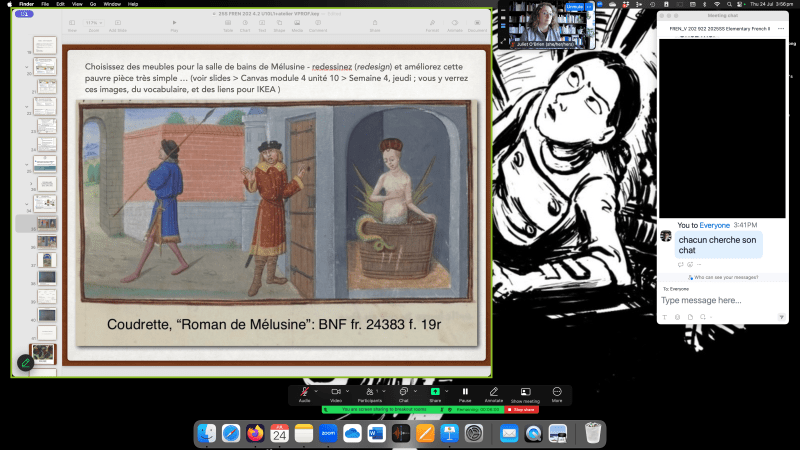
Next up: summer reading and thinking about artificial intelligence, in general and the generative kind; maybe some consent and inclusive ecofeminist pedagogy, maybe some Marguerite Yourcenar and Brussels museum-bothering. Meanwhile, here’s a live action moment from my summer teaching; because online teaching can be as improvisational and unpredictable, as whimsical and cartoonish as any other medium, just as live and lively and alive. Any teaching, learning, and other fundamentally human interaction balances the intelligence of understanding—from poetic Old Occitan entendemen and Florentine intelletto to contemporary critique—with performance, making a fictional world, story-telling, enchantment, magic and spell-casting, danger … but it’s “just” in your head: artifice.
 Juliet O’Brien