Welcome to a new rubric, WELLBEING: the radical revolutionary wing of The Consent Project.
Today’s motivational message:
You cannot catch up on sleep.
You can try, but you will fail. That’s because what you’re trying to do is: catch up with Sleep. Sleep is a god. You are not. You are a human(imal). You and Sleep cannot be peers. You cannot race each other, even if either of you wanted to or thought, after just a moment’s actual reflection, that racing was itself a good idea. To think that you are in the same dimension, let alone share physical space and able to interact bodily? That’s hubris. All hubris is by definition doomed to failure; tragic, epic, mythopoetic, culture-defining paradigmatic failure.
This—situation, problem, world—is unfair; fundamentally, essentially, indeed quintessentially unfair because it is unequal. There is no possibility of fairness and equality. Gods are gods, humans are humans. There is no possibility of change and redress through bringing in equity and justice, as they have no place here. Sure, there might be ways around this problem: if supernaturals are partly natural rather than utterly alienly unnatural, if capable of emotion and understanding and imagination, if they are creative enough to be kithy with humans, if this is Ursula K. Le Guin’s Ekumen universe rather than Planet Earth Bronze Age and its patriarchal descendants.
You cannot catch up on sleep, or with Sleep, because you are a human being. It is good to be human. Embrace your humanity and rejoice in it.
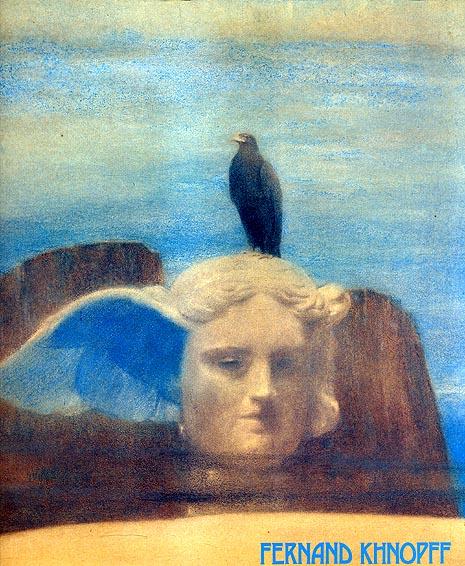
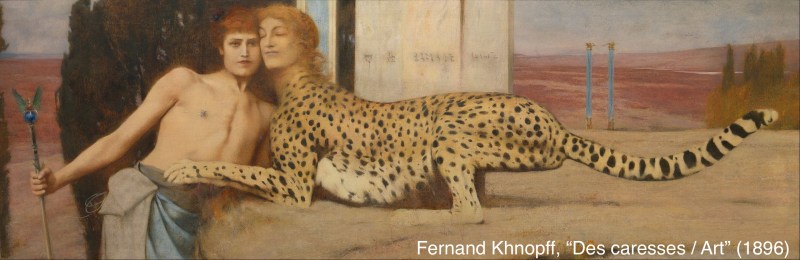
A rare and seldom-seen portrait of Hypnos: Fernand Khnopff, “La belle au bois dormant” (1909, pastel; possibly the sole extant panel of a triptych; from the exhibition “Fernand Khnopff et ses relations avec la Sécession viennoise,” Musée royaux des beaux-arts de Belgique, Bruxelles, October-December 1987).
Yesterday’s motivational message (related):
You cannot “catch up on” sleep; but you can “get in” dream-time, and that can be part of “getting back into” writing.
That can in turn be part of returning to creativity, imagination, understanding, emotion, … in short: you’e resuming the thinking that makes you human and keeps you humane. Reconnecting with yourself, if you will; a reconnection that is a very bodily “re-member-ing” yourself as a self.
[I was writing this in] A transgressively leisurely Saturday of abundant sleep, not doing much and doing it slowly, extra rest, and further naps on the sofa.
Feeling guilty about laziness? Persuading yourself that luxuriating is permissible as it translates to something constructive? You’re actually a success as that’s an achievement, catching up on sleep puts you ahead as you bank resources, savings, and investments for the future?
Thought about it. But no. Not so much “catching up” on sleep—aggressively competitive, quantified, functional; an extractive resource, an unattainable target, and an image from a recurring anxiety nightmare; a late capitalist metaphor of progress, dehumanising regress, and failure—as “getting in” that dream-time, in all its cornucopian senses, with an egressive view to “getting back into” writing. At the poor old mind’s own pace: starting small and simple with weekending of no email or anything work-related, minimal online stuff in general (except reading and writing), and delighting in joyous idling.
Here on The Sofa That Is Poetic-Oneric Central, we’ve also been playing digressively with Google Ngram. No-one “caught up on sleep” (that is, tried to; as we know, it’s an impossibility) before about 1900, it’s predominantly a post-war phenomenon and noticeably prevalent from the 1980s onwards; and the historical usage-patterns vary fascinatingly across languages. Meanwhile, way back in the early days of the idea, while expressionists and cubists and futurists are doing their modernist thing with time and mechanisation and artificial speed, Proust did it better as an artful adverbialist adventure “à la recherche du temps perdu.”
And now I want “Proust Does It Better” on a t-shirt. No, on pyjamas …
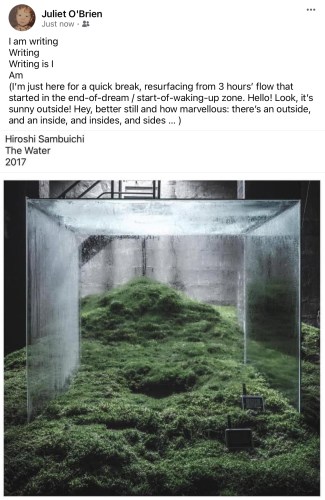
I wrote that in response to something I’d seen on Facebook a few days before:
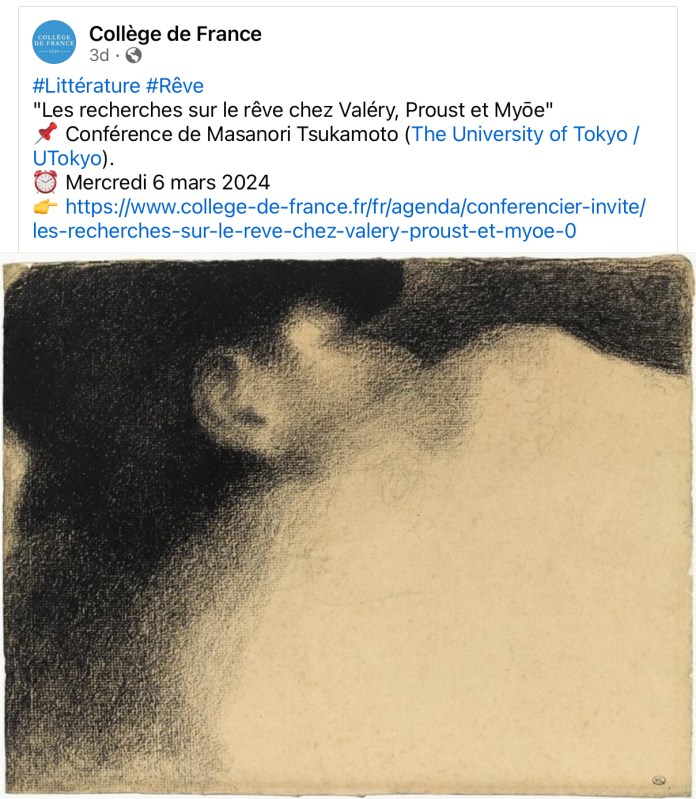
(Fun fact, to declare flat-footedly before anyone lauds elegant flânerie or eclectic culture générale: of the other doctoral dissertations that I could—might, perhaps should—have written as expansions of graduate course term papers, one was on Apollinaire and a medievalist anti-modernism, from Suzanne Nash’s mind-altering 20th-century French poetry grad seminar, feat. Valéry.)
Here’s the poster/programme and here’s the full abstract.
It doesn’t look like The talk will be livecast or recorded—and 5 p.m. in France is 8 a.m. in our time-zone so would be perfect for me, still half-asleep, still half-dreaming—and you can now (2024-03-13 update) watch or listen on the Collège de France – Lettres, langues, philosophie YouTube channel (https://www.youtube.com/watch?v=LUZW_x2ozi0):
So. You cannot catch up on sleep, or with Sleep, because you are a human being. It is good to be human. Embrace your humanity and rejoice in it.
That is already good, and it gets better. Right here, right now, we are in the perfect intellectual moment for embracing humanity: the affective turn in humanistic research and the academic humanities. Fellow academics, and not just colleagues in the literary / literate humanities: remember that you’re a human, re-member yourself as a human.
For further human-making reading (as you can see, I’m still digesting my sabbatical reading work): I refer you to the brilliant and beautiful Karl Steel’s How to Make a Human: Animals and Violence in the Middle Ages (Ohio State University Press, 2011) and How Not to Make a Human: Pets, Feral Children, Worms, Sky Burial, Oysters (University of Minnesota Press, 2019).
Sabbatical project: reading and thinking
Sleep has been having a moment these last few years, in the recent existential crisis of being in time in pandemic lockdown, its affecting sleep patterns and how people have lived with their changing, and an interest—therapeutically (re)constructive too—in learning about other patterns and rhythms of waking and sleeping; as people opened up, in theory and in lived practice, to other ways of being, from other places and cultures and times, such as premodern / medieval two-phase nocturnal sleep. Nous n’avons jamais été modernes. We continue to be in the middle, and that is a fine and splendid thing.
My sabbatical happened at the perfect moment: two years after the start of the pandemic, after a term of “back to normal” in all its rhetorical and ideological obscentity, and when my own sleep was far from “normal.”
The Beloved summarised my sabbaticalising thusly: “spent most of it under a duvet.” Much of that was sleep. I had not planned for sleep in the original application and project description that I wrote in October 2020. My first thanks to UBC is for approving my sabbatical leave at all, as that approval (March 2021) sustained me through a difficult year. My second thanks is for being a university that doesn’t bug its faculty with progress reports on their deliverables; that is of course a big difference compared to a project in a non-university organisation, or one funded by an external grant.
Sabbatical part 1, January 2022
What I hadn’t realised was the extent to which I had been overworking between March 2020 and the end of 2021; I had some idea (and wrote about it in October 2021), but January 2022 was when it hit fully.
I crashed. I wasn’t just burned out or broken down: I’d forced myself to keep going, but as an unthinking shell, any mental activity focussed on reacting to the latest external stressor and working through other people’s and institutional crises. I had no life or self outside of teaching.
At the start of the sabbatical, then, therefore, entirely sensibly and as would be predictable and expected to anyone except me: I crashed. For about a month. I went into my office in the department just often enough to water my plants. I thank them, and their reminders of my duty of care to them, for keeping me sentient enough in what was otherwise quite a zombie state; it wasn’t so much me keeping them alive as them keeping me alive.
Zombie or spectral – I’m not sure which. While I was on sabbatical, one of my department’s administrative staff removed my name and office number from the notice-board facing the elevators (though not my actual office, it was still there), which resulted in a new recurring nightmare to add to what was already a fun set: I was dead, and a ghost haunting Buchanan Tower. It might have been indeed so, come to think of it, if time and multiple timelines work like they do in The Haunting of Hill House (the 2018 Netflix series, which had been in my (pre-sabbatical) pandemic visual-narrative unstructured mind-wandering relaxing sustaining reading). The Tower is weird, some colleagues reckon it’s haunted, and though it was officially built in 1971-72 it’s been under (re)construction for much of the present century in a never-ending—unendable?—siege by scaffolding, construction fencing, and KINETIC TOGETHER BUILDING BETTER corporate signage; every day bar (by my count) two in the last fifteen years. Last week’s latest episode in the history of attempts by non-humanities people to control The Tower? Perhaps that was me, asleep and dreaming, two years ago …
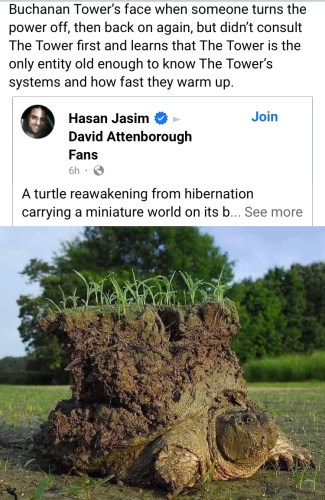
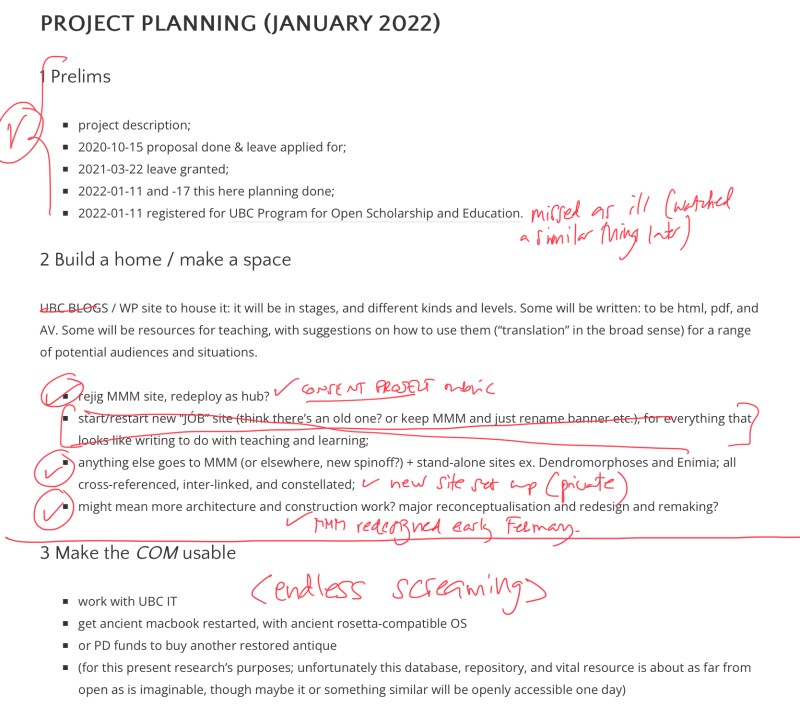
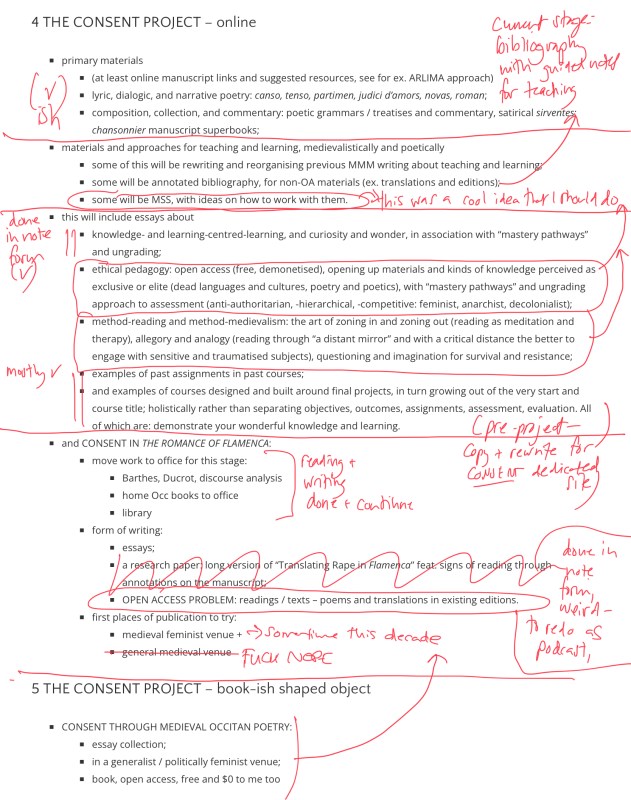
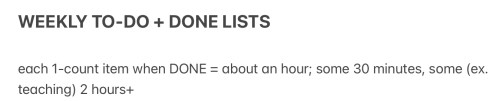
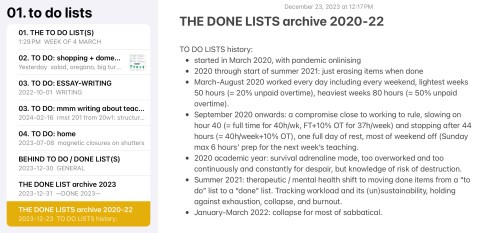
But I don’t remember much of that time. I kept “to do” and “done” lists, which will look familiar to anyone who lives with mental health conditions (or, as I like to think of it, “a brain”). Here is an explanatory note and two examples:
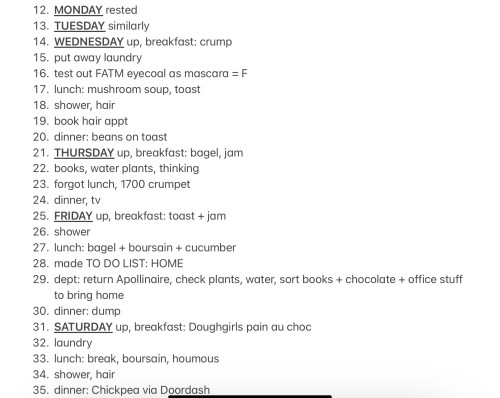
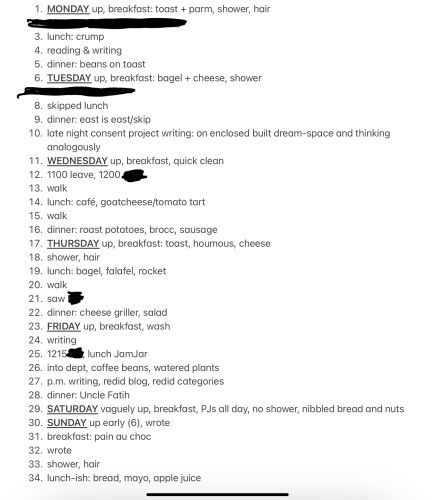
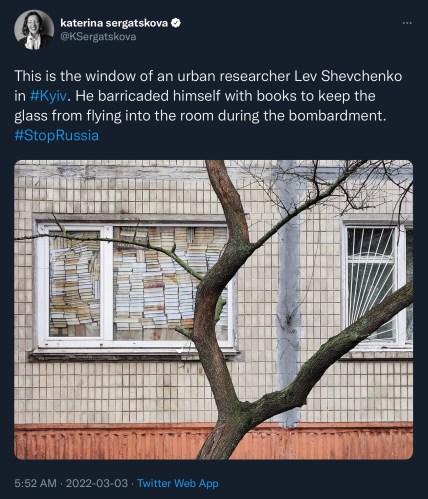
Sabbatical part 2, February-April 2022
My brain started to wake up. I think that watching lots of zombie movies and series was part of this; there will also be project writing, later, about zombies and consent. I moved books around, as a first step of reading. I wrote about that as part of the project, as it’s part of the process / methodology. I moved books to my office, and moved them around there. I started reading.
Then Russia invaded Ukraine.
How do you think about anything else when that happens? How can you read or write or think about anything else, let alone “your” thing, or at all? (And of course there are all the other wars and idiocies and climate catastrophies local and global and and and.) Why read, write, think, or be? What’s the point? Not just what’s the point of abstruse academic stuff; but – at all. So sabbatical time was punctuated by moments of despair. Moments suspended regular time. Time out of time, time out of joint, in a temporality already weirded by sabbatical irregularity. Moments could be minutes or slipstreamed days. Slumping back into January’s haziness, now a haze of gloom, spreading deepening overwhelming.
And yet, a time and a haze punctuated by rage.
How angry can you get, when your brain has only just started waking up and working properly again and when you have time to think for the first time in years, with stupid men doing their stupid manly thing of making war? But I did read; not on the project reading list, deviating to what then was more urgent.
I read contemporary poetry.
Ilya Kaminsky, especially.
There is nothing more urgent than poetry.
There is nothing that matters more than poetry. There is nothing that matters less than poetry. And so I wrote, because my writing didn’t matter. Most of my writing from February and March is bad poetry. There’s about 3000 lines on how and why I bite my nails and destroy my finger-tips, present and past. That’s not going into a formal report nor into The Consent Project, though it is about consent: it’s too personal, rough, raw. On St Patrick’s Day I scalded my writing hand and wrote, badly, about the stages that the wounds went through. That did reduce nail-biting for a while; an odd episode, for symbolic appropriateness, as around St Brigid’s day was when I was maximally productive for official project purposes: for example, website work (aligning with a project explicit objective).
So what is there to show for that time? Reading done. Thinking started, done, doing. The writing that is readiest for others’ reading: by accident, that which is most immediate and applicable currently, about consent in work, wellbeing, and life.

My principal achievement produced during sabbatical: I got back into thinking and reading and writing. The first step was crashing for about a month. There was sleep, too. My body forced me to stop and rest. I had been overworking, sometimes dramatically so, and under stress. I don’t want to say “I was stressed” as I had no active agency; it was reaction to external conditions. I rediscovered that I had a body around the same time that I rediscovered that I had a mind, and that they were connected. There was perimenopause too, whose start date is uncertain as monthly cycles had been perturbed and my hair misbehaving for several years, during which I’d not investigated causes and sought medical advice as I assumed it was “all just stress.” The official date for the start of menopause “proper,” celebrating 52 unbleeding weeks, my M-Day is the day after sabbatical ended: the 1st of May, a May Day that used to be red and green, that still has red in the background but that now feels more generally green. A green of hope, desire for peace, and spring growth.
Like many people, I had had problems with reading during the first stages of the pandemic. I read less in those two years than I did in the last two weeks. Once I started being able to read again, in February 2022, everything improved. I am a reading creature; it’s been part of me all my conscious life, my earliest infant memories are visual, and I started to read in the sense of doing things with written words before kindergarten (childhood hyperlexia). I am most grateful to UBC for granting me this leave because it enabled a return to reading; then reading helped thinking, and that realisation that, for this individual organism, reading and mind and body are inextricably interconnected, as seen most clearly when zoning out spiralling in a vicious or virtuous cycle.
Unfortunately I’ve had a patchy next two years of maintaining that reading-mind-body connection and its necessary time for reading and thinking: new anxieties and stressors, but that’s another story, and not for here, and better managed this past month. Given that time for reading and thinking contribute to my work—indirectly, like they do for everyone; directly, for university teaching and learning—I would advocate for that time to be an integral part of the regular working week. (I’m writing this on a Sunday.) They are, sort of, for research and educational leadership faculty; teaching faculty have 4 months in 7 years (or rather, might have, conditional on an application’s acceptance), one month a year without any teaching duties, and one month of annual vacation leave. One could redistribute that month through the year as regular reading-and-writing days; that would be one day per week in the winter session teaching terms, plus a few days that could be a week of holiday, and no reading-and-writing days when teaching in summer session. But that’s not the point of annual vacation leave: it’s supposed to be for vacation. I might enjoy reading and writing and thinking, and they might be good for me and relaxing in their own way, but they’re vocational not vacational.
Our university needs to look, and think, seriously about how it acknowledges and resources intellectual work: because that is what reading and thinking (and writing) are. In the literate thinking humanities, anyway, which are and always have been the centre of a university, and central to what it means to be a university.
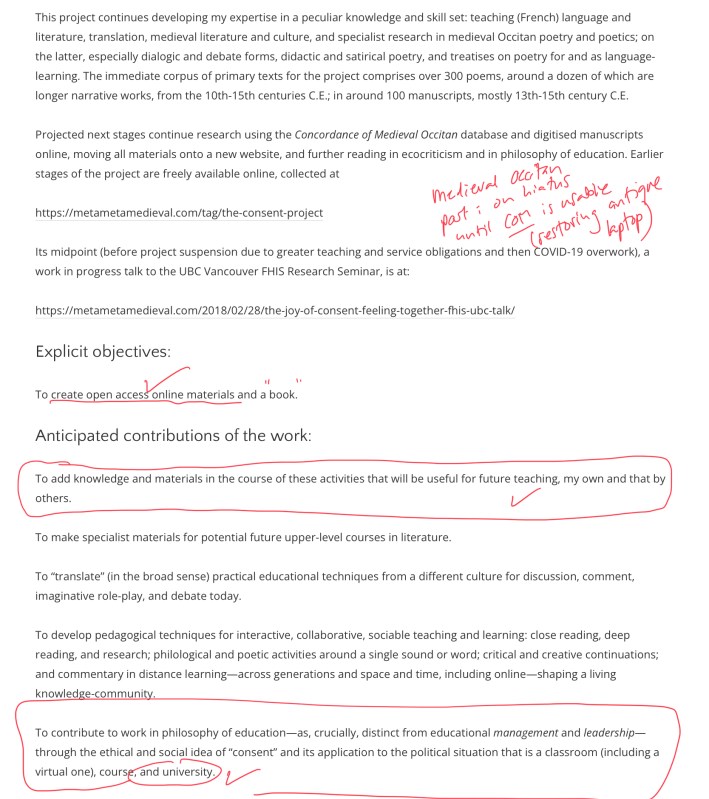
I thought about this while sabbaticalising, and talked and wrote about it in October 2022: “Being human: intellectual life, balance, being in time and space (FHIS Graduate Workshop on mental health and academic productivity).” That fulfils two categories in the original project’s Anticipated Contributions: (1) To add knowledge and materials in the course of these activities that will be useful for future teaching, my own and that by others. (2) To contribute to work in philosophy of education—as, crucially, distinct from educational management and leadership—through the ethical and social idea of “consent” and its application to the political situation that is a classroom (including a virtual one), course, and university.
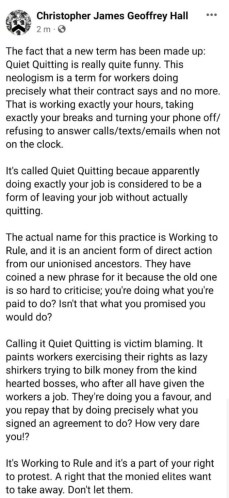
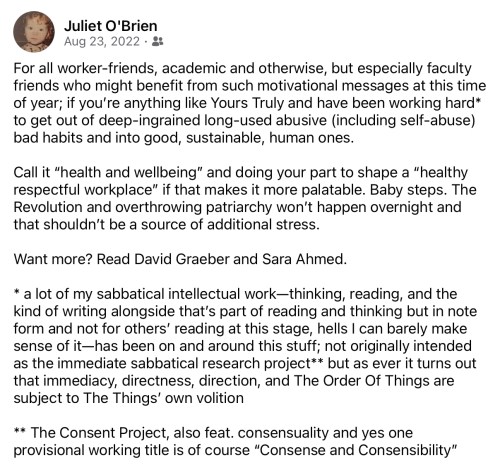
From August 2022, here’s another tangible deliverable product for this sabbatical, also known as “professional development leave”: working to rule, more or less.
The HR and salaries part of WorkDay assums a 40-hour week plus up to 10% unpaid overtime (roughly; I forget whether it’s 44 or 45 hours, and I don’t want to go and look as that means dealing with WorkDay and I’m willing to do all sorts of things that are technically “work-work” outside regular working hours BUT NOT THAT). One or two days off per week. It’s not yet 8-8-8, we’ve a lot of work to do to “catch up with” the creative thinking about labour of two centuries ago and, institutionally and culturally, we’ve a lot to learn about other ways of being human in time; dovetailing ideally with our university’s strategic plans, with decolonising and Indigenising the curriculum, and with a core (academic) mission where we’re also a living lab for innovation and sustainability.
How about working on systemic and social justice, right here right now, as an example for our city, province, and world?
Sabbatical project: thinking about what a sabbatical is
The astute reader will have observed that I’ve been calling this thing a “sabbatical,” whereas my employers call it “professional development leave.” As the latter is what I applied for, I ought to explain what these two things are and how what I did with my four months is both of these things.
A sabbatical is semantically and etymologically related to “sabbath”; it is a year of rest every seventh year.
3Six years thou shalt sow thy field and six years thou shalt prune thy vineyard, and shalt gather the fruits thereof: 4But in the seventh year there shall be a sabbath to the land, of the resting of the Lord: thou shalt not sow thy field, nor prune thy vineyard. 5What the ground shall bring forth of itself, thou shalt not reap: neither shalt thou gather the grapes of the firstfruits as a vintage: for it is a year of rest to the land
Douay-Rheims Bible, Leviticus 25:3-5
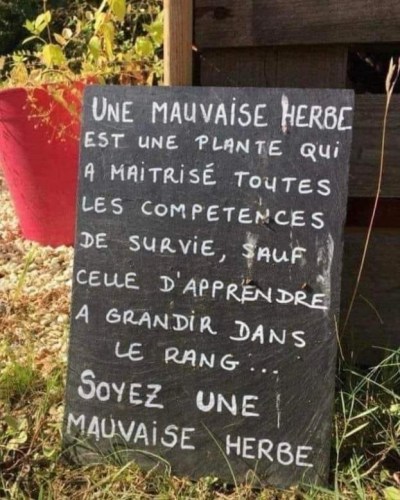
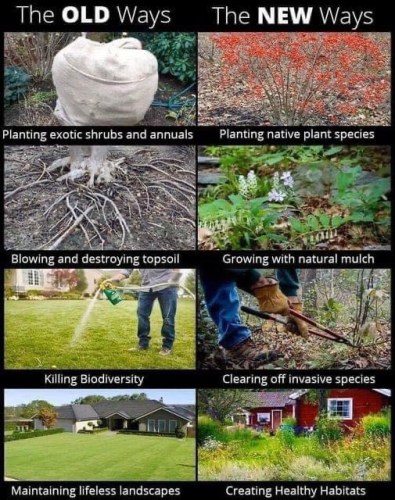
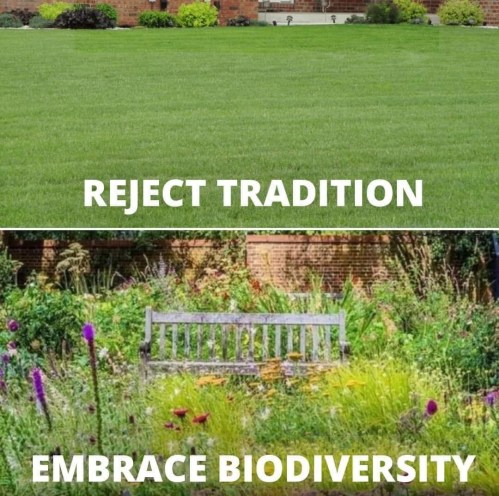
A sabbatical is a time of pause, of leaving a place to its own devices, for rest and recovery, for replenishing the soil. It is part of a “normal” regular natural cycle, for crop rotation and biodiversity. When sabbaticalising, fallow fields and humans alike might look overgrown with weeds, wild, maybe a bit scrubby and scruffy, bits dying off dessicated rotting. We might look like we need to be cut back, our wounds and scars might be more obvious, we might look grim. Leave us alone. What you don’t see: everything below the surface, in the soil, the seeds and germs of new growth, the other species who’ve moved in to join the ecosystem.
Fallowness should look different, and it should make you question your perception of what you see at the surface, remembering that there’s a below-the-surface in fields that aren’t fallow, and in land that isn’t fields. Fallow fields should also make you look again and think carefully about productivity, growth, and neat tidy mega-mono-cultures.
I persist, despite HR verbiage to the contrary, on calling Spring 2021 a “sabbatical.” Why is the other—official—term problematic? Well, it’s based on organisational admininstrative structures to do with work that divide human resources—you, me—into (1) work time and (2) non-work time. (The invisible (3) “life” is fortunately left alone.) (2) Non-work time is leave. Leave is subdivided in turn into reasons for the leave: leave for what purpose? Other options include “medical” (paid, I think up to a point, depending) and “personal” (unpaid, depending). Leave has to have a purpose. My application had to have “explicit objectives.”
An unforeseen result of that leave was: I changed from thinking of “Professional Development Leave” as an aberration, perversion, and obscenity; to thinking of it as a translation of a root idea shared by both terms.
You are away from your regular business (in its true sense, your occupation, what occupies you). You are developping, be that self-development or, less arrogantly, with and through the help and input of others—people, reading, ideas—who “resource” you, who add nutrients to the ground that holds you, who feed the “source” of underground water springs, your literal “well being.” And what’s happening is to do with your profession and with a being a professional: in the sense of reconnecting with your radical professionalism, when you translate the p-word from a generic (assumptive invasive neocolonial) non- and anti-university commercialised sense, to the sense that is at the root and source of being an academic.
Professional development leave brings you back to the roots of radical professionalism: thought itself. I had time and space for thought. It was not part of the sabbatical / PDL plan to think about what a sabbatical / PDL was, but it happened because I’m someone who thinks about words; this is one kind of philology. My re-member-ing myself as a human was also remembering that I was, and am, a philologist. Realising that I had forgotten, and why: overwork, exhaustion, burnout, depression, despair. It was quite the cogito moment, thinking about thinking, and rediscovering thereby that I still had a mind.
The main thing that I did during the sabbatical that is an explicit outcome and quantifiable: books read (including reread, but all rereading is reading, and all good reading implies multiple and continued future rereading…) Here they are, along with notebooks in the bottom right-hand corner.
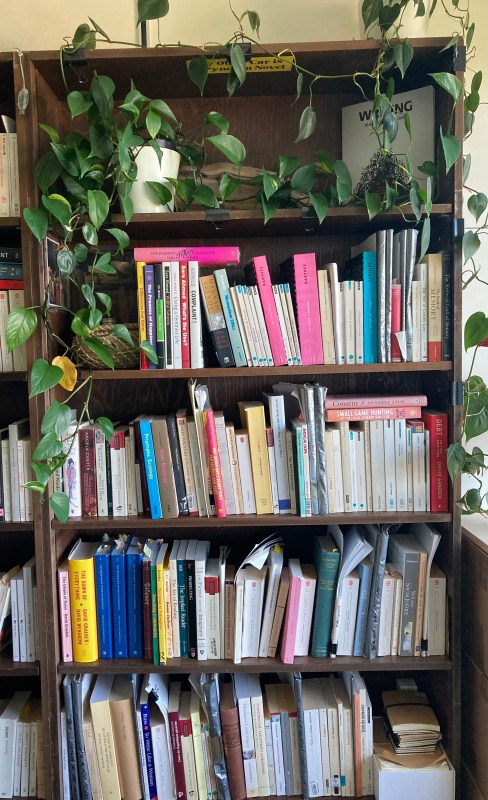
More Consent Project books and notes are on my desk, as well as the 3000-line nail-biting poem, because they overlap with material for a short story about weasels (not part of the sabbatical work, but part of The Dendromorphoses project).
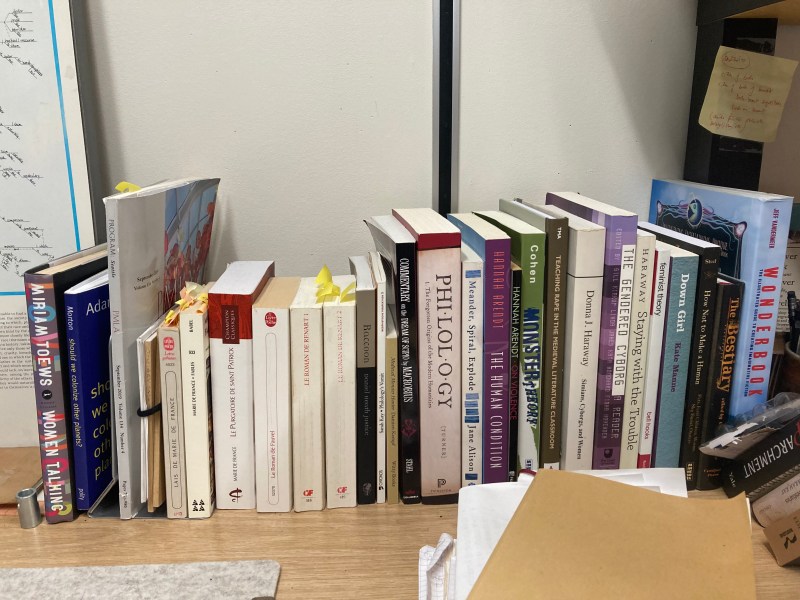
Sabbatical project: rewilding
Reading Jeff VanderMeer has helped in becoming comfortable with what might to others be uncomfortable: Wonderbook (pictured above) alongside Dead Astronauts for strange narrative and time, weird voices, alien ways of thinking, wild writing.
My own discomfort: thinking, reading, and reconnecting these two things resulted in rewilding myself.
I like writing. It can be hard. Today it’s easy: I got up, half-asleep half-dreaming, I started writing (in the bathroom), I wrote all morning, took a break, then spent the afternoon and evening transcribing from notebook to here, splicing in bits and pieces from Facebook and images. What helps is letting the writing (a.k.a. thinking) do its thing, not trying to direct and control it. What that means is: not trying to write like I’m “supposed to.” On approved topics and texts. In the right way. At the right time (so, yes, Sunday morning; but with practical limits, so not while teaching, and I carry a notebook and can make ‘phone audio notes if the need arises). In the right form, for approved forms of publication. I write badly. I’ve done approved forms, except for monographs / The Book; I’ve known myself for long enough, and known book-writers well enough for long enough, to know that I can’t do that (in its present socio-culturally acceptable shape), it’s beyond me.
Essays, yes, in the Make Montaigne Great Again mode, in all its assaying wild humanity. Short stories, yes, and that’s been the last three years’ writing, off and on and around and about. Poetry, yes, sort of: prose poetry, short stories, and creative non-fiction with line breaks and structured stanzaically, that feels natural and comfortable. But it has to flow, and to flow it has to be wild, even if that means it’s bad (for any given sense of the word, and queered and ironic “bads”), and it takes on forms and takes its time in unpredictable unexpected ways. Fot that is where the real stuff happens, the creativity and imagination #necessary to #producing #innovation.
The vital ingredient? Consent.
Prior, informed, free consent. Writing might be “bad” but it will be “good” to and for me if it’s not subject to external authoritative constraint, to direction of content and form, to pressure on quantified production. I’m not going to write Proper Articles in Approved Journals in The Scholarship of Teaching and Learning. I’m not going to write research articles for research journals in medieval studies and literary criticism. I’m certainly not going to write an academic monograph. I might hope to write a small beautiful gem of a poem that resists, persists, and perdures; fragile, barely surviving delicately in a marginal corner of something bigger; something like the Tomida femina (on which see “The consolation and living magic of old poetry” from October 2018). Is that too much? It feels like an arrogance, outrecuidance, over-reach; if I’ve learned anything from the sabbatical time and its reading, if I now know anything more about consent: let your writing do its own thing. It is only “yours” if you are also “its.” The two of you are a relationship and that means parity, understanding, mutual aid and mutual respect, and consent.
A sabbatical leaves fields fallow, to wildness. After a sabbatical, a field has learned and grown from its exposure to wilding, and the wild is still there, even if it has to hide somewhat. In the next springs, who know what will appear above the surface, and who knows what’s going on underneath and what mycorrhizae are up to; they’re the real deep “development” of a professional development leave (along with, and associated with, “sources” and nourishing resourcing to your “well being”). This here today is a fresh spring shoot. Others are unknown mysteries, they might be marvels or monsters; that’s the sleeping beauty.
Epilogue
Screenshot of the original application, annotated:
Screenshots of my outrageously over-ambitious planning on a rare “up” day in mid-January 2022: