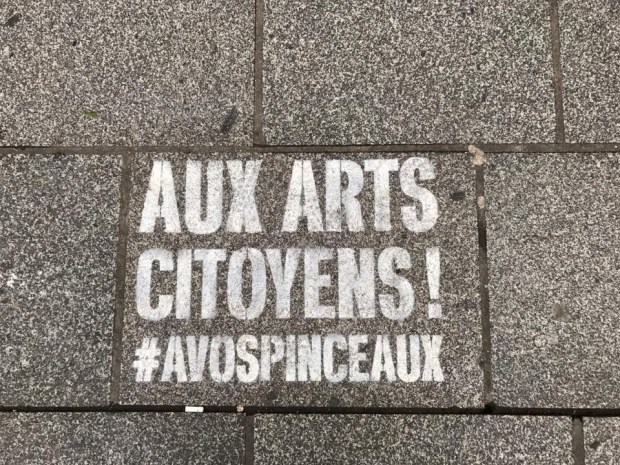
IMAGES
The first part of my summer reading report is a shared album:
https://www.icloud.com/sharedalbum/#B1tGfnH8tp6lNb
WORDS
Summer “reading-reading” started out alongside, but moved from being unrelated, to a counterpoint, into entwining.
SF summer reading included short stories of a directly AI slant:
- Elizabeth Bear – in The Best of Elizabeth Bear (Subterranean Press, 2020)
- “Tideline”
- “Okay, Glory”
- “Dolly”
- “Erase, erase, erase”
- Sarah Pinsker – in Sooner or Later Everything Falls Into the Sea: Stories (Small Beer Press, 2019)
- “The low hum of her”
Read from a certain angle, Marguerite Yourcenar’s Mémoires d’Hadrien (Plon, 1951; Gallimard, 1974) depicts a luxurious version of education — personal tutors, secretaries, etc. — even for a Roman emperor; and companions in livelong learning, books and the bookish and more animated, associated with imperial travels and “work-work” for a life of intellect, meditation, and melancholy asceticism … with an uncomfortable jostling of sensitivity, cruelty, and unfeeling coldness; of humanism and inhumanity. The discomfort feels familiar from other-world SF dealing with the alien / divine: e.gg. N.K. Jemisin’s Inheritance Trilogy, Tanith Lee’s Tales from the Flat Earth, Charlie Stross’s Laundry Files novels, the works of Adrian Tchaikovsky and Jeff VanderMeer and Octavia E. Butler, and 19th-20th c. capitalist-extractive-colonialist-imperialist vampires.
Hadrien‘s most problematic educational exemplarity is that of Antinoüs. Sculpted into the perfect living doll, deified, literary immortality centuries later; transcending humanity. Fellow academic colleagues: Be careful what you wish for, in this lesson on pedagogy, when engineering and training your own unnatural offspring of artificially-generated and -generating intelligences: remembering Galatea, Rousseau’s Julie, Villiers de L’Isle-Adam’s future Eve, Mary Shelley’s Frankenstein’s monster, Bella Baxter in Poor Things …
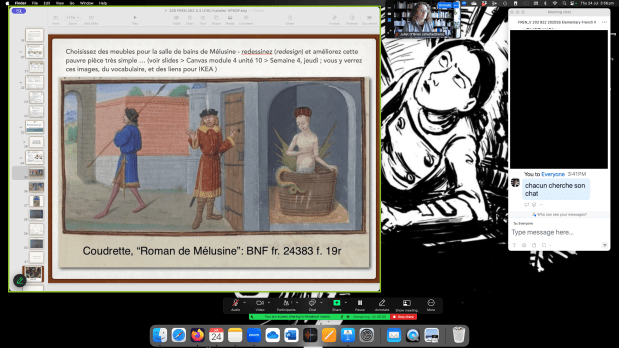
Teaching (July-August) brought in another early SF cautionary tale. Mélusine, 14th-c. CE French. Imagining mythical beings and monsters, considering human/inhuman/monstrous divides, and their interactions’ offspring and potential cyber or posthuman inheritance and future. Imagining other past worlds and possible future ones was the immediate task at hand: researching online and writing and speaking in French, redesign a nicer bathroom for Mélusine. Its context: a course, therefore with GenAI and other digital tools lurking in the background, and their pedagogically and cognitively constructive use or destructive abuse; the more so when a course is online. After a moment in class caught my eye and I captured the whole screen, and on later reflection: I see an eloquent image of our teaching and learning now. Consider this allegory of the day. What (if any) is the true monstrosity in that moment? Who’s the real monster? What does it mean to be monstrous anyway? Should it be negatively loaded, or perceived as a fixed binary either/or state? Where do we draw moral, ethical, social, and political lines; how; why? What lessons can the histories and stories of other worlds teach us, for analogical future reference and capacious imagineering?
In one layer or dimension of the virtual environment of my teaching backdrop, Ada Lovelace is inside the difference engine, from Sidney Padua’s 2DGoggles. Although this has been “my” wallpaper since 2009, Lovelace’s facial expression is a nice tl;dr quick version of how I felt about all that summer reading that accompanied teaching work.
Should you need some respite from ever more of the same old stuff about GenAI, perhaps you might wish to try the thrilling adventures of Lovelace and Babbage instead. Much more fun, beautiful, and educational than the rest of this post.
Otherwise: next, then, is a curated collection of links to readings, mostly in reverse chronological order. Compiled as a simple browser reading list and retrieved 2025-08-28. Includes some videos for light relief. (Sort of. They’re heavy.)
“You can choose to use AI to learn, or you can choose to use AI to avoid learning.” Intent Amplified: A new philosophy course on how to use AI critically and responsibly. Gus Skorburg (University of Guelph), Moving Things Around, 2025-08-19; and 2025-08-28, Return on Investment: A better “AI short-circuits learning” argument: “As many teachers are preparing their introductory lectures, here’s a better argument for AI short-circuiting learning. As always, I give some examples of how to use AI to support rather than supplant thinking.” Via Justin Weinberg, Daily Nous 2025-08-21. The series will be continuing …
AI and Assessment in Arts (UBC): “this guide offers some practical strategies for adapting your assessments in response to widespread student AI use. Rather than prescribing a single approach, we present options you can choose from based on your teaching context and comfort level.” Via which:
– AI in Education: “a resource for students, built by students, to provide ways you can use generative artificial intelligence productively and responsibly as part of your learning journey in university.” University of Sydney, retrieved 2025-08-27.
– AI for Educators: similarly, but by educators for educators (University of Sydney).
Can AIs suffer? Big tech and users grapple with one of most unsettling questions of our times. As first AI-led rights advocacy group is founded, industry is divided on whether models are, or can be, sentient. Robert Booth, The Guardian 2025-08-26.
Teen killed himself after ‘months of encouragement from ChatGPT’, lawsuit claims. Open AI to change way it responds to users in mental distress as parents of Adam Raine allege bot not safe. Robert Booth, The Guardian 2025-08-27; and the lawsuit and the OpenAI response
Do AI Companies Actually Care About America? “Democratic AI” is great branding for the Trump era. Matteo Wong, The Atlantic 2025-08-25.
The AI Doomers Are Getting Doomier. The industry’s apocalyptic voices are becoming more panicked—and harder to dismiss. Matteo Wong, The Atlantic 2025-08-21.
AI IS A MASS-DELUSION EVENT Three years in, one of AI’s enduring impacts is to make people feel like they’re losing it. Charlie Warzel, The Atlantic, 2025-08-18.
You don’t need an AI policy — you need two. Victor Kumar (Boston University), Daily Nous 2025-08-26.
From the Teen Vogue series about ChatGPT:
– H&M Is Tapping AI Models. Here’s Why It Could Be Problematic If beauty standards were unrealistic before, just wait until they are actually unreal. Alyssa Hardy, 2025-03-27.
– AI Therapy? How Teens Are Using Chatbots for Mental Health and Eating Disorder Recovery. Mallary Tenore Tarpley 2025-05-01.
– 72% of Teens Are Turning to AI For Companionship. Fortesa Latifi 2025-07-25.
– How ChatGPT Could Be Making Your OCD Worse. Anna Rogers 2025-07-16.
– ChatGPT Is Everywhere — Why Aren’t We Talking About Its Environmental Costs? In this op-ed, politics editor Lex McMenamin explains why using AI to search “how to be sustainable” could be accomplishing the opposite. 2025-05-07.
YOUR GOVERNMENT-ASSIGNED LIFE COACH. Dre Koval, McSweeney’s Internet Tendency 2025-07-07.
Barbara Graziosi (Princeton University) 2025-07-16: ‘The ancient world was just as big and interesting as the modern world. There were many languages, traditions and ideas that are still worthy of study today. Human traces, however, get lost to history as time marches on. Manuscripts and papyri miss pieces, fade and deteriorate, becoming ever harder to comprehend and translate for the present. The humanistic quest to retrieve meaning from the past took Barbara Graziosi right across campus. Barbara Graziosi, the Ewing Professor of Greek Language and Literature, worked closely with colleagues in mathematics, computer science, classics and the humanities, to develop new methods to restore ancient texts in order to understand them. “They help us understand the different ways we can live, as human beings, on this earth – and the many ways we make meaning and beauty out of the experience,” Graziosi said.’
“The Myth of the Useless Humanist” vs “Humanities myths, busted”: a letter to colleagues.” Jeffrey Cohen, Future Lost Archive 2025-08-16.
Developer survey shows trust in AI coding tools is falling as usage rises “AI solutions that are almost right, but not quite” lead to more debugging work. Samuel Axon, Ars Technica 2025-07-31.
STAND.earth petition: “Join the growing chorus of voices demanding that AI data centers run around the clock on renewable energy and benefit the communities where they’re located. Petition text to: Microsoft, Google, Amazon, and other tech giants. The growth of the AI sector cannot come at the expense of healthy communities and a stable climate. We, the undersigned, demand that, as a start, your company commits to ensuring that any new AI data centers run on renewable energy around the clock and that all existing data centers transition to 100% renewable energy no later than 2030.”
Will AI outsmart human intelligence? Geoffrey Hinton / recorded at The Royal Institution, 2025-05-30. Tech headlines in the last couple of years have been dominated by Artificial Intelligence. But what do we actually mean by intelligence? What has AI learned from biological intelligence, and how do they still differ? Acclaimed computer scientist, and winner of the 2024 Nobel Prize in Physics, Geoffrey Hinton will examine the similarities and differences between artificial and biological intelligence, following his decades of ground-breaking work which has enabled the neural networks of today. — Geoffrey Hinton is Professor Emeritus at the University of Toronto, and a world renowned expert in the field of deep learning. He is often referred to as the “Godfather of AI”, and in 2024 was jointly awarded the Nobel Prize in Physics “for foundational discoveries and inventions that enable machine learning with artificial neural networks”. He is a fellow of the Royal Society and the Royal Society of Canada, and has been recognised with many awards around the world including the Turing Award, the Royal Society Royal Medal, and Dickson Prize. Hinton received a BA in Experimental Psychology from the University of Cambridge in 1970 and his PhD in Artificial Intelligence from the University of Edinburgh in 1978. Following postdoctoral work at Sussex University and the University of California San Diego, he joined the Computer Science department at Carnegie Mellon University, before moving to the Department of Computer Science at the University of Toronto in 1987. He set up the Gatsby Computational Neuroscience Unit at University College London before becoming University Professor in Toronto in 2006 and latterly University Professor Emeritus. Since 2017, Hinton has been Chief Scientific Advisor at the Vector Institute in Toronto.
A language model built for the public good MACHINE LEARNING INNOVATION & INDUSTRY ETH Zurich and EPFL will release a large language model (LLM) developed on public infrastructure. Trained on the “Alps” supercomputer at the Swiss National Supercomputing Centre (CSCS), the new LLM marks a milestone in open-source AI and multilingual excellence. Florian Meyer & Mélissa Anchisi (ETH Zurich) 2025-07-09.
Quality of scientific papers questioned as academics ‘overwhelmed’ by the millions published This article is more than 1 month old Widespread mockery of AI-generated rat with giant penis in one paper brings problem to public attention. Ian Sample, The Guardian 2025-07-13.
The case for making art when the world is on fire. Amie McNee / TEDxManchester 2025-03-07.
(Related, not directly, but listing it here anyway as it’s good reading) Feminist Pedagogy for Teaching Online. Ed. Jacquelyne Thoni Howard, Enilda Romero-Hall, Clare Daniel, Niya Bond, and Liv Newman; Athabasca University Press, June 2025. “Instructors across higher education require inspiring and practical resources for creating, adapting to, and enhancing, online teaching and learning spaces. Faculty need to build collaborative, equitable and trusting online learning communities. This edited volume examines the experiences that interdisciplinary and global feminist educators have had—both their successes and their challenges—in infusing feminist pedagogical tenets into their online teaching and learning practices. Contributors consider how to promote connection, reflexivity, and embodiment; build equity, cooperation, and co-education; and create cultures of care in the online classroom. They also interrogate knowledge production, social inequality, and power. By (re)imagining feminist pedagogy as a much-needed tool and providing practical advice for using digital technology to enact these tenets in the classroom, this collection will empower educators and learners alike.” (Read online or download the PDF or buy it at this link.)
UBC CTLT Edubytes newsletter, 2025-06. “This month, our guest editor is Rich Tape, programmer analyst at the Centre for Teaching, Learning and Technology. He presents the LLM Sandbox, a Large Language Model service designed to help UBC faculty experiment with GenAI in their courses.”
[The rest of the list from here onwards / downwards is less pretty as I’ve not tidied its formatting to natch throughout. Right now, however, I need to preserve my hands: they are required for building Canvas courses over the next week …]
Using AI to predict breast cancer and personalize care MIT/MGH’s image-based deep learning model can predict breast cancer up to five years in advance. Adam Conner-Simons and Rachel Gordon | CSAIL Publication Date: May 7, 2019
There’s no simple solution to universities’ AI worries. Josh Freeman, Prof Paul Johnson and Prof Robert McColl Millar respond to a letter on tackling the use of artificial intelligence by students. The Guardian 2025-06-23.
– the letter: Universities face a reckoning on ChatGPT cheats. Dr Craig Reeves says some institutions don’t seem interested in dealing with the problem of AI use by students and are resisting in-person assessments. 2025-06-17.
– re: Revealed: Thousands of UK university students caught cheating using AI. Guardian investigation finds almost 7,000 proven cases of cheating – and experts says these are tip of the iceberg. Michael Goodier, The Guardian 2025-06-15.
Harvard Business Review > AI and machine learning series:
– What Gets Measured, AI Will Automate; by Christian Catalini, Jane Wu and Kevin Zhang. June 19, 2025
– Recalculating the Costs and Benefits of Gen AI; by Mark Mortensen. June 23, 2025.
MIT Technology Review > Artificial Intelligence series:
– The problem with AI agents: we’re starting to give AI agents real autonomy, and we’re not prepared for what could happen next; by Grace Huckins. June 12, 2025.
Before You Trust That TikTok Doctor, Make Sure They’re Real. Cristina POPOV, Bitdefender 2025-06-18.
“Your Brain on ChatGPT: Accumulation of Cognitive Debt when Using an AI Assistant for Essay Writing Task”△ Nataliya Kosmyna 1 MIT Media Lab Cambridge, MA Eugene Hauptmann MIT Cambridge, MA Ye Tong Yuan Wellesley College Wellesley, MA Jessica Situ MIT Cambridge, MA Xian-Hao Liao Mass. College of Art and Design (MassArt) Boston, MA Ashly Vivian Beresnitzky MIT Cambridge, MA Iris Braunstein MIT Cambridge, MA Pattie Maes MIT Media Lab Cambridge, MA; arXiv preprint, via MIT Media Lab 2025-06-10
Some university professors say AI is here to stay, so students should learn how to use it JOE FRIESEN POSTSECONDARY EDUCATION REPORTER, The Globe and Mail JUNE 2, 2025 (yes, this sort of thing is why I subscribe to Teen Vogue and Lightspeed Magazine and The Tyee instead)
UBC CTLT Generative AI summer events and archives (this is what got me reading; and thinking about GenAI alongside summer reading)
Irina Dumitrescu, The Process: creative living in a distracted age:
– The world is in chaos. It’s time to make your art. But you have to make it yourself. FEB 01, 2025
– What makes me mad about AI in education. How to crush a generation and tell them they’re winning. MAY 08, 2025
– How to read more in 11 easy steps. An idiosyncratic to-do list. MAY 17, 2025
“Diabolus Ex Machina This Is Not An Essay” Everything Is A Wave, AMANDA GUINZBURG. JUN 01, 2025: “Presented to you in the form of unedited screenshots, the following is a ‘conversation’ I had with Chat GPT upon asking whether it could help me choose several of my own essays to link in a query letter I intended to send to an agent. What ultimately transpired is the closest thing to a personal episode of Black Mirror I hope to experience in this lifetime.” …
Teachers Are Not OK. Jason Koebler, 404 media podcast · JUN 2, 2025: AI, ChatGPT, and LLMs “have absolutely blown up what I try to accomplish with my teaching.”
“The blur in the corner of your eye.” Sarah Pinsker, Uncanny Magazine issue 29, July/August 2019.
Le temps de la lecture, avec Sylvia Minne fondatrice de “Reading Wild”. La Beautaniste, 2022-01-24.
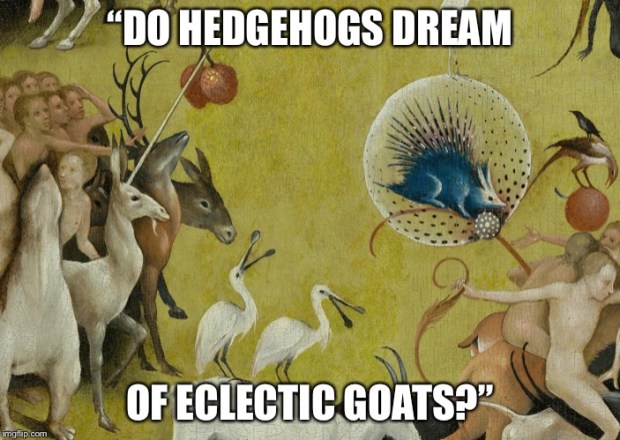
(Image above: hand-crafted meme, made by me … without AI … but with collaborators unconsenting as dead; Hieronymus Bosch, Philip K. Dick; 2019-05-09, first posted on Tw**ter 2018-10-03 in comment on a @boschbot automated tw*t.)
 Juliet O’Brien