
”Make Necromancy an Art Again”
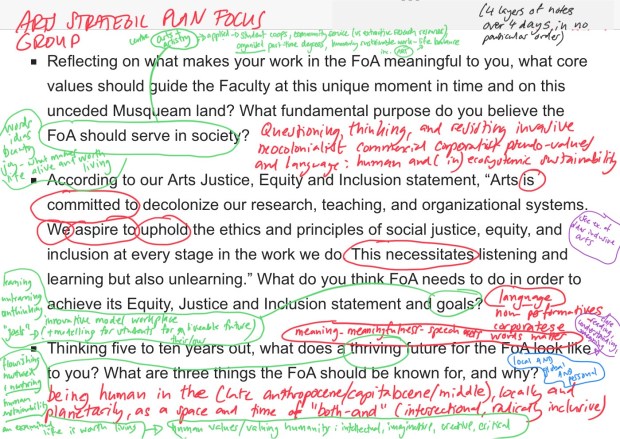
Core values

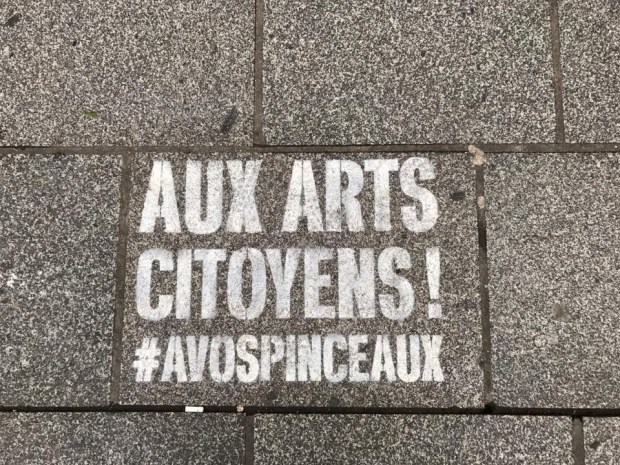






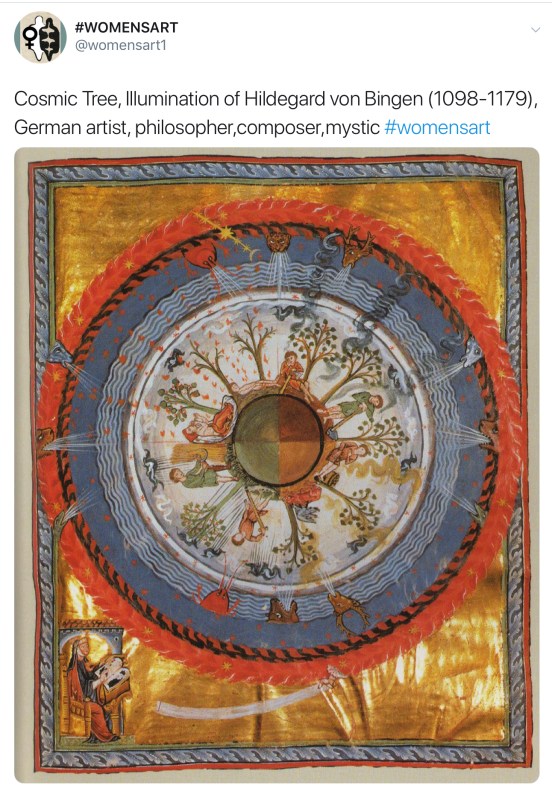
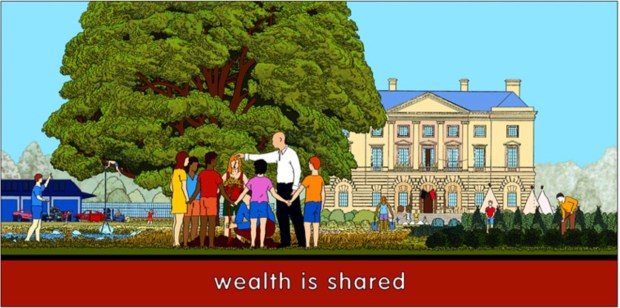
















Some suggestions for motivational mottos:
- ars artis gratia
- ars poetica (just kidding)
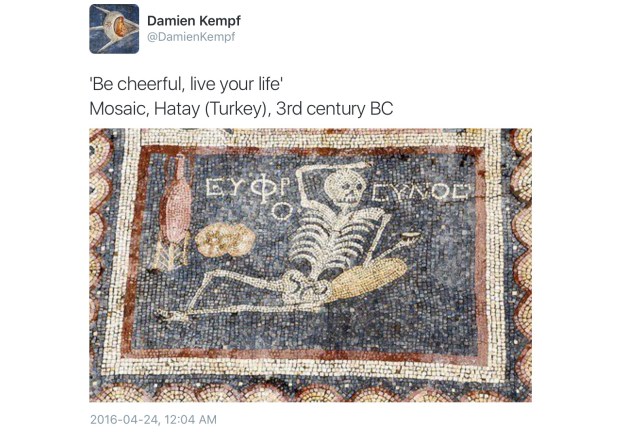
- vive ut vivas (very seriously)
- vivat, crescat, floreat (because what better foil to #LiveLaughLove than the convivial, companionable, collegial, communitarian, comic spirit of adelphic Goliardic student culture)
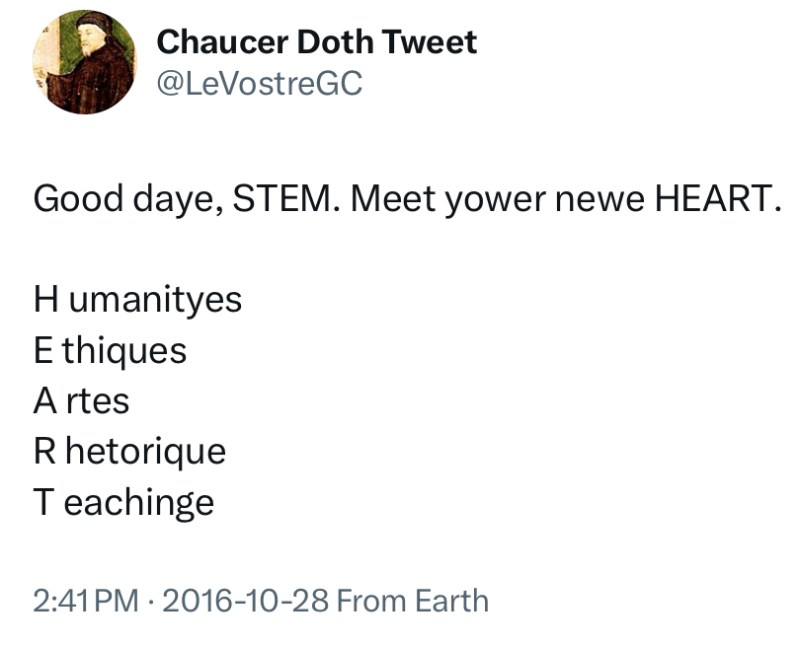
A selection of utterly impractical and therefore useless antique non-strategic idea-plans:
- notes on the liberal arts (October 2015)
- university undergraduate liberal arts education is #AntiFascistSFF (August 2017)
- notes towards a utopia (April 2017)

Fundamental purpose
“Vivere est cogitare”?
Cicero’s “philosophia est ars vitae,” oft quoted and ever decontextualised, sounds like it would be another perfect motto for the literate thinking humanities and the imaginative and creative arts, but it’s usually quoted out of context, and here too its decontextualisation and recontextualisation would run contrary to its sense; it would be good to think, through that section of text, about how medicine, thinking and the examined life, meaningfulness, and wellbeing intertwine, humanly inextricably humanly.
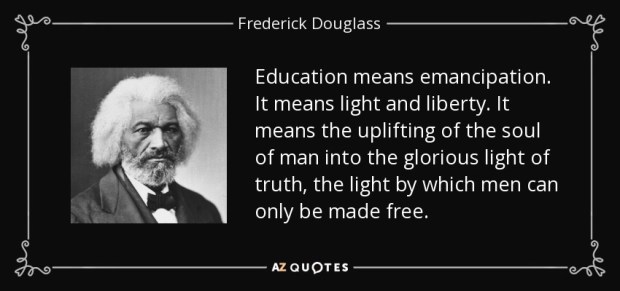
I’ve been preaching the gospel of a liberal arts education being an undergraduate university education for some time; as part of an art of life and life of art; as a medieval, postmedieval, anti-modern emancipation and decolonisation. During what were strange historical times here at UBC and on this continent, I taught a course, a strange course, in our then Medieval Studies program (September-December 2016):
- MDVL 301A: Medieval European Literature of the 5th to the 14th centuries
(taught in English with original languages included for comparison; texts read and worked on in original or English depending on student programme and degree requirements)
“THE LIBERAL ARTS” @ UBC Blogs
From around that time (2015-18), here’s a curated collection of my old ramblings and witterings, twitchings and twitterings, on the place formerly known as twitter*:
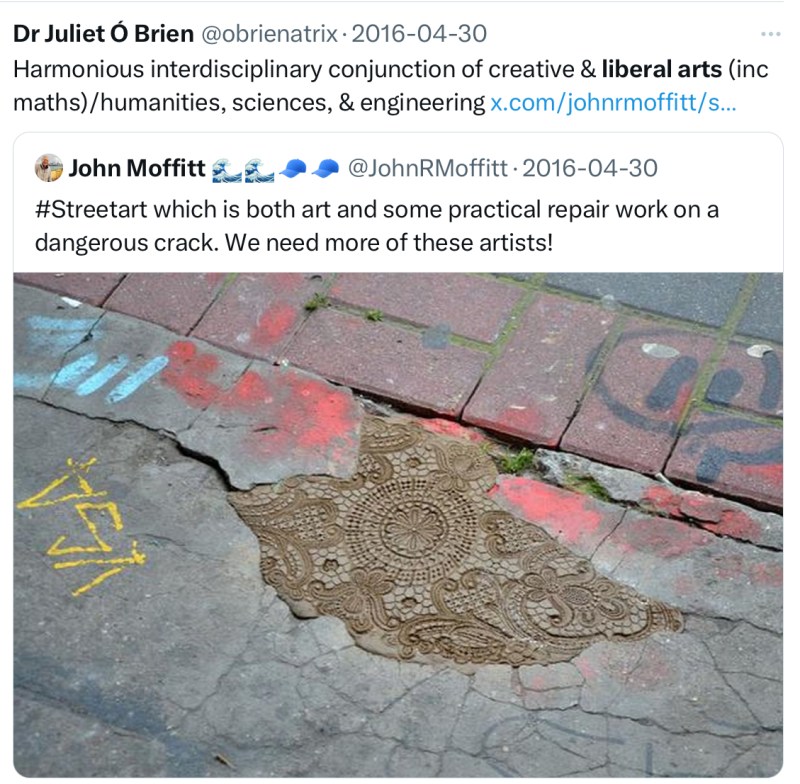
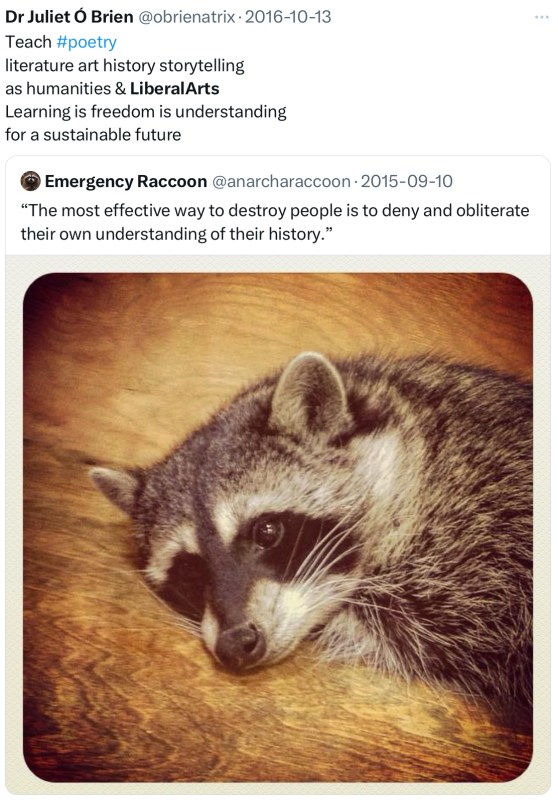
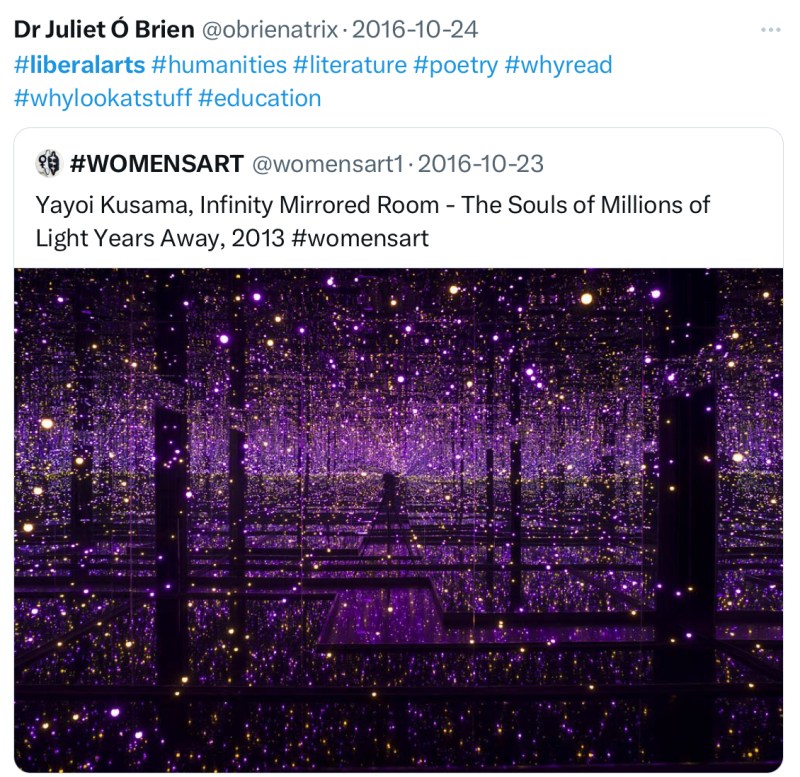
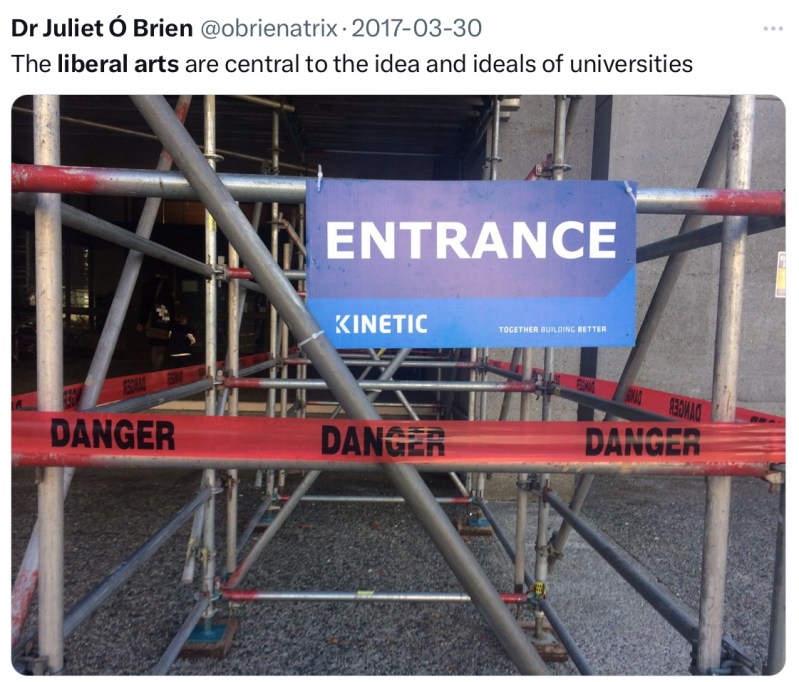

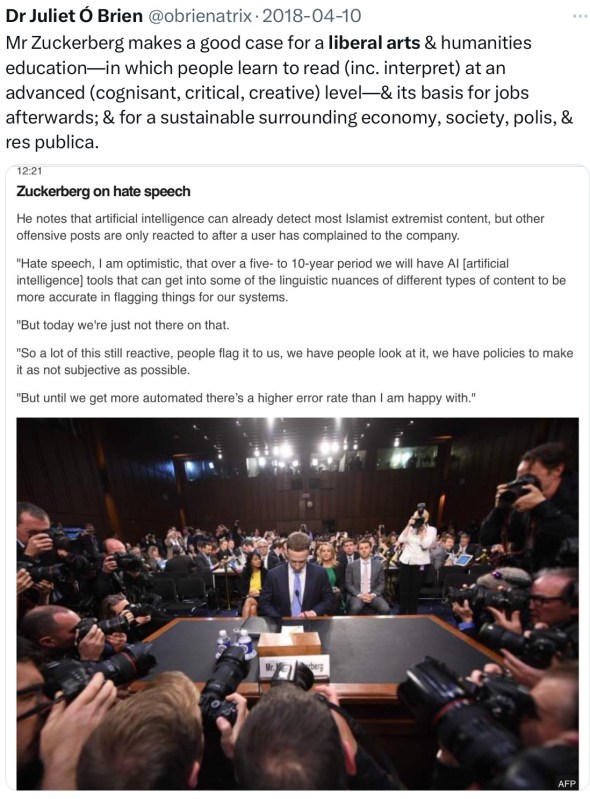
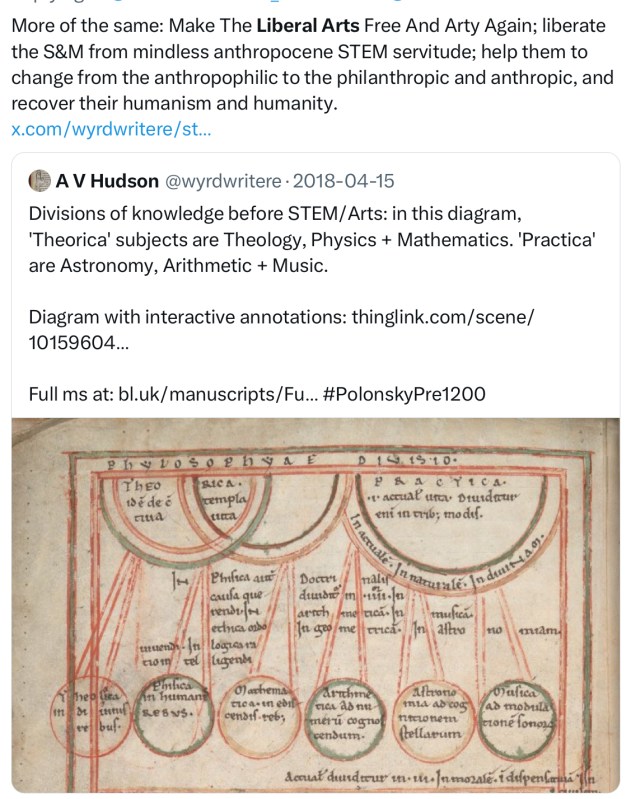
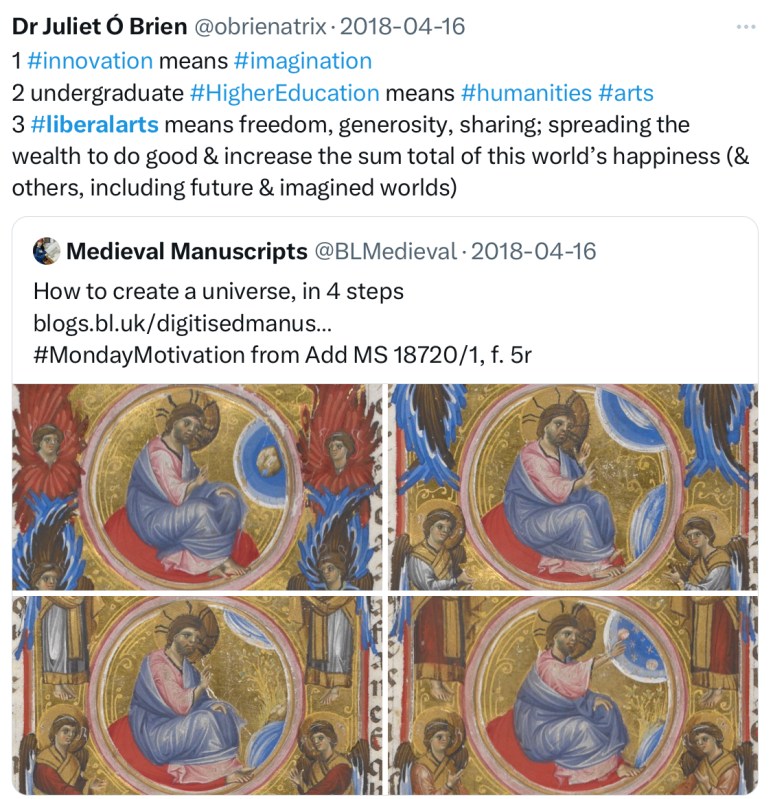
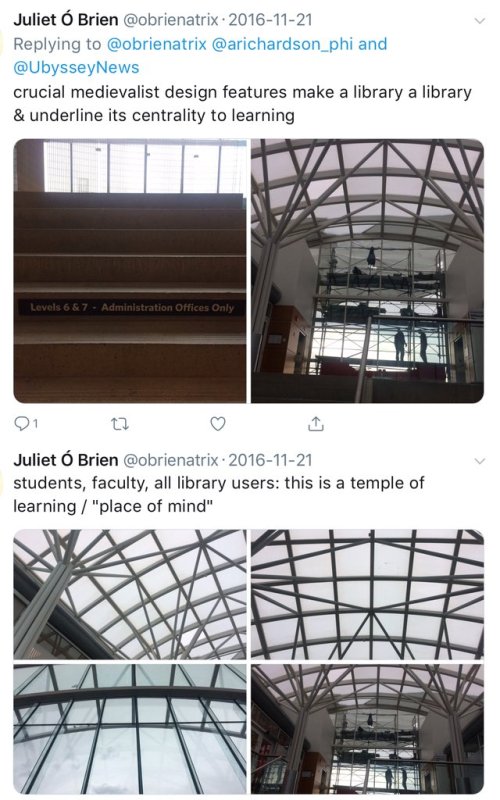
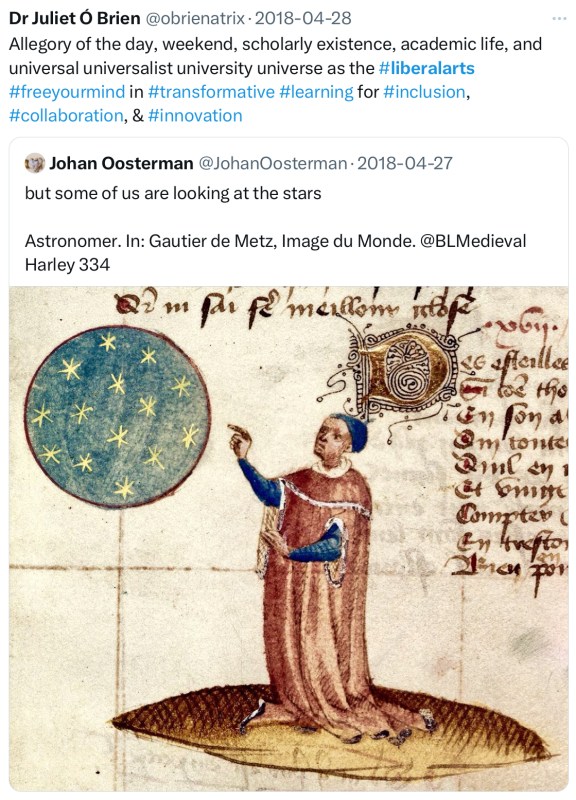
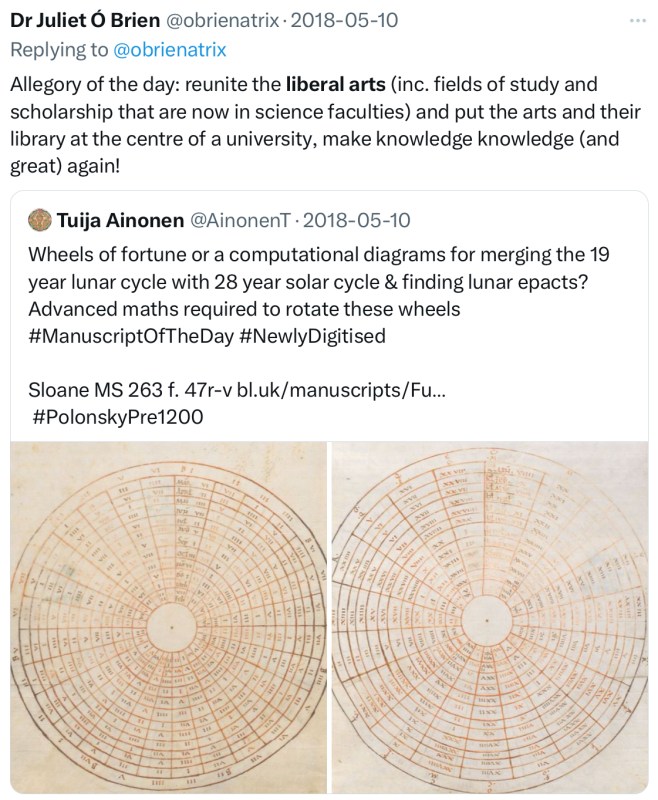
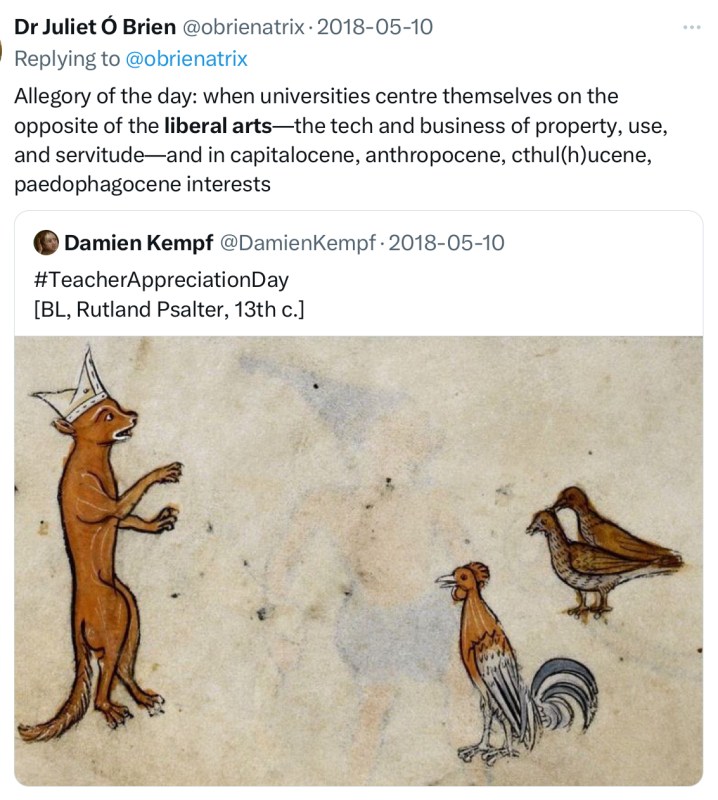

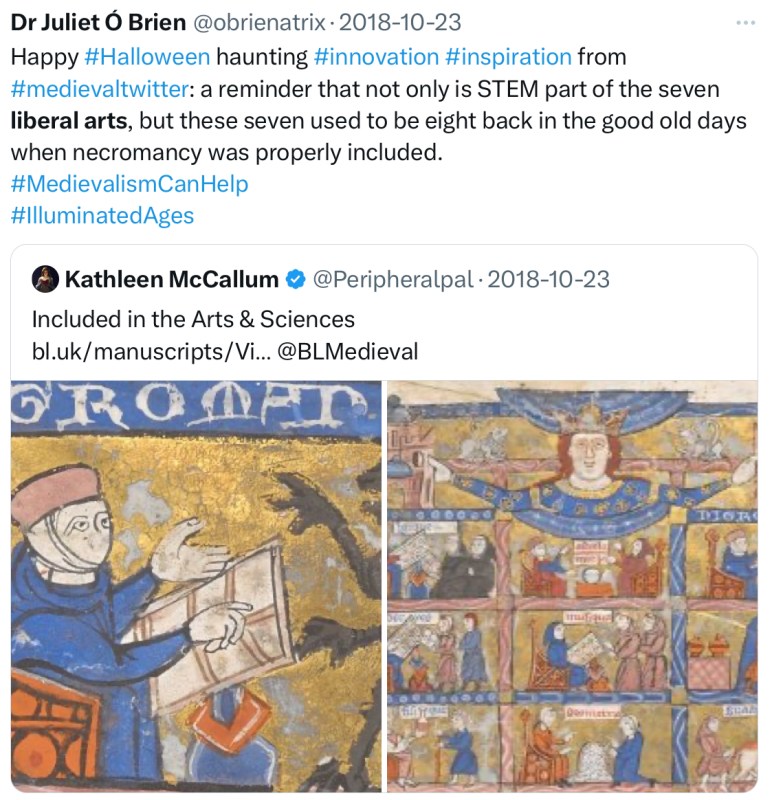
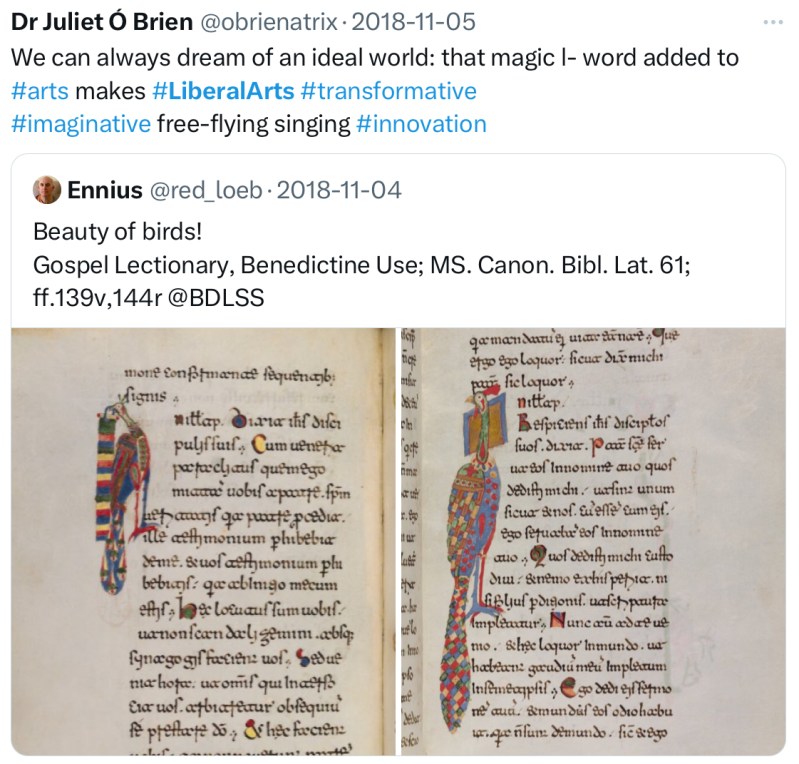
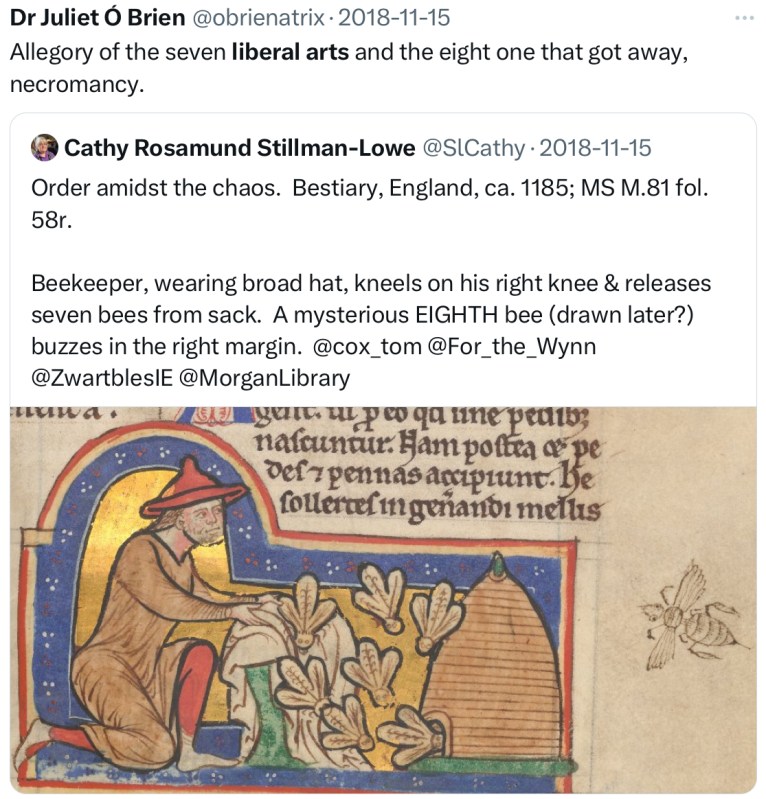
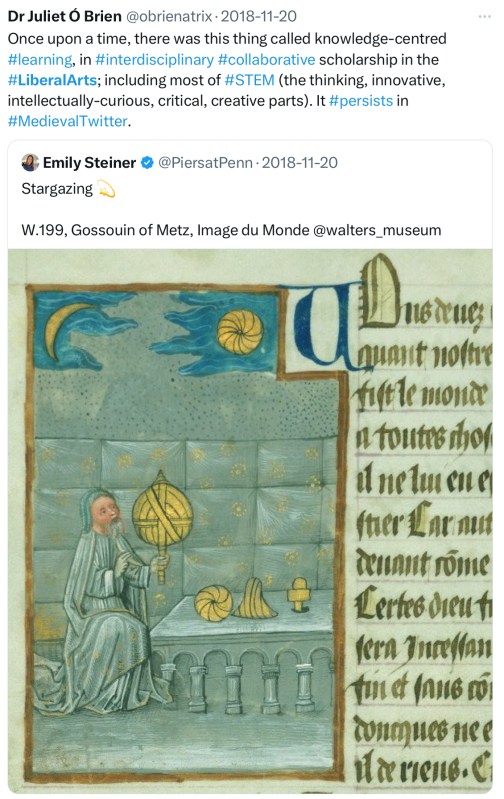

* back when it was good and valuable, a comfort and haven, a place of virtual mind, equitable and diverse and inclusive, support for marginalised communities, free, an online open society … but I digress; alas, what a loss.
Goals for a thriving future
Ten ideas for translating “core values” and “fundamental purpose” into practical “goals” for a “thriving future”, formulated as Learning Outcomes:
- Undo the vicious cycle of poverty, cost of living (starting with housing and food), and overwork; as a priority goal of long-term equitable inclusive sustainability
- Address the root cause of malady—like any good practitioner of the ars vitae, a.k.a. medicine—before spending more money and other resources on more and yet more and ever more para- and non-academic support services for corporatised pseudo-thriving; related elephant in the room, “On textbooks, midterm blues, and other truths of social justice” (October 2017)
- Freeze fee increases, campaign for increased public funding—this is a public university, and a public good—to support undergraduate and graduate students: so that they can focus on learning, without also at the same time having to work to live (and also: any and all student work should be structured with studies, ideally an entangled harmonious part of them: co-ops, internships, labs and library / archive and research assistantships, sandwich degrees, organised part-time degrees with sponsors)
- Make fees scaled and income-linked, with zero fees for as many students as possible
- Bring back zero fees for PhD students: as I recall this was a thing at UBC when I first arrived here (to work, as Arts faculty), and is no longer the case
- Move from loans to grants
- Move from a “market rates” neoliberal profiteering economic model to one that’s decolonised and anti-(neo-)colonialist
- Provide accommodation on campus and environs for all registered students and their dependents; this to be subsidised and its cost linked to cost of living; so that all students can live dignified independent adult lives (including in community, with friends, in a supportive environment; but not a “choice” of grimness, debt, or family)
- Do something constructive about the for-profit destructive wings and satellites of our university (starting with student housing and UBC Properties Trust)
- Subsidise food on campus, and vary it to accommodate students as people with tastes (which are also needs, for humans, we are not interchangeable mechanical units of productivity): see the last part—“the food problem”—of “an idea” (March 2011); for a more recent example in The Ubyssey’s 2024 (un)limited magazine, “The missing ingredient: how culturally-relevant food access supports student wellbeing,” by Tova Gaster and Mahin A. Alam and photo by Zoe Wagner
Listening, learning, unlearning, and a meaningful (work-)life worth living
Three last things, appended here at the end as it seems from my time here that they would be an optional extra and luxury beyond our wildest imaginings, an antique obsolescent redundancy, and therefore appendicial:
1: QUIET
- As fundamental learning conditions, for thinking and reading and writing, for teaching and research, for their conjunction for a whole learnèd community of students and faculty;
- As part of sustainability and environmentalism (and physical and mental health): stop noise pollution, including leaf-blowers and beeping reversing vehicles; limit construction noise, to levels suitable for the work of thought (rather than for a workplace that’s a construction site);
- In an ideal world: one day a week free of noise (perhaps overlapping with “time” below), which should not be a weekend day of rest, as that is outwith a humane regular working week;
- A quiet “minds at work” zone with no motorised vehicle access (other than accessibility vehicles like the shuttle) and designated “slow” channels (protecting pedestrians who might look like they’re zoned out, but are in the zone) during regular working hours;
- Related: “Academic work, peace, harmony, and goodwill to all” (March 2017) and this piece on peace and quiet; creative (at the same time practical) ideas on improving quiet on campus in the second half of “research days, featuring bonus innovation” (May 2015) and “innovation: how to improve beeping reversing trucks” (September 2015); mindful of why quiet might be dangerous and an organisational threat, as it might lead to thinking: “clarity and transparency” (February 2016).
2: TIME
- Dedicated reserved time, in which no teaching or administrative meetings should be scheduled, that is reserved for intellectualising: talks, work in progress colloquia, and plain simple hanging out (with kvetching and bitching and gossiping, culturally intersectional feminist rather than in an old-boy-club way);
- Bring back the Wall Centre Ideas Lounge as a “place of mind,” or the room at the bottom of Buchanan Tower (this had been an idea about 10 years ago, in one of the never-ending phases of its reconstruction), open all day with keycode access for faculty and staff, with honour-code coffee, tea, and snacks;
- Related: “inhuman lacks of resources” (November 2014) and “innovations (4-5)” (February 2014, also about food).
3: SPACE
- A proper decent functional research library:
- with open shelf access, ideally reference-only and limited in-library reserve use (like Cambridge UL, add a marker in a book that you’re reading there and you can keep reading it at your reading-station for up to 3 days), footfall / use measured by numbers of entries (not by borrowing);
- in quiet and stillness, enforcing a rule of silence (it’s 2024, you can communicate silently using electronic devices), a place for reading quietly including separate equipped rooms for listening and watching as this is “reading” in the full arts and humanities and human sense;
- rid of small rooms reserved for individual and small group “study” and the floors and floors—most of our library space—of non-academic financial and executive administrative occupation and para-academic CTLT, who could move into the UBC Life building and to the South Campus storage facility, so that the most central academically-active campus space is prioritised for academic work, and to facilitate the return of books to our main arts and humanities libraries (Koerner and IKB), noting with interest that Koerner “was originally intended to be Phase I of a new Central Library; eventually, Main Library was re-built as the Irving K. Barber Learning Centre instead” (UBC Walter C. Koerner Library archives);
- keeping some areas as open “unquiet” space, to be entirely furnished with comfortable adaptable multipurpose furniture like divans and ottomans, for eating and napping too, as an intermediate space located between the quiet library and a cafe.
- Classrooms adequate for our teaching:
- designed with priority to input from front-line university workers, the people who actually actively teach in the arts and humanities—externally-imposed conditions affect, direct, impede, and control teaching; and teaching style is part of faculty academic freedom—and from people who have to be there for hours doing the learning: see “learning environments” (July 2019) on our classrooms’ inadequacy … which hasn’t changed since then, if anything it’s worsened with ever fewer boards around a room, student gaze ever more directed in one direction and an unwittiningly ironic opposite of decolonising, Indigenising, and unlearning approaches to any education let alone a university one in the Arts;
- and please can we burn those stupid flip-table things and rethink seating, from the bottom up, in a humanly-sustainable fashion, conducive to health and wellbeing, and offering welcome and comfort to all as a matter of equity, diversity, and inclusion? see for example “innovations (1-3)” (February 2014) for some alternatives and ideas …
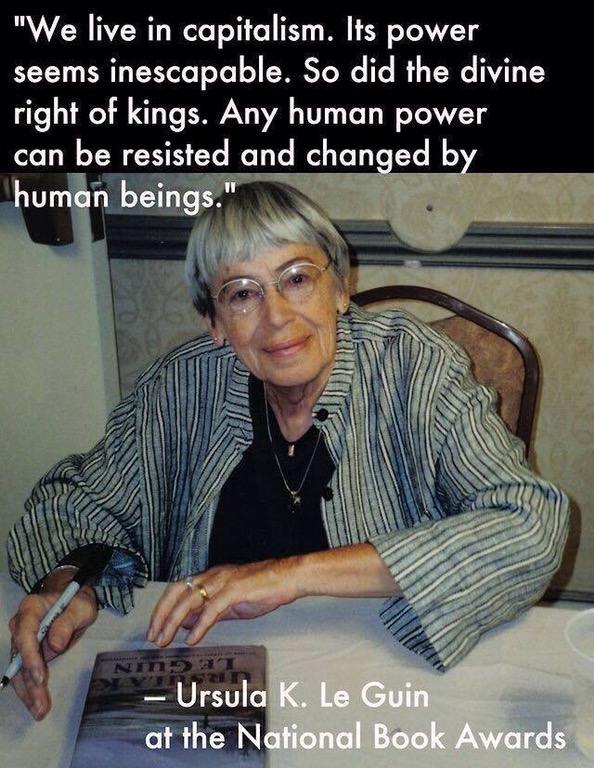
Last words from a related Koerner:
 Juliet O’Brien