This is a slightly more up-to-date version of the old outils utiles (2010). It was a version of my original 2003 curated collection of resources, and revised in turn through 2012-23: FREN 101 (ARCHIVE, 2013-18), FREN 102 (ARCHIVE, 2013-18), FREN 101 & 102 (2018-19, up to the March-April 2020 COVID-19 onlinising “pivot”), and UBC Canvas course sites (2020-24, access restricted to UBC Vancouver students taking these courses). These reference resources are primarily intended for university French language classes from CEFR levels A1 to B2; there’s some overlap with resources at the C1 level, for writing in French about literature (2017 version here). Thanks to JB, a student from summer 2023’s FREN 202 (CEFR A2) who asked for a version that’s available and accessible in the longer term: long live free open knowledge, mutual aid, and sustainability!
1. Listening & watching (click to expand/contract full details)
Some free resources online, in no particular order …
AUDIO
- Linguno Good for practice! You can also select your level (A1, A2, etc.)
- Duolingo
- TV5 MONDE:
- TV5 Monde – Apprendre le français: lots of audio and video here, with options of selecting level, topic, etc.
- TV5 MONDE: free French radio and TV online
- RFI (Radio France International):
- le journal en français facile The news in slower slightly simplified French. You can use this as a podcast or follow along with the transcript too.
- RFI : apprendre et enseigner le français
- Radio-Canada: free radio and TV online (this is CBC in French)
- HERE AT UBC ❤️: Kafou Muzik @ CiTR 101.9 FM (UBC student radio): monthly, music of the Francophone world, with my colleague Dr Antje Ziethen, archived at https://www.citr.ca/radio/kafou-muzik/episodes/
- Because I am geeky and nerdy, I like things like this (general, grad-level, and specialist new knowledge): https://europe.tv5monde.com/en/tv-guide/entertainment/merci-professeur-Season-8-679576 which is also on YouTube, look up < tv5 merci professeur cerquiglini > and you’ll find more of him
- Not strictly podcasts or for language learning, but for fun I listen to talks/lectures at the Collège de France: https://www.college-de-france.fr/fr/audiovisuel; find out more about this curious institution, for example, here: https://en.wikipedia.org/wiki/Coll%C3%A8ge_de_France
- Bibliothèque nationale de France (BNF) > Fonds sonores = audio archives of song, speech,
- Tennessee Bob’s Famous French Links: a classic, one of the largest and oldest supersites in the world, for all things French and Francophone: including links to radio and TV online, great for music all over the world
VIDEO & MOVIES
- Office national du film du Canada (National Film Board of Canada): over 5000 free movies
- Radio-Canada: free radio and TV online (this is CBC in French)
- Arte: European culture and public service TV channel (in French, also in German; based jointly mainly in France and Germany; read more about it …); also their YouTube channel
- YouTube : watch videos in French on anything that you’re interested in or working on! Music, fashion, experiments, documentaries, children’s TV. Some recommendations:
- 5 Rue Sésame = Sesame Street
- Les Schtroumpfs = the Smurfs
- Les Moomins / Moumines = the Moomins
- (ancient programme from when I was a kid) L’île aux enfants
- … and anything that you watched when you were a kid (and perhaps still do), cartoons, etc.
- Tennessee Bob’s Famous French Links: a classic, one of the largest and oldest supersites in the world, for all things French and Francophone: including links to radio and TV online, great for music all over the world
- Free classic movies in French online:
- a selection: “Mini festival de cinéma français d’il y a un siècle,” curated by me in March 2020
- OpenCulture has many movies in French, and from Francophone directors, that are free
- Internet Archive
- UbuWebLinks to an external site.
- la BNF (Bibliothèque nationale de France):
- https://www.youtube.com/user/BibliothequeBnF/videos
- https://gallica.bnf.fr/html/und/videos/cinema-et-audiovisuel?mode=desktop
- https://gallica.bnf.fr/html/und/videos/theatre?mode=desktop
- https://gallica.bnf.fr/services/engine/search/sru?operation=searchRetrieve&exactSearch=false&collapsing=true&version=1.2&query=(gallica%20all%20%22thème%20:%20cinéma%22%20and%20dc.publisher%20all%20%22CNDP%22%20)%20%20and%20(dc.type%20all%20%22video%22)&suggest=10&lang=FR
- Netflix (not free):
- some TV and movies in French
- you can also change the language (dubbed) and subtitles to French on many shows
- if you watch Netflix using Chrome, rather than in the app: Chrome Language Learning with Netflix Extension
- UBC Library has a good collection of films in French (free):
1. find out information about a film from IMdB and Wikipedia:
Wikipedia > list of films by country
Wikipedia > list of films by country of production
Wikipedia > list of French-language films
Wikipedia > list of French films (with sub-lists…)
2. look it up in the library catalogue
3. borrow it and watch it in the comfort of your own home or stream it or ask the library about streaming…
4. tip: the Videomatica collection - VIFF (Vancouver International Film Festival) at home
2. Pronunciation
Here is a very useful free, open, online collection of resources: 
Here are some basics from other sources on French pronunciation:
- http://french.about.com/od/pronunciation/a/beginningpronunciation.htm
- http://french.about.com/od/pronunciation/a/letters.htm
- http://apprendre.tv5monde.com/fr/search/site/Prononciation?f[0]=im_field_niveau%3A19
- http://www.frenchsounds.com/FSYouTubeLinks.html
Here are some general guides on pronunciation, on producing sounds in general (including sounds in French), from UBC’s eNunciate project. 
 They include (for many-to-most sounds) videos, animated video diagrams, instructions for producing the sound, and further links to yet more online materials:
  (image linked to eNunciate)
 (click on the image, eNunciate link opens in new tab)
***EXTRA FRENCH (PRONUNCIATION, VOCABULARY-BUILDING, PRACTICE)*** 
- Duolingo (free, and available as an excellent app)
- + listen to and watch as much in French as you can
On phonetics in general:
On French pronunciation and sounds (in French):
- http://phonetique.free.fr/
- Wikipedia (in French), “Phonétique française“
- http://www.lepointdufle.net/phonetique.htm

3. Sound atlas of French varieties in Canada = Atlas sonore des variétés de français au Canada
To hear #accents #francophones from around the country, navigate the Sound Atlas of French varieties in Canada! This tool helps to understand the diversity of #French spoken here. #LinguisticDiversity #FRcan University of British Columbia https://ow.ly/eicZ50Pf65z
(Drs Marie-Eve Bouchard and Amanda Cardoso, UBC Vancouver)
4. Gender in French, including inclusive French = le français inclusif
INTRODUCTION (for newcomers to this language): gender / le genre
- Grammatical gender in French:
- Everything—from apples to hamsters to physiotherapists to zoology, people and other living creatures and non-living things and abstractions, places, things, ideas, absolutely everything / every thing, all nouns—has a gender, masculine or feminine.
- This doesn’t necessarily have any other associations or anything to do with gender in actual life, lived experience, and social constructs. It’s a classification system, part of organising knowledge. Think of grammatical gender in French as a generalised structural category, as a matter of taxonomy and ontology. Like genus in biology and genre in literature and film and other creative media, grammatical “gender” is related to a shared linguistic and conceptual ancestor, the Latin gens = family; in turn a kinship relationship through sharing a common ancestor.
- ex. le chocolat = grammatically masculine
- Sometimes there’s a historical reason:
- the word that you see contains archaeological remains of older words and languages, including layers of languages with different category-systems for nouns where French has 2 categories; these older traces and roots are mostly Latin (5 declensions), also P-Celtic (probably 3), Greek (3) … and if you enjoy this kind of detective puzzle, welcome to historical linguistics!
- plus language contact through trade and other exchanges (including students and other scholars, and fashion and food), seasonal or longer-term movement for work, migration, war, exile, seeking refuge, travel … for example contacts in the 12th-15th centuries CE with contemporary Italian, Latin, Greek, Hebrew, Arabic, Persian, Armenian, Chinese, …
- and newer words imported from the 16th-21st centuries CE (from a large number and wide range of languages around the world), through colonialism (and continuing trade etc.): these words are usually masculine
- ex. le chocolat (from Nahuatl via Spanish, first attested in French around 1598)
- Neutral or inclusive gender is also used for people, as a matter of preference, courtesy, and respect: like in English
- depending on the situation, speaker, and context: also animals and other animate sentient life
- (but this does not apply to inanimate objects, like chocolate)
- The form that I use most often is iel/li
- for more see READINGS below, for ex. https://divergenres.org/wp-content/uploads/2021/04/guide-grammaireinclusive-final.pdf, p. 5-7 (pronouns) and p. 9-10 (adjectives, including occupations)
- ex. li professeuxe est françaixe, iel est françaixe
- for more see READINGS below, for ex. https://divergenres.org/wp-content/uploads/2021/04/guide-grammaireinclusive-final.pdf, p. 5-7 (pronouns) and p. 9-10 (adjectives, including occupations)
READINGS
Some further readings on inclusive pronouns:
- the Wikipedia article on grammatical gender in general: https://en.wikipedia.org/wiki/Grammatical_gender
- Divergenres, Guide de grammaire neutre et inclusive (2021, Québec): in French, with nice clear boxed explanations: https://divergenres.org/wp-content/uploads/2021/04/guide-grammaireinclusive-final.pdf
- Égale Canada – Fondation émergence, Grammaire neutre (2020, Ontario): https://egale.ca/wp-content/uploads/2020/06/French-Inclusive-Language-4.0.pdf
- —, French Style Guide (2023 live working document) with a glossary of inclusive language: https://egale.ca/awareness/french-style-guide/ with further resources on p. 4-5
- Guide de la terminologie liée à l’équité, la diversité et l’inclusion – Lexiques et vocabulaires – TERMIUM Plus® – Ressources du Portail linguistique du Canada – Canada.ca (noslangues-ourlanguages.gc.ca)
- For more about third or neutral other options: here are three sample resources, the last is more than a century old (by a philologist scholar) and in turn looks back to older predecessors … (the oldest neutral pronouns that I’ve met in French were from over 800 years ago)
5. Grammar
SOME RECOMMENDED GRAMMAR BOOKS
- (not free) A reference grammar with practice exercises:
- Sylvie Poisson-Quinton, La grammaire du français en 44 leçons et plus de 230 activités, niveau A1. (Paris: Éditions Maison des langues, 2014). ISBN 9788415640127
- Catherine Huor-Caumont et al, La grammaire du français en 44 leçons et plus de 220 activités, niveau A2. (Paris: Éditions Maison des langues, 2014). ISBN 9788415640134
- Patrick Guedon & Sylvie Poisson-Quinton, La grammaire du français en 40 leçons et 201 activités, niveau B1. (Paris: Éditions Maison des langues, 2013). ISBN 9788415640165
- Verbs and conjugating them:
- Bescherelle conjugaison (online, free) and its original printed book form, in any edition from 1980 onwards. This is the canonical French verb book.
- (not free) A reference grammar, with a few exercises, in English:
- Jacqueline Morton, English Grammar for Students of French, any edition (Ann Arbor: Olivia & Hill, 1st ed. 1979, current 7th ed. 2013).
EXPLANATIONS, EXAMPLES, & EXERCISES
- Linguno Good for practice! Select appropriate level, ex. A1 for beginners.
- Tex’s French Grammar: Carl Blyth, Karen Kelton, et al, University of Texas, Austin (explanations in English)

Some free online resources for reference and explanation, listing grammar terms and topics alphabetically (ex. adverbs, participles, past tenses, verbs):
- Index of French grammar and pronunciation glossary terms: Material mostly from the old French.about.com > now Thoughtco.com (explanations in English).
- Connectigramme: Clear but colourful, visually striking grammar explanations and further links; Henriette Gezundhajt, York University (explanations in French)
Some more free online resources for more grammar:
- French language guides to improve reading, writing, and comprehension skills for all levels; Thoughtco.com (explanations in English).
- Wikipedia, especially for looking up grammatical terms, starting with their French grammar page
- FHIS UBC Vimeo channel – Dr Anne Scott’s French grammar explanations (explanations in French).
MORE PRACTICE EXERCISES
- TV5 Monde: learning French (not just grammar), from the main French international TV channel > niveau A1 (débutant), A2 (élémentaire), etc.
- Le Point du FLE: Large online repository of more exercises; look for specific topics and for your level (A1, etc.).
- Tex’s French Grammar: “An online pedagogical reference grammar of the French language that combines authoritative grammar explanations, self-correcting exercises and online audio with surreal dialogues and cartoon images.” Carl Blyth, Karen Kelton, et al; University of Texas, Austin. Not aligned with DELF / CEFR, but still generally useful: for example, if you feel that you need a different angle of approach and more practice on a specific topic.
- REPSIT – À la découverte du monde francophone (University of Calgary).
MORE, AND MORE ADVANCED
- While these last items cover topics from A1 level upwards, the explanations are in French that is at approximately B1-B2 level:
- so that you can see a short classic synthesis representing French grammar as one whole thing: Le Grimoire, Lexique grammatical cursif; Pascal Michelucci, University of Toronto.
- The whole Grimoire includes grammar explanations and exercises—mostly at least at CEFR / DELF B2 level, so this is a site to bookmark if you are continuing with more French later—and a collection of literary texts
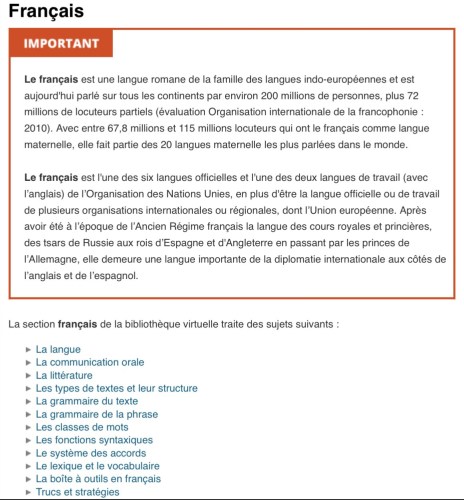
- Bibliothèque virtuelle Alloprof > le français provides an idea of the place of grammar within a language as a whole; Quebec: see especially la grammaire de la phrase, les classes de mots, les fonctions syntaxiques
- La langue française (Nicolas Le Roux et al.)
6. Dictionaries
FRENCH DICTIONARIES ONLINE
- Linguee
- French to and from English
- French to and from Bulgarian, Czech, Danish, Dutch, Estonian, Finnish, German, Greek, Hungarian, Italian, Latvian, Lithuanian, Maltese, Polish, Portuguese, Romanian, Slovak, Spanish, Swedish
- Chinese, Japanese, and Russian to and from English (from which you can then do an English—> French search)
- etc. …
- WordReference
- French to and from English and Spanish (but also several other languages to and from English)
- for French-English: based on the biggest bilingual dictionary in existence, Collins-Robert Super Senior (the WordReference database goes above and beyond it), and accompanied by excellent forums discussing issues of current usage, new words, etc.
- Lexilogos
- French to and from many, many, many languages, including Arabic (arabe), Chinese (chinois), Gujarati (goujarati), Japanese (japonais), Korean (coréen), Persian (perse), Urdu (ourdou)
- (as well as historical dicrionaries, older forms of French, and other older languages)
- Le Wiktionnaire
- big old solid dictionaries (like the TLF, linked directly further down) form its base, plus pronunciation (with audio clips), etymology, synonyms and antonyms, related words, translations cross-referring to Wiktionaries for other languages
- Reverso : anglais-français + conjugaison
- Larousse : français, synonymes, conjugaison
- Le Littré
- TLFi, Le Trésor de la langue française informatisé (via CNRTL, where you can also find other and older dictionaries)
- Traduction du français au français : dictionnaire franco-québécois (dufrancaisaufrancais.com)
—UN GUIDE LINGUISTIQUE FRANCO‑QUÉBÉCOIS
—Pour se comprendre entre francophones
—Le site Traduction du français au français se veut l’équivalent d’un petit guide linguistique. Sa particularité ? Celle de traduire du français au français, ou plus précisément du français du Québec au français de France. Il s’adresse autant aux Québécois qui voyagent en Europe qu’aux Français qui visitent le Québec.
MORE
- TV5 Monde has some dictionaries, as well as other resources about the French language
- Oxford Language Dictionaries ℅ UBC Library
- more links to dictionaries and other reference works c/o the Open Directory Project and Ask.com is often useful too
- For many-to-most languages: Google Translate usually includes a sound-file of pronunciation, examples of usage, and phonetic transcription. PLEASE NOTE THAT GOOGLE TRANSLATE IS NOT A DICTIONARY. It is of limited usefulness and reliability for beginners; the more context you provide, the more accurate it is. See further below in the next section, TRANSLATION ENGINES.
TRANSLATION ENGINES
Automated translation—of larger blocks of text, or indeed a whole text—is of limited usefulness for people who are actually actively learning a language and are in the beginner and intermediate stages, as this is a crucial time for learning how a language’s words—lexicon and semantics—do not map exactly onto words and meanings in your home language. It is also an important time for learning that new language’s grammar and syntax, how a language is structured, how it functions and what it is (in its own right, as a whole thing in itself, for us to work with respectfully rather than just something to instrumentalise and use).
That having been said, translation engines are a very useful supplement to the dictionaries above, for looking up words or phrases (for example, how to express a larger idea). Here is why, and how to make good use of translation engines. A simple search (ex. Google, Bing, Yahoo) for a single word will either provide you with a single answer (which is a top hit but not necessarily the right result for what you want to say) or a list of possible answers. If you’re a beginner, faced with a list of words in a language that is new to you, you have no way to know which of these results—be that a single word, or a list of options—because you don’t know enough of the language yet. So how do you check?
1. With any translation engine, provide as much context as possible: at least a sentence, ideally a whole paragraph. Even with engines providing a single top hit, this will help to nuance meaning.
2. As with any search / research, read all search results or as much as humanly possible (on a Google search, for example, by page 10-12 you should at least be starting to see patterns: repetitions, answers that seem more likely, answers that seem like outliers). If there are too many results and if there is no coherent pattern, refine your search. Do not rely on a general search engine’s ranking of results, as it has no necessary correlation with what you are looking for.
3. If in doubt, take the resuling translation (the full sentence or paragraph, NOT just one single word) and run it back through a translation engine into your original language. Does it still look like what you wanted to say?
4. If the resulting translation uses structures and tenses (and other verb conjugations) that you don’t know, please do not use them. Rework what you wanted to say (in both your original language and French, and ideally working with French to start with) and use the French grammar and syntax that you already know and understand. If in doubt, come and see your instructor in office hours to talk about translation problems.
5. Use the resulting translation search results to ensure that you have chosen the right French word(s) to translate the word (or short phrase, for an idea for example) that you wanted to express in the first place. This means that you are using a translation engine as a dictionary, using it to perform a more sophisticated dictionary search, and NOT to translate a whole text. (The inclusion of examples of usage, which helps readers to make decisions about meaning in context, are a characteristic of good big monolingual dictionaries, like the OED for English and the Grand Robert for French. Both are in our UBC Library, where you can access their excellent electronic versions for free.)
6. Last stage: make a note of the new vocabulary that you have learned. This could be in a vocabulary notebook (a physical book or a virtual one) or in a “savoir-vivre” ePortfolio [this is/was an assignment in some courses that I teach, or other journaling thinking-about-learning-while-learning slow deep course-long work].
- The best English-French / French-English translation engine at present—and also from and into Dutch, English, French, German, Italian, Polish, Spanish—is DeepL (from the makers of Linguee)
- Second-best for the seven languages above, but the best at the moment all round for a large number of languages: Google Translate
- Can also be used as a translation engine adapted to use as a higher-powered dictionary:
—Baidu,
—Bing Translator and Microsoft Translator (both are Microsoft), and the older heritage Bing (now also Microsoft, as is also the old Windows Live) & Yahoo (& the old Babel Fish). - Automated translation in, for example, Microsoft Word is notoriously unreliable; verb conjugations, for example. It produces characteristic mistranslation patterns which trained linguists, such as your instructor, can recognise immediately. Please do not use such inbuilt spelling and grammar checkers: the other reason not to do so is that using them this way doesn’t help your learning beginners’ and intermediate French. (They can be useful learning tools for other linguistic things; if you’re curious about this, talk to your instructor or the coordinator.)
OFFLINE / PHYSICAL BOOKS
- Search the UBC Library catalogue
- Vancouver Public Library catalogue
- The Collins-Robert Senior/Unabridged Engiish-French / French-English dictionary is in Koerner Library reference
- Chinese-French / French-Chinese dictionaries in UBC Libraries
- Chinese-French / French Chinese dictionaries in Vancouver Public Library
- Japanese-French / French-Japanese dictionaries in UBC Libraries
- Korean-French / French-Korean dictionaries in UBC Libraries
7. Reading
DES TEXTES LITTÉRAIRES
- Association des Bibliophiles Universels : Le site existe encore et permet de télécharger des ouvrages, mais il ne met plus de livres en ligne depuis l’année 2002.
- ATHENA
- Bibliothèque nationale de France (BNF)
- BNF le site pédagogique = literature, history, culture, visual arts, architecture, photography, thematic interdisciplinary humanities … with extra explanatory and critical apparatus useful (and intended) for students; for literature, see especially:
- Le Club des Poètes : « Fondé en 1961 par le Poète et Résistant, Jean-Pierre Rosnay, et animé par son fils Blaise, le Club des Poètes a pour vocation de “rendre la poésie contagieuse et inévitable” parce qu’elle est ‘l’anti-polluant de l’espace mental”, “le contrepoids et le contrepoison d’une existence qui tend à faire de nous des robots”. Tous les soirs, du mardi au samedi, nous organisons des récitals au 30 de la rue de Bourgogne à Paris. Depuis 1996, sur Internet, vous pouvez découvrir les poètes que nous aimons, vous tenir au courant de l’agenda de nos soirées, découvrir notre podcast, communiquer avec nous et suivre au jour le jour toutes nos aventures poétiques.
Bienvenue en Territoire de Poésie.
La poésie est vivante, vive la poésie. » - La poésie sur la toile francophone
- Réseau francophone numérique – bibliothèque :
Le Réseau Francophone Numérique (RFN) est un consortium des 30 plus grandes institutions documentaires de la Francophonie réparties dans 20 pays. Déjà engagées dans des programmes de numérisation patrimoniale ou soucieuses de développer des projets dans ce domaine, elles fédèrent leurs efforts au service du rayonnement des cultures francophones et de la langue française. Le Réseau entend donc refléter la diversité des sources francophones des pays du Nord et du Sud sur l’espace numérique, aider les pays membres à conserver et à reconstituer leur patrimoine, enfin favoriser l’émergence de programmes cohérents de numérisation partagée. Il contribue ainsi à la vitalité et au rayonnement du français comme une des langues essentielles de la diversité culturelle et comme instrument du dialogue des cultures. L’Organisation Internationale de la Francophonie, en charge de la coopération multilatérale francophone entre les 84 États et gouvernements qui la composent, apporte son soutien au RFN depuis la création de celui-ci en 2006.
AVERTISSEMENT : A partir du lundi 3 mars 2025 le présent site sera déplacé à l’adresse https://www.rfnum.org - flâner sur le réseau (version française)
- (liens cassés et sites disparus)
- Digital Librarian: French Literature
- Genres littéraires et extraits (Université de Montréal)
LA PRESSE FRANÇAISE (old links)
- Agence France Presse
- Le Canard enchaîné
- L’Express
- Le Figaro
- L’Humanité
- Libération
- Le Monde diplomatique
- Le Monde
- Le Nouvel Observateur
- Paris-Match
- Voir aussi d’autres sites, en dehors de la France, chez Tennessee Bob – journaux ; magazines.
8. Local Francophone life (old links, not rechecked in some time)
UBC
- The Department of French, Hispanic and Italian Studies
- FHIS > Undergraduate French > Advising
- FHIS Learning Centre (free)
- FHIS French tutors list (not free)
- UBC Francophone Students Association (@ Facebook)
- UBC Modern Languages Club – AMS Clubs
- Centre de la Francophonie de UBC
- French language courses (not free, not for credit) c/o UBC Extended Learning
- Centre culture francophone de Vancouver: café littéraire, café philosophique, beach volleyball, knitting & sewing circle, board games night, library, and other activities and events … en français
- FHIS CineClub
- UBC Library has a good collection of films in French (free):
1. find out information about a film from IMdB and Wikipedia
Wikipedia > list of films by country
Wikipedia > list of films by country of production
Wikipedia > list of French-language films
Wikipedia > list of French films (with sub-lists…)
2. look it up in the library catalogue
3. borrow it and watch it in the comfort of your own home…
4. tip: the Videomatica collection
STUDY ABROAD
- UBC Go Global Exchange programs allow you to learn from another perspective and take courses that may not be available at UBC. All courses successfully completed abroad (with the exception of activity courses) that appear on your transcript will transfer to UBC and can be applied towards your UBC program. Exchange students pay the same or comparable tuition as your regular UBC tuition. UBC has established partnerships with various institutions in France, Belgium, Switzerland and Québec.
- Explore Discover another region of Canada while learning French! Explore is a five-week intensive language-learning course. You can take the course in the spring or summer, whichever you prefer. You can also take a job for the rest of the summer, if you wish. Participants in Explore receive a $2,000 bursary (taxable income) that covers tuition fees for the course, instructional materials, meals, and accommodation. The educational institution you will be attending receives the bursary directly. Explore offers courses adapted to your level (beginner, intermediate, or advanced), as well as many activities that allow you to meet with others from across the country who wish to improve their French. Some schools may give credits or equivalences for Explore, so check with the institution to which you wish to transfer your credits or where you wish to obtain equivalences.*
*You cannot satisfy the UBC Arts Language Requirement in this way, but you can earn 6 elective credits in French, countable towards a BA degree, but not countable towards a French Minor or Major.
… and some incentives to learn more French: more exchange and mobility opportunities …
- BC Francophone Affairs Program A number of official-languages programs funded by the Government of Canada and administered by the Ministry of Education are available to residents of British Columbia. The B.C. Ministry of Education offers bursaries to residents of the province who take at least 55% of their courses in French while pursuing full-time studies at an accredited post-secondary institution in Canada. See also: Bursary for Post-secondary Education in French: Eligibility Criteria and Guidelines.
- Campus France Canada A governmental agency that helps students to find appropriate matches between their academic objectives and the great diversity of higher education opportunities in France. It provides online access to a database of all programs, prerequisites and requirements in all fields of study. It also facilitates the visa application process and provides pratictal information about housing, financial aid, work permit and all you need to know about living and getting around in France.
- Odyssey Language Assistant Program in English-speaking schools in Quebec or New Brunswick for nine months, for Canadian citizens or permanent residents (non-Francophone) who have solid English-language skills and have completed at least one year of post-secondary education. (Odyssey also has a parallel program for Francophone students, for example from Quebec, working as language assistants in French-speaking schools in BC.)
- CampusBourses A search engine that delivers instant information on funding opportunities for studying in France. From the licence (bachelor) to the postdoc levels, CampusBourses contains data on grant and scholarship programs of national and local governments, corporations, foundations, and institutions of higher education.
- The French Embassy website also provides information about the English (Foreign Language) Assistant Program in France (for Canadian students who have completed at least 2 years of undergraduate studies), and about scholarships and grants available for Canadian graduate students who wish to study in France.
(Information adapted from FHIS Study abroad – French.)
FRANCOPHONE LIFE IN VANCOUVER
- Vancouver en Français
- Le Centre culturel francophone de Vancouver
- L’Alliance française de Vancouver: see especially their cultural events
- Francouver
: Vancouver Francophone and Francophile communityalas, no more 😦 - Théâtre la Seizième: theatre in French (Tuesday, Thursday, & Saturday performances with English surtitles)
- Movies:
- Vancouver Public Library (free)
- Black Dog Video (video store, rentals, not free)
- Limelight Video
(video store, rentals, not free)alas, no more 😦 - They Live Video
(video store, rentals, not free)alas, no more 😦 - Vancouver International Film Festival (not free) includes films in French that are not necessarily just from France)

 Juliet O’Brien